Author name: Vaikundamoni

French Certification Courses

Explore the smartest ways of learning to speak French at the best French Certification Courses Centre in Coimbatore.

How to Speak French- Professional Courses

  • Training for all the professional levels from A1 and A2 as per the Common European Framework of Reference for Languages (CEFR) pattern.
  • Training for international Alliance Francaise exams.
  • Model tests to prepare for international French exams.
  • All aspects of the French language i.e. listening, speaking, reading and writing covered.
  • Additional focus on speaking and listening modules.
  • Comprehensive and well-researched study material.
Spoken French Classes Customized French Language Courses The customized intensive French courses have all the features of the professional language courses.These courses are specifically designed for people:
  • who have less time in hand.
  • who have erratic work schedules
  • who have specific learning requests.
  • who require one on one sessions.
  Our Plus Points                                                         The Intensive French Language learning programme in our institute has the following features:  
  • Follow the Common European Framework of Reference for Languages (CEFR)
  • Individualized Training.
  • Structured Materials.
  • Continuous and Comprehensive Evaluation.
  • Smart Learning Methods.
  • Audio Video Sessions.
  • Multimedia Support.
  • One on one Sessions.
 ]]>

German Language Certification

Discover the quickest way of Learning to Speak German through the Best German Language Certificate Course Preparation Centre in Coimbatore. Special Full-Time and Part-Time German Language Certification Courses are regularly conducted for Engineers and Engineering Students.

German Classes in Coimbatore Spoken German, Beginners Course in German, A1 German Course, A2 German Course, B1 German Course  are some of the courses available in our language Centre in Coimbatore. They are suitable for those leaving for Germany  for higher studies. Spoken German The courses in German Language correspond to the levels of the Common European Framework of Reference for Languages (CEFR) . As a result our students are able to compete very well in the Goethe Examinations.

Customized Courses

The customized intensive German courses have all the attributes of the professional language courses. These courses are specifically designed for people:
  • who have less time in hand.
  • who have erratic work schedules.
  • have specific learning requests. require one on one sessions.
The course of German language follows a structured method enabling the learners to know how to learn and speak German. Learn to Speak German
Our Plus Points                                                         The Intensive German Language learning programme in our institute has the following features:
  • Individualized Training.
  • Structured Materials.
  • Continuous and Comprehensive Evaluation.
  • Smart Learning Methods. Audio Video Sessions.
  • Multimedia Support. One on one Sessions.
German Courses The intensive ” How to Speak German?” Sessions help in sharpening the Grammar and structural skills of the Candidates. The course materials are designed to constantly refine and fine-tune the skills of the participants and bring out the best in them. Hence, the candidates doing the German courses here shine and outshine others in all walks of life. The knowledge of a new language helps improve their career prospects.
]]>

Learn Itlalian

Common Conversational Words and Phrases in Italian

By mastering the basics of conversation in Italian, you put yourself and the person you’re talking to at ease. Everyone should learn essential Italian conversational words and phrases before traveling to Italy. These words and expressions are sure to come up in most everyday conversations.

Courteous phrases

Being polite is just as important in Italy as anywhere else in this world. The following words and phrases cover most of the pleasantries required for polite conversation. After all, learning to say the expressions of common courtesy in Italian before traveling is just good manners.
sĂŹ (yes)
no (no)
per favore; per piacere; per cortesia (please)
Grazie (Thank you)
Molte grazie (Thank you very much.)
Prego! (You’re welcome!)
Si figuri! (It’s nothing.)
Mi scusi. (Excuse me.)
prego (by all means)
PuĂČ ripetere, per cortesia? (Can you please repeat.)

Personal pronouns

Once you’ve mastered the common pleasantries, the next important thing to learn is how to refer to people. The most common way is by using personal pronouns. In Italian, the pronouns (you and they) are complicated by gender and formality. You’ll use slightly different variations of these words depending to whom you are referring and how well you know them.
Io (I)
lui (he)
lei (she)
noi (we)
tu (you [singular])
lei (you [singular/formal])
voi (you (plural/informal])
loro (you (plural/formal])
loro (they)
Use the informal tu (singular you) and voi (plural you) for friends, relatives, younger people, and people you know well. Use the formal lei (singular you) when speaking to people you don’t know well; in situations such as in stores, restaurants, hotels, or pharmacies); and with professors, older people, and your friends’ parents.

The formal loro (plural you) is rarely used and is gradually being replaced by the informal voi when addressing a group of people.

References to people

When meeting people in Italy, be sure to use the appropriate formal title. Italians tend to use titles whenever possible. Use the Lei form when using any of the following titles. A man would be called Signore, which is the same as Mr. or Sir. An older or married woman is called Signora and a young lady is called Signorina. It is also helpful to know the correct vocabulary term for referring to people based on their age, gender, or relationship to you.
uomo (a man)
donna (a woman)
ragazzo (a boy)
ragazza (a girl)
bambino [M]; bambina [F] (a child)
padre (a father)
madre (a mother)
figlio [M]; figlia [F] (child)
fratello (a brother)
sorella (a sister)
marito (a husband)
moglie (a wife)
amico [M]; amica [F] (a friend)

In Italian, there are four words to cover the English indefinite articlesa and an. For masculine words, you would use uno if the word begins with a z or an s and a consonant and you would use un for the rest. For feminine words, you should use ‘un for words beginning with a vowel and una for words beginning with a consonant.

Phrases for travelers

There are some Italian phrases that are particularly helpful to international travelers. Below are several phrases may come in handy during your stay in Italy.
  • Mi scusi. (Excuse me. [Formal])

  • Non parlo bene l’italiano. (I don’t speak Italian well.)

  • Parla inglese? (Do you speak English? [Formal])

  • Parlo inglese. (I speak English.)

  • Mi sono perso. [M]; Mi sono persa. [F] (I’m lost.)

  • Sto cercando il mio albergo. (I’m looking for my hotel.)

  • SĂŹ, lo so. (Yes, I know.)

  • Non lo so. (I don’t know.)

  • Non so dove sia. (I don’t know where it is.)

  • Non capisco. (I don’t understand.)

  • Capisco, grazie. (I understand, thanks.)

  • PuĂČ ripetere, per cortesia? (Can you repeat, please? [Formal])

  • È bello. (It’s beautiful.)

  • È bellissimo. (It’s very beautiful.)

  • Vado a casa. (I’m going home.)

  • Domani visitiamo Venezia. (We’ll visit Venice tomorrow.)

  • Due cappuccini, per favore. (Two cappuccinos, please.)

  • Non lo so. (I don’t know.)

  • Non posso. (I can’t.)

  • Non potevo. (I couldn’t.)

  • Non lo faccio. (I won’t do it.)

  • Non dimenticare! (Don’t forget!)

  • Lei non mangia la carne. (She doesn’t eat meat.)

  • Non siamo americani. (We aren’t American.)

  • Il caffĂš non Ăš buono. (The coffee isn’t good.)

  • Non Ăš caro! (It’s not expensive!)

It’s possible to use more than one negative in a sentence. For example, you may say Non capisce niente (He/she doesn’t understand anything). Generally, you may just put non in front of your verb to negate your sentence, such as m‘ama non m‘ama(he/she loves me, he/she loves me not).

Common places and locations

It is also helpful to know the correct vocabulary for some of the common places or locations that you might need or want while traveling in Italy.
banca (bank)
cittĂ  (city)
il consolato Americano (American consulate)
il ristorante (restaurant)
in campagna (in the country)
in cittĂ  (in the city)
in montagna (in the mountains)
l‘albergo (hotel)
l‘ospedale (hospital)
la casa (house)
la polizia (police)
la stazione dei treni (train station)
metropolitana (subway)
museo (museum)
negozio (store)
paese (country)
spiaggia (beach)
stato (state)
ufficio (office)

Some Italian Phrases:

English Phrases Italian Phrases
English Greetings Italian Greetings:
Hi! Ciao!
Good morning! Buongiorno!
Good evening! Buona sera!
Welcome! (to greet someone) Benvenuto!/ Benvenuta! (female)
How are you? Come stai?/ Come state (polite)?
I’m fine, thanks! Bene, grazie!
And you? e tu? e lei? (polite)
Good/ So-So. Bene/ cosĂŹ e cosĂŹ.
Thank you (very much)! Grazie! / (Molte grazie)!
You’re welcome! (for “thank you”) Prego!
Hey! Friend! Ciao! Amico!
I missed you so much! Mi sei mancato molto!
What’s new? Cosa c’ù di nuovo?
Nothing much Non molto
Good night! Buona notte!
See you later! A dopo
Good bye! Arrivederci!
Asking for Help and Directions
I’m lost Mi sono perso/ persa (feminine)
Can I help you? Posso aiutarti?/ posso aiutarla (polite)?
Can you help me? Potresti aiutarmi?/ potrebbe aiutarmi? (polite)
Where is the (bathroom/ pharmacy)? Dove posso trovare (il bagno/ la farmacia?)
Go straight! then turn left/ right! Vada dritto! e poi giri a destra/ sinistra!
I’m looking for john. Sto cercando John.
One moment please! Un momento prego!
Hold on please! (phone) Attenda prego!
How much is this? Quanto costa questo?
Excuse me 
! (to ask for something) Scusami!/ Mi scusi! (polite)
Excuse me! ( to pass by) Permesso
Come with me! Vieni con me!/ Venga con me! (polite)

How to Make Small Talk in Italian

Making small talk in Italian is just the same as in English. Touch on familiar topics like jobs, sports, children — just say it in Italian! Small talk describes the brief conversations that you have with people you don’t know well. Small talk generally consists of greetings and introductions and descriptions of personal information and interests.

Greetings and introductions

Although the Italians are often more formal than we are in America, you don’t need to wait around to be introduced to someone. Take the initiative to walk up to someone and say hello. The most common ways to greet someone is to simply say hello (Salve orBuon giorno). The following phrases are all you need to get a conversation started.
  • Mi chiamo . . . (My name is . . .)
  • Lei come si chiama? (What’s your name? [Formal])
  • Permette che mi presenti mia moglie, Fabiana? (May I introduce my wife, Fabiana?).
Greetings and introductions are usually accompanied by a Come sta? (How are you? [Formal]) There are many possible responses, but the most common would be to say I’m doing well (Sto bene!) or I’m so-so (Così così.).

Personal information

After the necessary introductions, small talk is really just a question of sharing information about yourself and asking the other person questions about themselves. The following phrases will come in handy when you’re chitchatting with someone new.
  • Sono degli . . . (I am from . . .)
  • Di dov’ù Lei? (Where are you from?)
  • Che lavoro fa? (What is your profession?)
  • Quanti anni hai? (How old are you?)
  • Dove vite? (Where do you live?)
  • Sono uno studente/ studentessa. [M/F] (I’m a student.)
  • Sono insegnante. [M]/Faccio l’insegnate. [F] (I’m a teacher.)
  • Sei sposato? [M]/Sei sposata? [F] (Are you married?)
  • Hai dei figli? [Informal] (Do you have any children?)
  • Ho tre figli. (I have three children.)
  • Sono uno studente. [M]/Sono una studentessa. [F] (I’m a student.)

Remember to use the formal Lei version of you when meeting someone for the first time.

Italian Nouns

All Italian nouns are masculine or feminine in gender. With very few exceptions, nouns which end in -o, -ore, a consonant, or a consonant followed by -one, are masculine.  The names of the days of the week (except Sunday), lakes, months, oceans, rivers, seas, sport teams, and names which denote males are masculine. Words imported from other languages are regarded as masculine regardless of their spelling. With a few exceptions, singular nouns which end in -a, -Ă , -essa, -i, -ie, -ione, -tĂ , -trice, or -tĂč are feminine.  The names of cities, continents, fruits, islands, letters of the alphabet, states, and names which denote females are feminine. In Italian grammar, if a word refers to a group of people, the masculine form is used: bambini           children amici                friends In a some cases, the gender of a noun is determined by its article.  For example, uno studente to denote a male student, or una studente to denote a female student.  All words which end in –nte or -ista are treated in this way. un cliente         a male client                            una cliente       a female client un pianista       a male pianist                          una pianista     a female pianist

Italian Pronouns

Pronouns are words that are used in place of a noun. They can stand in for the subject, Io mangio (I eat), the object, Paola mi ama (Paola loves me), or the complement, Io vivo perlei  (I live for her). There are many kinds of pronouns in Italian grammar, including personal, possessive, demonstrative, interrogative, and indefinite. Io mangio        I eat Paola mi ama   Paola loves me Io vivo per lei  I live for her

Italian Verbs

Verbs are the core of the Italian language, and they refer to an action (andare – to go; mangiare – to eat) or to a state (essere – to be; stare – to stay; esistere – to exist). In Italian grammar, there are three classes of verbs, five moods, and 21 verb tenses. Here are some common verbs to get you started: Andare             to go Mangiare         to eat Essere               to be Stare                 to stay Esistere           to exist

Italian Prepositions

Prepositions are words that show position in relation to space or time, or that introduce a complement. Some prepositions that are important to know in Italian are listed below: Preposition     Italian                                   English di:                    La casa di Paola                           Paola’s house a:                     Io vado a casa                               I go (to) home da:                   Il treno viene da Milano          The train comes from Milan in:                    La mamma ù in Italia                 The mother is in Italy con:                 Io vivo con Paola                       I live with Paola su:                    La penna ù sul tavolo                The pen is on the table per:                  Il regalo ù per te                         The gift is for you

Italian Conjunctions

Conjunctions are words that link to other words or groups of words, and common ones in Italian grammar include e- (“and”), ma (“but”), and se (“if”). Il cane e il gatto                                                   The dog and the cat Sono stanco, ma vengo                                   I am tired, but I come Se vuoi, puoi dormire qui                             If you want, you can sleep here

The Auxiliary Verbs: Essere and Avere

Essere:

io sono                I am tu sei                    you are lui/lei/Lei Ú      he/she is noi siamo           we are voi siete              you are loro sono            they are

Avere:

io ho                      I have tu hai                     you have lui/lei/Lei ha     he/ she has noi abbiamo       we have voi avete             you have loro hanno          they have

Italian Subject Pronouns / Pronomi personali

io ee-oh I noi noy we
tu too you (informal singular) voi voy you (informal plural)
lui, lei lwee/lay he, she loro loh-roh they
Lei lay you (formal singular) Loro loh-roh you (formal plural)
The Lei form is generally used for you (singular), instead of tu, unless you’re referring to kids or animals.  Loro can also mean you, but only in very polite situations. If you need to specify an inanimate object as “it” you can use esso (masculine noun) and essa (feminine noun), but since subject pronouns are not commonly used in Italian, these words are somewhat rare. Personal pronouns are the only part of the sentence in which Italian makes a distinction between masculine/feminine and neuter. Neuter gender is used for objects, plants and animals except man. How to Conjugate Italian Verbs in the Present Indicative Tense In Italian, the present indicative tense works much like the present tense in English. To conjugate Italian verbs in the present indicative tense, you first need to understand that Italian infinitives (the “to” form, as in to die, to sleep, to dream) end in one of three ways — and that you conjugate the verb based on that ending:
  • Verbs that end in -are
  • Verbs that end in -ere
  • Verbs that end in -ire                                                                     The endings of regular verbs don’t change. Master the endings for each mode and tense, and you’re good to go! Keep in mind that verbs agree with subjects and subject pronouns (io, tu, lui/lei/Lei, noi, voi, loro/Loro):
Common Regular Italian Verbs in the Present Indicative Tense
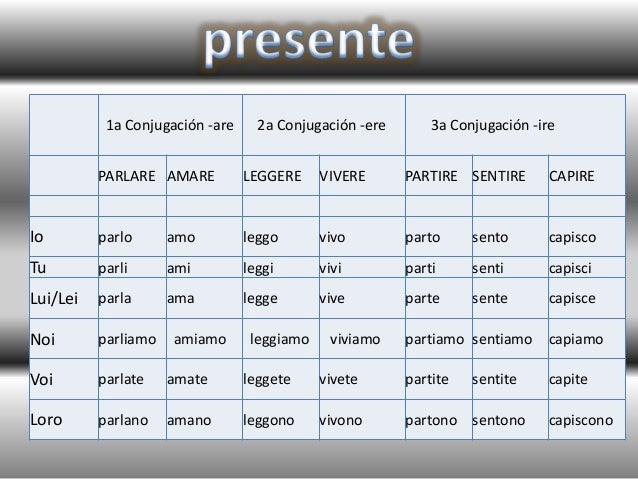
Subject Pronoun Lavorare (to work) Prendere (to take; to order) Partire (to leave) Capire (to understand)
io lavoro prendo parto capisco
tu lavori prendi parti capisci
lui/lei/Lei lavora prende parte capisce
noi lavoriamo prendiamo partiamo capiamo
voi lavorate prendete partite capite
loro/Loro lavorano prendono partono capiscono
Unfortunately, there are also irregular verbs, which you have to memorize. You’ll find that the more you practice them, the easier it is to use them in conversation:
Common Irregular Italian Verbs in the Present Indicative Tense
Subject Pronoun Andare (to go) Bere (to drink) Dare (to give) Fare (to do) Stare (to stay) Venire (to come)
io vado bevo do faccio sto vengo
tu vai bevi dai fai stai vieni
lui/lei/Lei va beve dĂ  fa sta viene
noi andiamo beviamo diamo facciamo stiamo veniamo
voi andate bevete date fate state venite
loro/Loro vanno bevono danno fanno stanno vengono
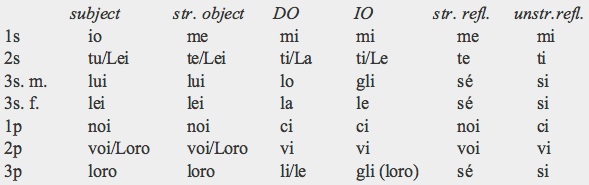
Italian Subject Pronouns and Object Pronouns: DIRECT OBJECT PRONOUNS A direct object is the direct recipient of the action of a verb. Direct object pronouns replace direct object nouns. In Italian the forms of the direct object pronouns (i pronomi diretti) are as follows:
Person Singular Plural
1st. person mi » me ci » us
2nd. person familiar ti » you vi » you
2nd. person polite* La » you (m. and f.) Li » You (m.)
Le » You (f.)
3rd. person lo » him, it li » them (m.)
la » her it le » them (f.)
These pronouns are used as follows:
  1. They stand immediately before the verb or the auxiliary verb in the compound tenses. Examples:
  • Li ho invitati a cena  »  I have invited them to dinner
  • L’ho veduta ieri  »  I saw her yesterday
  • Ci hanno guardati e ci hanno seguiti  »  They watched us and followed us
In a negative sentence, the word non must come before the object pronoun.
  • Non la mangia  »  He doesn’t eat it
  • PerchĂš non li inviti?  »  Why don’t you invite them?
  1. The object pronoun is attached to the end of an infinitive. Note that the final –e of the infinitive is dropped.
  • È importante mangiarla ogni giorno  »  It is important to eat it every day
  • Volevo comprarla  »  I wanted to buy it
  1. The Object pronouns are attached to ecco to express here I am, here you are, here he is, and so on.
  • Dov’ù la signorina? – Eccola!  »  Where is the young woman? – Here she is!
  • Hai trovato le chiavi? – SĂŹ, eccole!  »  Have you found the keys? – Yes, here they are!
  1. The pronouns lo and la are often shortened to l’.
(*) Note that second person polite form pronouns are capitalized.

Holiday Phrases:

Buon Anno! Happy New Year!
Buona Pasqua! Happy Easter!
Buon compleanno! Happy Birthday!
Buon Natale! Merry Christmas!
Buone feste! Happy Holidays!
Buona vacanza! Have a good vacation!
Buon divertimento! Have a good time!
Buon viaggio! Have a good trip!
Tanti auguri! Best wishes!
Babbo Natale is Santa Claus and il panettone or il pandoro are the traditional cakes eaten at Christmas. For Easter, the traditional cake is called la colomba. Be careful with the difference between ferie and feriale: le ferie or i giorni di ferie are holidays when most places of business are closed; the opposite is un giorno feriale, or a weekday/working day. INDIRECT OBJECT PRONOUNS While direct object pronouns answer the question what? or whom? Indirect object pronouns answer the question to whom? or for whom? Also, they’re the same as the Direct Object Pronouns except for the pronouns in the Third Person (i.e. to him; to her; to them).
Singolare Singular Plurale Plural
mi (to/for) me ci (to/for) us
ti (to/for) you (informal) vi (to/for) you (informal)
gli (to/for) him, it loro (to/for) them (m. & f.)
le (to/for) her, it
Le (to/for) you (formal f. & m.) Loro (to/for) you (formal f. & m.)
The direct object is governed directly by the verb, for example, in the following statement: Romeo loved her. The Indirect Object in an English sentence often stands where you would expect the direct object but common sense will tell you that the direct object is later in the sentence, e.g.: Romeo bought her a bunch of flowers. The direct object — i.e. the thing that Romeo bought is “a bunch of flowers”; Romeo didn’t buy “her” as if she were a slave. So the pronoun her in the sentence actually means “for her” and is the Indirect Object. Examples: » Qulacuno mi ha mandato una cartolina dalla Spagna Someone (has) sent me a postcard from Spain. » Il professore le ha spiegato il problema The teacher (has) explained the problem to her. » Voglio telefonargli I want to phone him. » Il signor Brambilla ci ha insegnato l’italiano Mr Brambilla taught us Italian. » Cosa gli dici? What are you saying to him/to them? » Lucia,tuo padre vuole parlarti! Lucia, your father wants to speak to you! » Non gli ho mai chiesto di aiutarmi I (have) never asked him to help me. » Non oserei consigliarti I would not dare to advise you » Le ho regalato un paio di orecchini I gave her a present of a pair of earrings

Useful Words in Italian:

and e eh always sempre sehm-preh
or o oh often spesso speh-soh
but ma mah sometimes qualche volta kwal-keh vohl-tah
not non nohn usually usualmente oo-zoo-al-mehn-teh
while mentre mehn-treh especially specialmente speh-chee-al-mehn-teh
if se seh except eccetto eh-cheh-toh
because perché pehr-kay book il libro lee-broh
very, a lot molto mohl-toh pencil la matita mah-tee-tah
also, too anche ahn-keh pen la penna pehn-nah
although benché behn-keh paper la carta kar-tah
now adesso, ora ah-deh-so, oh-rah dog il cane kah-neh
perhaps, maybe forse for-seh cat il gatto gah-toh
then allora, poi ahl-loh-rah, poy friend (fem) l’amica ah-mee-kah
there is c’ù cheh friend (masc) l’amico ah-mee-koh
there are ci sono chee soh-noh woman la donna dohn-nah
there was c’era che-rah man l’uomo woh-moh
there were c’erano che-rah-no girl la ragazza rah-gat-sah
here is ecco ehk-koh boy il ragazzo rah-gat-soh

Question Words in Italian:

Who Chi kee
Whose Di chi dee kee
What Che cosa keh koh-sah
Why Perché pehr-keh
When Quando kwahn-doh
Where Dove doh-veh
How Come koh-meh
How much Quanto kwahn-toh
Which Quale kwah-leh

Days of the week:

Monday lunedĂŹ loo-neh-dee
Tuesday martedĂŹ mahr-teh-dee
Wednesday mercoledĂŹ mehr-koh-leh-dee
Thursday giovedĂŹ zhoh-veh-dee
Friday venerdĂŹ veh-nehr-dee
Saturday sabato sah-bah-toh
Sunday domenica doh-men-ee-kah
yesterday ieri yer-ee
day before yesterday avantieri / l’altroieri (m) ah-vahn-tyee-ree
last night ieri sera yer-ee seh-rah
today oggi ohd-jee
tomorrow domani doh-mahn-ee
day after tomorrow dopodomani doh-poh-doh-mahn-ee
day il giorno eel zhor-noh
To say on Mondays, on Tuesdays, etc., use il before lunedĂŹ through sabato, and la before domenica.

Months of the year:

January gennaio jehn-nah-yoh
February febbraio fehb-brah-yoh
March marzo mar-tsoh
April aprile ah-pree-leh
May maggio mahd-joh
June giugno joo-nyoh
July luglio loo-lyoh
August agosto ah-goh-stoh
September settembre seht-tehm-breh
October ottobre oht-toh-breh
November novembre noh-vehm-breh
December dicembre dee-chem-breh
week la settimana lah sett-ee-mah-nah
month il mese eel meh-zeh
year l’anno lahn-noh
Days and months are not capitalized.  To express the date, use È il (number) (month).  May 5th would be È il 5 (or cinque) maggio.  But for the first of the month, use primo instead of 1 or uno. To express ago, as in two days ago, a month ago, etc., just add fa afterwards. To express last, as in last Wednesday, last week, etc., just add scorso (for masculine words) or scorsa (for feminine words) afterwards. una settimana fa – a week ago la settimana scorsa – last week un mese fa – a month ago l’anno scorso – last year

Possessive Pronouns and Possessive Adjectives

Possessive Pronouns:

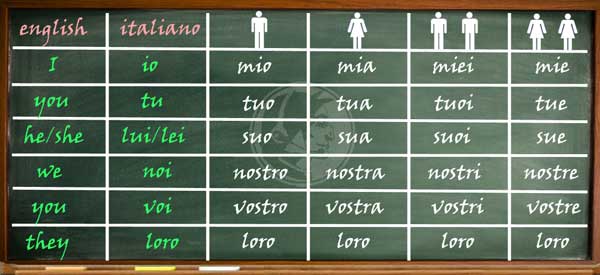
Maschile singolare Maschile plurale  Femminile singolare  Femminile plurale
il mioil tuo il suo il nostro il vostro il loro i mieii tuoi i suoi i nostri i vostri i loro la miala tua la sua la nostra la vostra la loro le miele tue le sue le nostre le vostre le loro

Italian Grammar Lessons: The Three Groups Of Regular Verbs

This lesson is about the three groups of Italian regular verbs. All Italian regular verbs can be divided into three groups, as classified according to the ending of their infinitive forms. Verbs in the first group or first conjugation end in – are, such as abitare, mangiare or lavare. Abitare – to live io abito tu abiti lui/lei/Lei abita noi abitiamo voi abitate loro/Loro abitano Verbs in the second group or second conjugation end in – ere, such as perdere and correre. Perdere – to lose io perdo tu perdi lui/lei/Lei perde noi perdiamo voi perdete loro/Loro perdono Verbs in the third group or third conjugation end in – ire, such as dormire and aprire. The main characteristic of the third group is that some verbs, such as preferire, add the suffix –isc between the root and the declination. Dormire – to sleep io dormo tu dormi lui/lei/Lei dorme noi dormiamo voi dormite loro/Loro dormono Preferire – to prefer io preferisco tu preferisci lui/lei/Lei preferisce noi preferiamo voi preferite loro/Loro preferiscono It’s important to learn the conjugations for these three groups as early as you can!

Italian Grammar Lessons: Reflexive Verbs

This lesson is about reflexive verbs! A reflexive verb is used when the subject and object of the verb are the same. For example, “kill yourself”. Reflexive verbs are more common in Italian than in English – verbs which in English are too “obvious” to be used in the reflexive form (wake up, get up, wash, clean your teeth, and so on..) do need the reflexive form in Italian. So, for example, in Italian you might “suicide yourself”, absurd as it sounds in English! Many Italian verbs have reflexive forms. You can recognise them because they end in “-si”. For example: alzarsi (get yourself up) svegliarsi (wake yourself up) vestirsi (dress yourself) lavarsi (wash yourself) riposarsi (rest yourself) mettersi (put yourself) fermarsi (stop yourself) sedersi (sit yourself) When you use a reflexive verb you have to put the correct reflexive pronoun before the verbs. The reflexive pronouns are: io – mi tu – ti lui/lei/Lei – si noi – ci voi – vi loro – si Here are two examples of the conjugation of reflexive verbs in Italian: svegliarsi – to wake yourself up (io) mi sveglio (tu) ti svegli (lui/lei/Lei) si sveglia (noi) ci svegliamo (voi) vi svegliate (loro/Loro) si svegliano alzarsi – to get yourself up (io) mi alzo (tu) ti alzi (lui/lei/Lei) si alza (noi) ci alziamo (voi) vi alzate (loro/Loro) si alzano

Modal verbs

Italian modal verbs are called “VERBI SERVILI“. They have irregular forms. They are: POTERE (can) VOLERE (to want, to wish, to need) DOVERE (must, to have to, ought to, should) Watch the following examples: 1. Mi puoi telefonare domani? (Can you call me tomorrow?) 2. Voglio andare a Roma (I want to go to Rome) 3. Aspettami, devo parlarti (Wait, I have to talk to you!) Modal verbs work as a support to other verbs and indicate possibility, will, need and duty. Verb SAPERE (can)  becomes a modal verb when it means  “ESSERE CAPACE DI” “to be able to”. example: So suonare il piano (I can play the piano) Modal verbs can be used with atonic personal pronouns that can stand before the modal verb( 1.) or after the infinitive (3.) Modal verbs are directly added to the infinitive of a verb without any prepositions. POTERE can be used: – with the meaning of “forse” (=perhaps, maybe): “Posso essermi sbagliato, ma non so esattamente” (=I could be wrong, but I don’t know exactly) – as a permission (may I?) : Posso uscire? (May I go out?) – as a capability: Quest’anno possiamo vincere il campionato (This year we can win the championship) – in the polite form: Potresti prestarmi il tuo libro? (Could you lend me your book?) DOVERE can be used: – with the meaning of probability: Deve essergli successo un incidente (He must have had an accident) – as an obligation, a need: Se vuoi migliorare il tuo italiano, devi fare i compiti. ( If you want to improve your italian, you must do your homework)
Modal Verbs – Present Tense
    • Io posso
    • Tu puoi
    • Egli puĂČ
    • Noi possiamo
    • Voi potete
    • Essi possono
    • Io voglio
    • Tu vuoi
    • Egli/ella vuole
    • Noi vogliamo
    • Voi volete
    • Essi vogliono
  • Io devo
  • Tu devi
  • Egli/ella deve
  • Noi dobbiamo
  • Voi dovete
  • Essi devono
In Italian as in English these modals verbs (verbi servili) are easy to identify. Modal verbs in Italian indicate a “must,” “capability” or a “wish.” These words can be used alone, as in “Vorrei una pizza” (“I’d like a pizza”), or as modal verbs in conjunction with another verb in the infinitive tense. For example, “Vorrei camminare un pĂČ di piĂč” (“I’d like to walk a little bit more.”) “Volere” for instance can be used with nouns and infinitives (“Voglio partire” or “Voglio una pizza.”) “Potere” and “dovere” can be used with infinitives only (“Non posso lavorare” or “Devomangiare ora.”) In the negative form you have only to put only NON in front of the modal:
  • Non puoi capire
  • Non devi partire
  • Non vuoi lasciarmi vero?
With the compound tenses, the modal verbs take the auxiliary plus the infinitive that follows. For example:
  • Claudio HA DOVUTO lasciare il suo lavoro. (dovere richiede AVERE)
  • Maria HA DOVUTO studiare. (studiare richiede AVERE)
  • Maria E’ DOVUTA uscire (uscire richiede essere)
  • Maria HA POTUTO parlare con lui (potere richiede avere)
  • Maria E’ POTUTA venire alla festa (venire richiede essere)
  • Maria HA VOLUTO mangiare (mangiare richiede volere)
  • Maria E’ VOLUTA VENIRE al cinema con me (venire richiede essere)
The auxiliary verb “to be” is used in the following examples:
  • Compound tenses and with many intransitive verbs like “sono partita“, “mio fratello Ăš uscito.”
  • With impersonal verbs: piove (it’s raining), fa freddo (it’s cold), fa caldo (it’s warm)
  • With reflexive verbs: “Maria si Ăš lavata le mani e si Ăš messa il tovagliolo prima di mangiare.” (“Maria washed her hands and put out the table cloth before eating.”)
volere – to want (to) potere – to be able to dovere – to have to
io voglio io posso io devo
tu vuoi tu puoi tu devi
Lei vuole Lei puo’ Lei deve
lui/lei vuole lui/lei puo’ lui/lei deve
noi vogliamo noi possiamo noi dobbiamo
voi volete voi potete voi dovete
loro vogliono loro possono loro devono
Volere can be used with nouns and infinitives (dictionary form). Voglio una birra. Voglio mangiare. Potere and dovere are used with infinitives only. Non posso studiare. Devo uscire. To negate a modal (to say you don’t want to, can’t or must not), just put non in front of it.

Italian Articles

In Italian grammar, articles identify the gender and the number of the nouns, and they are essential in order to recognize irregular nouns. Articles can be masculine or feminine, singular or plural and, except in some specific cases, they must always be used. The article serves to define the noun associated with it, and with which it must agree in gender and number. Definitive articles In Italian, we put the article before the noun, just like in English. However, in English, the definite article is only one – the.  In Italian, when the noun is masculine, there are three types of articles in the singular, and two types in the plural. For feminine nouns, there are two different articles for the singular, and one for the plural. Let’s take a look! Masculine Articles                                                    Feminine Articles Singular           Il          Lo        L’                                La        L’ Plural               I           Gli       Gli                               Le        Le Now, let’s break down when to use which definitive article in Italian! With masculine articles: Il is used before a noun that begins with a consonant, except“s + consonant, ps, gn, z, y, and z. Examples: Il ragazzo, il libro, il vino. I is the plural form of il. If you use il in singular, you have to use I in plural. Examples: I ragazzi, i libri, i vini. Lo is used before a noun that begins with s + consonant, ps, gn,z,y, and z. Examples: Lo studente, lo sport, lo psicologo, lo yogurt. Gli is the plural form of lo. If you use lo in singular, you have to use gli in plural. Examples: Gli studenti, gli sport, gli psicologi, gli yogurt. L’ is used before a noun that begins with a vowel or with h; in Italian grammar, h is silent.  Examples: L’ orologio, l’amico, l’ufficio, l’hotel. Gli is used for the plural form when l’ is used in the singular: Gli orologi, gli amici, gli uffici, gli hotel. Now, let’s go over when to use feminine definite articles. La is used before a noun that begins with a consonant: La casa, la ragazza, la bottiglia. L’ is used before a noun that begins with a vowel: L’amica, l’alice, l’onda, l’aspirina. Le is used with all feminine words in the plural: Le case, le ragazze, le bottiglie, le amiche, le alici, le onde, le aspirine. Indefinite Articles Indefinite articles in Italian grammar introduce a generic or not defined noun. The masculine indefinite articles are un and uno, and the feminine forms are una and un’ – meaning a or an. Un is used before masculine nouns starting with vowel or consonant: un uomo, un libro. Uno isused before masculine nouns starting with s+ consonant, z, gn, x, y, ps, pn, i+vowel, such as in uno studente. Una is used before feminine nouns starting with consonant, such as una donna. Un’ is used before feminine nouns starting with vowel, such as in un’automobile.

When to Use Articles

In Italian grammar, articles are used in the following cases: Before nouns: : il gatto, la donna, l’uomo, il libro, la casa. Before a person’s profession : il dottore, il meccanico, il professore, la professoressa. Before a title : il signore, la signora, l’onorevole. Before dates: il 2 giugno 1990 Before hours: sono le 3, ù l’una. Before names of nations or associations in the plural: gli Stati Uniti, le Nazioni Unite. Before the days of the week to indicate a repeated, habitual activity: la domenica studio italiano.  Articles are not used before nouns in the following cases: When they want to convey a very generic feeling of something indefinite: mangio pasta (“I eat pasta”), vedo amici (“I see friends”). Before a name: Roberto, Maria, Stefano, Alice, Roma, Milano Before the demonstrative adjective questo (“this”), quello (“that”): questa casa (“this house,” questo libro (“this book”), quel ragazzo (“that guy”). Before a possessive adjective followed by a singular family noun: mia madre, mio padre, mio fratello, mia sorella. With days of the week: domenica vado in montagna (“I am going to the mountains on Sunday”).

Italian Grammar Lessons: prepositions, ‘a’ or ‘in’?

This lesson is about the different use of the prepositions ‘a’ and ‘in’ in Italian grammar. Let’s start with the preposition ‘a’, which means ‘to’ (movement) or ‘in’ if it indicates location (cities and places). Examples: Tu dai la penna a Simona. (You give the pen to Simona.) Sono a casa. (I’m at home.) Abito a Roma, ma ora sono a Venezia. (I live in Rome, but now I’m in Venice.) We generally use the preposition ‘a’ with the infinite form of the verbs and with names of cities and minor islands. Examples: Vado a mangiare fuori stasera. (I will eat out this evening.) Torno a Madrid per Natale. (I will go back to Madrid for Christmas.) As regard the preposition ‘in’, we use it with the names of continents, states, nations, regions, larger islands, and with words ending in “-eria”. Examples: In Inghilterra bevi tù tutti i giorni. (In England you drink tea every day.) Bologna si trova in Emilia-Romagna. (Bologna is in Emilia-Romagna.) Di solito compro i libri in quella libreria. (I usually buy books in that bookshop.) Here are a few of the nouns before which we use the preposition ‘in’: banca (bank) , biblioteca (library), classe (class), città (city), chiesa (church), campagna (country), piscina (pool), ufficio (office), albergo (hotel), farmacia (pharmacy) Careful! When talking about someone’s house or place of work, you use the preposition ‘da’ plus the name of the owner. Examples: Sono dal dottore. (I’m at the Doctor’s office.) Vado da Sara per il weekend. (I’m going to Sara’s place for the weekend.)

Italian Grammar Lessons: There is/are – C’ù / ci sono

This lesson is about the use of “c’ù / ci sono“, which would translate into English as ‘there is/are’. The word “ci” is used as a pronoun referring to previously mentioned places and things in order not to repeat them. Examples: Quando vai al supermercato? (When are you going to the supermarket?) Ci vado domani (I will go there tomorrow) Ci = al supermercato (at the supermarket) “C’ù” is the short form of “ci ù”, while “ci sono” is the plural form and they state the presence or existence of someone or something. Examples: C’ù troppo zucchero nel mio caffù. (There is too much sugar in my coffee.) Ci sono molti negozi a Milano. (There are a lot of shops in Milan.) Ci sono molte ragioni per partire. (There are many reasons to leave.) C’ù qualcuno in cucina? (Is there someone in the kitchen?) To express negation, you just need to put the particle NON before “c’ù / ci sono”. Examples: Non c’ù nessuno in cucina. (There isn’t anyone in the kitchen.) Non ci sono penne nell’astuccio. (There aren’t any pens in the pencil case.) Back to Italian lesson on: there is / are – c’ù / ci sono

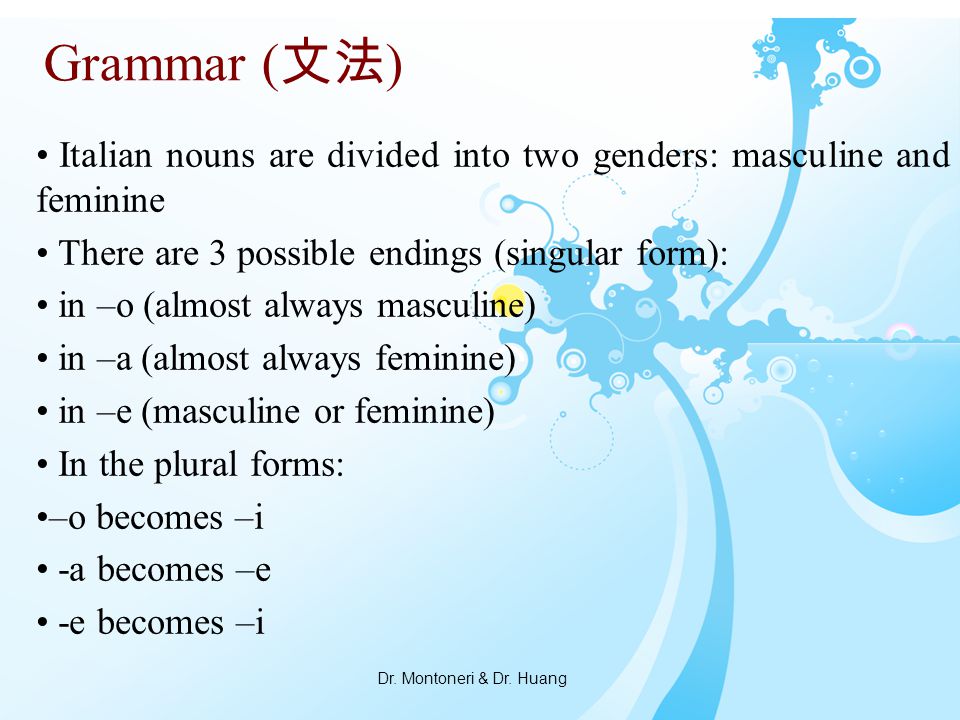
Italian Grammar Lessons: Plurals

This lesson will show you how to create the plural form of Italian nouns. It’s important to know the gender of the word (masculine or feminine) and you can usually work this out by looking at the vowel it ends with. To turn a singular word into a plural one, you usually only need to change the final vowel, though there are of course plenty of exceptions! Singular nouns ending in “-o” are usually masculine. To produce a plural you need to change this ending to “-i“, Examples: il cavallo → i cavalli (the horse – the horses) il tavolo →  i tavoli (the table – the tables) Nouns ending in “-a” are usually feminine. To create the plural form you need to change the final vowel to “-e“. Examples: la carota → le carote (the carrot – the carrots) la sedia →  le sedie (the chair – the chairs) But some nouns ending in “-a” are masculine,  in which case the plural is “-i“. Examples: il problema → i problemi (the problem – the problems) il poeta → i poeti (the poet – the poets) And similarly some nouns ending in “-o” are feminine and their plural is the same as the singular form. Examples: la radio →  le radio (the radio – the radios) la foto →  le foto (the photo – the photos) Club member Ida writes: Words like ‘la radio’, ‘la foto’, ‘la moto’ or ‘la auto’ do not change in the plural because they are truncated versions of the original words ‘la radiotelefonia’, ‘la fotografia’, ‘la motocicletta’ and ‘l’automobile’. Truncated words do not change in the plural.
Instead “la mano” which is a true feminine word that ends in “o” has the regular plural “le mani” following the rules for forming the plural.
The plural form of singular nouns ending in “-ista” can be either “-i” (if masculine) or “-e” (if feminine). Examples: l’artista → gli artisti / le artiste (the artist – the artists (m) / the artists (f)) il dentista → i dentisti / le dentiste (the dentist – the dentists) Some nouns have just one form which works both for the singular and for the plural. A good example is the various nouns which end with an accented vowel. Examples: la cittĂ  → le cittĂ  (the city – the cities) la virtĂč → le virtĂč (the virtue – the virtues) il papà → i papĂ  (the dad – the dads) Nouns ending in consonants (which are often borrowed ‘foreign’ words) also have identical singular and plural forms. Examples: il computer → i computer (the computer – the computers) lo yogurt → gli yogurt (the yogurt – the yogurts) There are some cases in which plural nouns have a different spelling. Some masculine substantives ending in “-co” and “-go” form their plural with “-chi” and “-ghi“. Examples: il tedesco → i tedeschi (the German – the Germans) l’albergo → gli alberghi (the hotel – the hotels) Others form the plural with “-ci” or “-gi“. Examples: l’amico → gli amici (the friend – the friends) l’archeologo → gli archeologi (the archaeologist – the archaeologists). Feminine nouns ending in “-ca” and “-ga” follow the same rule. Examples: la tasca → le tasche (the pocket – the pockets) l’alga → le alghe (the seaweed – the seaweeds)

Italian Grammar Lessons: Like – Piace/Piacciono

The verb “piacere” (to like) in Italian has an unusual construction, in the sense that the subject of the action is reversed. The meaning of “piacere” is best thought of as “to please, to be pleasing to” rather than ‘to like’. In English you ‘like’ something or doing something. In Italian it’s the object or activity that ‘pleases’ you. To construct this grammatically, we need to use indirect pronouns. For example: Mi piace la pizza (‘I like pizza’, but literally: ‘Pizza pleases me.’) Here’s the same example sentence conjugated for the different subjects: Mi piace la pizza. (‘Pizza pleases me.’) Ti piace la pizza. (‘Pizza pleases you.’) Gli piace la pasta. (‘Pizza pleases him.’) Le piace la pizza. (‘Pizza pleases her.’) Ci piace la pizza. (‘Pizza pleases us.’) Vi piace la pizza. (‘Pizza pleases you.’) Gli piace la pizza. (‘Pizza pleases them.’) A further complication is that, if the subject of the sentence is plural, you need to remember to change the verb from the third person singular (‘piace’) to the third person plural (‘piacciono’). For example: Mi piacciono i biscotti. (‘Biscuits please me.’) The negative is formed by adding ‘non’. For example: Non gli piace il cioccolato. (‘Chocolate doesn’t please him.’) Non ci piacciono le lasagne. (‘Lasagnes don’t please us.’) The verb ‘piacere’ can also be followed by another verb, which has to be in the infinitive form. For example: Mi piace leggere. (‘Reading pleases me.’) Non gli piace studiare. (‘Studying doesn’t please him.’) Ci piace mangiare al ristorante. (‘Eating at the restaurant pleases us.’)

Il presente: -are verbs

1. ABITARE : to live
Io: abito Noi: abitiamo
Tu: abiti Voi: abitate
Lui: abita Loro: abitano
2. ARRIVARE : to arrive
Io: arrivo Noi: arriviamo
Tu: arrivi Voi: arrivate
Lui: arriva Loro: arrivano
3. ASPETTARE : to wait for
Io: aspetto Noi: aspettiamo
Tu: aspetti Voi: aspettate
Lui: aspetta Loro: aspettano
4. CAMMINARE : to walk
Io: cammino Noi: camminiamo
Tu: cammini Voi: camminate
Lui: cammina Loro: camminano
5. COMINCIARE : to begin
Io: comincio Noi: cominciamo
Tu: cominci Voi: cominciate
Lui: comincia Loro: cominciano
6. CUCINARE : to cook
Io: cucino Noi: cuciniamo
Tu: cucini Voi: cucinate
Lui: cucina Loro: cucinano
7. GUARDARE : to watch
Io: guardo Noi: guardiamo
Tu: guardi Voi: guardate
Lui: guarda Loro: guardano
8. IMPARARE : to learn
Io: imparo Noi: impariamo
Tu: impari Voi: imparate
Lui: impara Loro: imparano
9. LAVORARE : to work
Io: lavoro Noi: lavoriamo
Tu: lavori Voi: lavorate
Lui: lavora Loro: lavorano
10. MANDARE : to send
Io: mando Noi: mandiamo
Tu: mandi Voi: mandate
Lui: manda Loro: mandano
11. NUOTARE : to swim
Io: nuoto Noi: nuotiamo
Tu: nuoti Voi: nuotate
Lui: nuota Loro: nuotano
12. PENSARE : to think
Io: penso Noi: pensiamo
Tu: pensi Voi: pensate
Lui: pensa Loro: pensano
13. PORTARE : to bring
Io: porto Noi: portiamo
Tu: porti Voi: portate
Lui: porta Loro: portano
14. TORNARE : to return
Io: torno Noi: torniamo
Tu: torni Voi: tornate
Lui: torna Loro: tornano

Il presente: -ere verbs

1. CADERE : to fall
Io: cado Noi: cadiamo
Tu: cadi Voi: cadete
Lui: cade Loro: cadono
2. CHIEDERE : to ask
Io: chiedo Noi: chiediamo
Tu: chiedi Voi: chiedete
Lui: chiede Loro: chiedono
3. CHIUDERE : to close
Io: chiudo Noi: chiudiamo
Tu: chiudi Voi: chiudete
Lui: chiude Loro: chiudono
4. CREDERE : to believe
Io: credo Noi: crediamo
Tu: credi Voi: credete
Lui: crede Loro: credono
5. LEGGERE : to read
Io: leggo Noi: leggiamo
Tu: leggi Voi: leggete
Lui: legge Loro: leggono
6. METTERE : to put
Io: metto Noi: mettiamo
Tu: metti Voi: mettete
Lui: mette Loro: mettono
7. PERDERE : to lose
Io: perdo Noi: perdiamo
Tu: perdi Voi: perdete
Lui: perde Loro: perdono
8. PRENDERE : to take
Io: prendo Noi: prendiamo
Tu: prendi Voi: prendete
Lui: prende Loro: prendono
9. RICEVERE : to receive
Io: ricevo Noi: riceviamo
Tu: ricevi Voi: ricevete
Lui: riceve Loro: ricevono
10. RIPETERE : to repeat
Io: ripeto Noi: ripetiamo
Tu: ripeti Voi: ripetete
Lui: ripete Loro: ripetono
11. RISPONDERE : to answer
Io: rispondo Noi: rispondiamo
Tu: rispondi Voi: rispondete
Lui: risponde Loro: rispondono
12. SCRIVERE : to write
Io: scrivo Noi: scriviamo
Tu: scrivi Voi: scrivete
Lui: scrive Loro: scrivono
13. SPENDERE : to spend (money)
Io: spendo Noi: spendiamo
Tu: spendi Voi: spendete
Lui: spende Loro: spendono
14. VEDERE : to see
Io: vedo Noi: vediamo
Tu: vedi Voi: vedete
Lui: vede Loro: vedono
15. VIVERE : to live
Io: vivo Noi: viviamo
Tu: vivi Voi: vivete
Lui: vive Loro: vivono

Il presente: -ire verbs

1. APRIRE : to open
Io: apro Noi: apriamo
Tu: apri Voi: aprite
Lui: apre Loro: aprono
2. DORMIRE : to sleep
Io: dormo Noi: dormiamo
Tu: dormi Voi: dormite
Lui: dorme Loro: dormono
3. MENTIRE : to lie
Io: mento Noi: mentiamo
Tu: menti Voi: mentite
Lui: mente Loro: mentono
4. OFFRIRE : to offer
Io: offro Noi: offriamo
Tu: offri Voi: offrite
Lui: offre Loro: offrono
5. PARTIRE : to leave
Io: parto Noi: partiamo
Tu: parti Voi: partite
Lui: parte Loro: partono
6. SEGUIRE : to follow
Io: seguo Noi: seguiamo
Tu: segui Voi: seguite
Lui: segue Loro: seguono
7. SENTIRE : to hear
Io: sento Noi: sentiamo
Tu: senti Voi: sentite
Lui: sente Loro: sentono
8. SERVIRE : to serve
Io: servo Noi: serviamo
Tu: servi Voi: servite
Lui: serve Loro: servono
9. VESTIRE : to dress
Io: vesto Noi: vestiamo
Tu: vesti Voi: vestite
Lui: veste Loro: vestono
Il presente: all verbs
1. ANDARE : to go
Io: vado Noi: andiamo
Tu: vai Voi: andate
Lui: va Loro: vanno
2. AVERE : to have
Io: ho Noi: abbiamo
Tu: hai Voi: avete
Lui: ha Loro: hanno
3. CONOSCERE : to know
Io: conosco Noi: conosciamo
Tu: conosci Voi: conoscete
Lui: conosce Loro: conoscono
4. DARE : to give
Io: do Noi: diamo
Tu: dai Voi: date
Lui: dĂ  Loro: danno
5. DEDICARE : to dedicate
Io: dedico Noi: dedichiamo
Tu: dedichi Voi: dedicate
Lui: dedica Loro: dedicano
6. DIRE : to say or tell
Io: dico Noi: diciamo
Tu: dici Voi: dite
Lui: dice Loro: dicono
7. DOVERE : to must or have to
Io: devo Noi: dobbiamo
Tu: devi Voi: dovete
Lui: deve Loro: devono
8. ESSERE : to be
Io: sono Noi: siamo
Tu: sei Voi: siete
Lui: Ăš Loro: sono
9. FARE : to make or do
Io: faccio Noi: facciamo
Tu: fai Voi: fate
Lui: fa Loro: fanno
10. INSEGNARE : to teach
Io: insegno Noi: insegniamo
Tu: insegni Voi: insegnate
Lui: insegna Loro: insegnano
11. METTERSI : to put on
Io: mi metto Noi: ci mettiamo
Tu: ti metti Voi: vi mettete
Lui: si mette Loro: si mettono
12. PERDERSI : to get lost
Io: mi perdo Noi: ci perdiamo
Tu: ti perdi Voi: vi perdete
Lui: si perde Loro: si perdono
13. POTERE : to be able
Io: posso Noi: possiamo
Tu: puoi Voi: potete
Lui: puĂČ Loro: possono
14. PRENDERE : to take
Io: prendo Noi: prendiamo
Tu: prendi Voi: prendete
Lui: prende Loro: prendono
15. PREPARARSI : to get ready
Io: mi preparo Noi: ci prepariamo
Tu: ti prepari Voi: vi preparate
Lui: si prepara Loro: si preparano
16. PROIBIRE : to forbid
Io: proibisco Noi: proibiamo
Tu: proibisci Voi: proibite
Lui: proibisce Loro: proibiscono
INTRODUCTIONS

Manuela: Ciao Giorgia, come stai? Giorgia: Bene, grazie! E tu? Manuela: Anch’ io! Oh, ciao Veronica! Che piacere vederti! Dove vai? Veronica: Ciao Manuela! Io vado a Milano. E tu? Manuela: Anch’ io vado a Milano. Veronica: Lei ù una tua amica? Manuela: Sì, studiamo insieme all’università. Veronica: Piacere, io sono Veronica! E tu come ti chiami? Giorgia: Piacere, io mi chiamo Giorgia. Di dove sei? Veronica: Io sono di Cagliari, e tu? Giorgia: Io sono di Sassari ma studio a Cagliari. E tu che cosa fai? Veronica: Anch’io sono una studentessa. Quanti anni hai? Giorgia: 20. E tu? Veronica: Io ho 21 anni.
Introductions in Italian

Informal

A: Giulia, ti presento il mio amico David. B: Piacere di conoscerti! C: Piacere mio!

A: Maria, ecco il mio nuovo vicino. B: Piacere, io sono Maria. Tu come ti chiami? C: Mi chiamo David, piacere!

Formal

A: Buonasera signora Riva, le presento il mio amico. B: Sono Giovanna, molto lieta! C: Piacere, David.

A: Scusi, Ăš lei la dottoressa Rossi? B: Si sono io, e lei come si chiama? A: Sono Maria Ricci, piacere.

 Look at the conjugation of the following verbs:

ESSERE (to be)

AVERE (to have)
CHIAMARSI (to call yourself)

 Io sono

 Tu sei

 Lui/Lei Ú

 Io ho

 Tu hai

 Lui /Lei ha

 Io mi chiamo

 Tu ti chiami

 Lui/Lei si chiamaPresent Perfect (Passato Prossimo)

 How to say hello and goodbye in Italian.

Saying hello

Saying goodbye

Ciao Hi

Buongiorno Good morning

Buonasera Good evening

Salve Hello

Arrivederci Goodbye

A dopo See you later

A domani See you tomorrow

A presto See you soon

ESSERE (to be)
AVERE (to have)
VOLERE (to want)
FARE (to make)

Io sono

Tu sei

Lui/Lei Ăš

Noi siamo

Voi siete

Loro sono

Io ho

Tu hai

Lui /Lei ha

Noi abbiamo

Voi avete

Loro hanno

Io voglio

Tu vuoi

Lui/Lei vuole

Noi vogliamo

Voi volete

Loro vogliono

Io faccio

Tu fai

Lui/Lei fa

Noi facciamo

Voi fate

Loro fanno

Saying Hello in Italian

INCONTRO TRA AMICHE – Dialogo informale SAYING HELLO TO FRIENDS – informal dialogue

A: Ciao Anna! B: Ciao Francesca, come stai? A: Molto bene grazie, e tu? B: Non c’ù male, grazie.

INCONTRO TRA ADULTI – Dialogo formale SAYING HELLO FORMALLY

A: Buongiorno signora Rossi! B: Buongiorno, come sta? A: Abbastanza bene, grazie. E lei? B: CosĂŹ cosĂŹ.

Saying Goodbye in Italian

Informal:

A: Ciao Monica, ci vediamo dopo! B: Ciao Tania, a piĂč tardi!

A: Buonanotte Valentina, alla prossima volta! B: Ciao, a presto!

Formal:

A: ArrivederLa professoressa! B: Arrivederci ragazzi! A domani!

Saying Hello in Italian

INCONTRO TRA AMICHE – Dialogo informale SAYING HELLO TO FRIENDS – informal dialogue

A: Ciao Anna! B: Ciao Francesca, come stai? A: Molto bene grazie, e tu? B: Non c’ù male, grazie.

INCONTRO TRA ADULTI – Dialogo formale SAYING HELLO FORMALLY

A: Buongiorno signora Rossi! B: Buongiorno, come sta? A: Abbastanza bene, grazie. E lei? B: CosĂŹ cosĂŹ.

BERE (to drink)

AIUTARE (to help)
MANGIARE (to eat)

Io bevo

Tu bevi

Lui /Lei beve

Noi beviamo

Voi bevete

Loro bevono

Io aiuto

Tu aiuti

Lui /Lei aiuta

Noi aiutiamo

Voi aiutate

Loro aiutano

Io mangio

Tu mangi

Lui/Lei mangia

Noi mangiamo

Voi mangiate

Loro mangiano

4) The plural of nouns are formed in this way:

Masculine
Feminine

libro – libri

coltello – coltelli

albero – alberi

matita – matite

strada – strade

casa – case

AT THE STATION
Giorgia: Io vorrei qualcosa da mangiare. E voi? Manuela e Veronica: Si, anche noi! Andiamo in quel ristorante vicino!
ORDERING FOOD AT THE RESTAURANT

Giorgia: Buongiorno, io vorrei un piatto di spaghetti, grazie. Cameriere: Vorrebbe altro? Giorgia:No, grazie. Manuela: Anche io vorrei un piatto di spaghetti. con il pomodoro fresco. Veronica: Per me una bistecca con insalata.

Cameriere: Qualcosa da bere? Giorgia:3 bottiglie di acqua naturale, grazie!

Veronica: Scusi, potrebbe portarci il conto? Cameriere: VoilĂ ! In tutto 30 euro! Giorgia:Grazie e arrivederci! Cameriere: Arrivederci!

Present Perfect (Passato Prossimo)

The present perfect tense is used to express something that happened in the past, and which is completely finished (not habitual or continuous). To form this compound tense, which can translate as something happened, something has happened, or something did happen, conjugate avereor sometimes essere and add the past participle.  To form the past participle, add these endings to the appropriate stem of the infinitives:

-are -ato
-ere -uto
-ire -ito
Verbs that can take a direct object are generally conjugated with avere.  Verbs that do not take a direct object (generally verbs of movement), as well as all reflexive verbs, are conjugated with essere and their past participle must agree in gender and number with the subject. Avere uses avere as its auxiliary verb, while essere uses essere as its auxiliary verb.  Negative sentences in the present perfect tense are formed by placingnon in front of the auxiliary verb. Common adverbs of time are placed between avere/essere and the past participle. Io ho visitato Roma.  I visited Rome. Tu non hai visitato gli Stati Uniti.  You didn’t visit the United States. Abbiamo conosciuto due ragazze.  We met two girls. Maria ù andata in Italia.  Maria went to Italy.  (Note the agreement of the past participle with the subject.) Ho sempre avuto paura dei cani. I’ve always been afraid of dogs. Hai già finito di studiare? Have you already finished studying? → In addition, some verbs take on a different meaning in the present perfect: conoscere means to meet and sapere means to find out (or to hear). Reflexive Verbs in the Present Perfect Tense Since all reflexive verbs use essere as the auxiliary verb, the past participle must agree with the subject. The word order is reflexive pronoun + essere + past participle. Mi sono divertita. I had fun. Si ù sentito male. He felt bad. Prepositions & adverbs of place
at, to a over / above sopra
in in under / below sotto
on / up su inside dentro
from, by da outside fuori
of di around intorno a
with con between tra
without senza among fra
for per near vicino a
next to accanto a far lontano da
behind dietro before prima (di)
in front of davanti a after dopo (di)
across attraverso against contro
down giĂč toward verso

Reflexive Verbs:

Reflexive verbs express actions performed by the subject on the subject.  These verbs are conjugated like regular verbs, but a reflexive pronoun precedes the verb form.  This pronoun

always agrees with the subject.  In the infinitive form, reflexive verbs have -si attached to them with the final e dropped.  Lavare is to wash, therefore lavarsi is to wash oneself.  (Note that some verbs are reflexive in Italian, but not in English.)

Reflexive Pronouns
mi ci
ti vi
si si

Common reflexive verbs:

to be satisfied with accontentarsi di to graduate (from college) laurearsi
to fall asleep addormentarsi to wash up lavarsi
to get up alzarsi to put on mettersi
to be bored annoiarsi to get organized organizzarsi
to get angry arrabbiarsi to make a reservation prenotarsi
to be called chiamarsi to remember to ricordarsi di
to forget to dimenticarsi di to make a mistake sbagliarsi
to graduate (from high school) diplomarsi to feel (well, bad) sentirsi (bene, male)
to have a good time divertirsi to specialize specializzarsi
to shave (the face) farsi la barba / radersi to get married sposarsi
to stop (oneself) fermarsi to wake up svegliarsi
to complain about lamentarsi di to get dressed vestirsi

Io mi lavo. I wash myself. Noi ci alziamo presto.  We get up early. Si sveglia alle sette. She wakes up at seven.

The plural reflexive pronouns (ci, vi, si) can also be used with non-reflexive verbs to indicate a reciprocal action.  These verbs are called reciprocal verbs and are expressed by the words each other in English.

to embrace abbracciarsi to run into incontrarsi
to help aiutarsi to fall in love with innamorarsi
to kiss baciarsi to greet salutarsi
to understand capirsi to write to scriversi
to meet conoscersi to phone telefonarsi
to exchange gifts farsi regali to see vedersi
to look at guardarsi

Ci scriviamo ogni settimana.  We write to each other every week. Vi vedete spesso?  Do you see each other often?

Basic Conversation:

yes si
no no
please / you’re welcome Per piacere / prego or figurati
you’re very welcome Sei veramente il benvenuto
thank you grazie
thank you very much grazie mille
thanks grazie
Excuse me! Mi scusi!

Communication

English Italian Pronunciation (Audio)
I understand. Capisco
I don’t understand Non capisco
Hello (on the phone) / I beg your pardon? Pronto
What does that mean? Cosa significa?
I don’t know. non lo so
I don’t speak Polish. Non parlo Polacco
I speak a little Polish. Parlo poco Polacco
Do you speak english? (informal) Parli Inglese?
Do you speak english? (formal) Lei parla Inglese?
Yes, I do speak english. Si, parlo inglese.
No, I don’t speak english. No, non parlo inglese

Making acquaintances

English Italian Pronunciation (Audio)
Please talk more slowly! Parla piĂč piano perfavore!
Nice to meet you! Piacere di conoscerti!
How are you? Come stai?
Good, thank you Bene, grazie
I’m well, thanks! Sto bene, grazie!
Not bad, thanks! Non male, grazie!
very bad molto male
What’s your name? Come ti chiami?
My name is [
]. mi chiamo
What’s your first name? Qual’e il tuo nome?
My first name is [
] Il mio nome ù
How old are you? Quanti anni hai?
I’m [
] years old. Ho 
 anni
What are your hobbies? Quali sono i tuoi hobby?
What do you like doing? Cosa ti piace fare?
What are you doing (at the moment)? Cosa stai facendo adesso?
Where do you live? Dove abiti?
I live in [
] vivo a
I’m from England Vengo dall’Inghilterra
I’m English Sono Inglese
  • Italian Grammar: “tu” and “Lei” forms

    This lesson is about the informal and formal “tu” and “lei” forms in Italian grammar, and also covers useful phrases for first meetings. In Italian you use the second person form “tu” (you) when speaking to someone you know or someone of your own age or younger, but  “Lei”  when being formal. So for example, in formal situations we’d say “Che lavoro fa?” (What job does he/she do?) rather than “Che lavoro fai?” (What job do you do?). Check out these informal / formal versions of conversations you might have on first meeting someone. INFORMAL: Ciao, come stai? [Hello, how are you?] FORMAL: Buongiorno come sta? [Good morning, how are you?] REPLY: Bene grazie [Fine thank you.] INFORMAL: Come ti chiami? [What is your name?] FORMAL: Lei come si chiama? [What is your name?] REPLY: Mi chiamo 
 [My name is 
] / Sono 
 [I am 
 ] INFORMAL: E tu? [And you?] FORMAL: E Lei? [And you?] REPLY: Piacere. [A pleasure!] INFORMAL: Di dove sei? [Where are you from?] FORMAL: Di dove ù?  [Where are you from?] REPLY: Sono 
, di 
 [I’m (nationality), from (city)] INFORMAL: Dove vivi? [Where do you live?] FORMAL: Dove vive?  [Where do you live?] INFORMAL: Come si scrive il tuo cognome? [How do you spell your surname?] FORMAL: Come si scrive il suo cognome? [How do you spell your surname?] INFORMAL: Come si pronuncia il tuo cognome? [How do you pronounce your surname?] FORMAL: Come si pronuncia il suo cognome? [How do you pronounce your surname?] INFORMAL: Quanti anni hai? [How old are you?] FORMAL: Quanti anni ha? [How old are you?] REPLY: Ho 
 anni [I am 
 years old] INFORMAL: Qual ù il tuo numero di telefono? [What is your telephone number?] FORMAL: Qual ù il suo numero di telefono? [What is your telephone number?] INFORMAL: Qual ù il tuo indirizzo? [What is your address?] FORMAL: Qual ù il suo indirizzo? [What is your address?] INFORMAL: Che lavoro fai? [What is your job?] FORMAL: Che lavoro fa? [What is your job?] REPLY: Sono 
 [I am 
 ] INFORMAL: Ciao, alla prossima volta! [Bye, see you at the next time!] FORMAL: Arrivederla, spero di vederla presto! [Bye, see you at the next time!] REPLY: A presto! [See you soon!]

    Italian Grammar Lessons: The Past / Passato Prossimo

    This lesson will show you how to use the principle Italian past tense, the “passato prossimo”. Italian has a “near past” tense and a “remote past” tense. The latter is used mostly in narratives (novels and the like) so in normal conversation you will not normally need to choose between them. Just use the passato prossimo, as explained on this page. For English speakers, there is one point of confusion: in English, you choose between the Simple Past tense (“I studied”) and the Present Perfect tense (“I have studied”). When speaking Italian, both forms would translate as the passato prossimo, even though the passato prossimo LOOKS more like the second one (“Ho studiato” = “I have studied”??) because of the use of the auxiliary verb “avere”. It’s confusing, but the thing to remember is that when you’re talking, you use the passato prossimo 99% of the time. The “passato prossimo” is formed with the auxiliary verb essere OR avere + participio passato (past participle). Just in case you’re still vague on the conjugation of “essere” and “avere”, here they are: essere – to be io sono tu sei lui/lei ù noi siamo voi siete loro sono avere – to have io ho tu hai lui/lei ha noi abbiamo voi avete loro hanno You probably don’t know the “participio passato”  (past participle) of the verbs you’ve learnt, but not to worry! You can normally form the “participio passato” from the infinitive of a verb (this only applies to “regular” verbs) by changing the ending of verb: -are → ato (mangiare-mangiato) -ere → uto (avere-avuto) -ire → ito (dormire-dormito) So when you want to talk about a past action or event, you need to use avere or essere plus the past participle.  But which one? Avere or essere? The majority of verbs use “avere”, just like in English (I have studied). For example: Paola ha dormito a lungo. Mario ha visitato un museo. Io e Marco abbiamo pranzato in un locale tipico. I ragazzi hanno mangiato una pizza. But essere is used with: – verbs of movement – verbs of changing state – reflexive verbs For example: Paola ù andata al cinema. Mario ù andato al cinema. Io e Maria siamo andate al cinema. I ragazzi sono andati a casa. Note that with “essere” the ending of the past participle changes to reflect the gender and singluar/plural of the subject. The final thing you need to remember is that there are regular and irregular past participle forms. Examples of regular past participle forms: andare – (essere) andato/a avere – (avere) avuto tornare – (essere) tornato/a dormire – (avere) dormito cercare – (avere) cercato montare – (avere) montato mangiare – (avere) mangiato preparare – (avere) preparato guardare – (avere) guardato Examples of irregular past participle forms: fare – (avere) fatto mettere – (avere) messo venire – (essere) venuto prendere – (avere) preso essere – (essere)stato/a leggere – (avere) letto rimanere – (essere) rimasto aprire – (avere) aperto dire – (avere) detto scegliere – (avere) scelto scrivere – (avere) scritto uscire – (essere) uscito/a vedere – (avere) visto

    Italian Grammar Lessons: Two Irregular Adjectives & Adverbs

    Two important irregular adjectives are buono – good and cattivo – bad. The comparative and superlative forms are: buono – good, migliore – better, il migliore – the best cattivo – bad, peggiore – worse, il peggiore – the worst For example: Questo ù un buon libro. – This is a good book. Il mio libro ù migliore del tuo. – My book is better than yours. E’ il libro migliore che ho letto. – It’s the best book I’ve read. Quel cane ha un cattivo carattere. – That dog has a bad character. Il tempo a Bologna ù peggiore del tempo al sud Italia. – The weather in Bologna is worse than in the south of Italy. Questa ù la peggiore pizza che ho mangiato. – This is the worst pizza I’ve eaten. The adverb forms are also irregular and confusingly similar to the adjectives: bene – well, meglio – better male – badly, peggio – worse For example: Parli l’italiano bene. – You speak Italian well. Parli l’italiano meglio del tuo amico. – You speak Italian better than your friend. Guidi male. – You drive badly. Guidi peggio di un italiano! – You drive worse than an Italian!

    Italian Grammar Lessons: the impersonal form with ‘Si’

    In this lesson you will study the impersonal form with ‘si’, which is more or less the Italian equivalent of the passive form in English. For example, in English: In Bologna people eat a lot of meat. (active form) In Bologna a lot of meat is eaten. (passive form) The same effect is achieved in Italian using the “impersonal si” and the third person singular or third person plural. You need to choose singular or plural according to the object of the verb (meat, in my example). Look at these examples: Singular A Bologna la gente mangia molta carne. A Bologna si mangia molta carne. “molta carne” – is singular so we use “mangia” Plural A Bologna la gente mangia molti gelati. A Bologna si mangiano molti gelati. “molti gelati” – is plural so we use “mangiano” Further examples: In Italia quando si mangiano gli spaghetti (plural), si usa solo la forchetta (singular). Dopo i pasti non si beve il cappuccino (singular). Il salame non si compra (singular). I vini rossi non si bevono freddi (plural). A colazione non si mangiano i salumi (plural). La vera pizza si prepara (singular) con la mozzarella. La domenica si mangia molto (singular). Il sabato si dorme a lungo.

    Italian Grammar Lessons: Adverbs

    This lesson is about what an adverb is and how most adverbs are formed in Italian grammar. An adverb is an invariable part of the sentence (that means it cannot be declined for number, gender and case) and it determines, modifies the way an action is done or specifies something about a verb, an adjective or another adverb. It usually answers to the question “How?” (“Come?” in italian). Adverbs are formed by adding the suffix “-mente” to the feminine singular form of the adjective. For example: lento → lenta → lentamente giusto → giusta → giustamente felice → felice → felicemente If the adjective ends in “-ile” or “-ale”, you simply add the suffix to the root of the adjective. For example: gentile → gentilmente (gently) servile → servilmente (slavishly) speciale → specialmente (especially) generale → generalmente (generally) It is important to note that not all the adjectives can turn into adverbs and that not all the adverbs are derived from adjectives! As said, the adverbs can modify or specify the word to which they are referred. It can be a verb: Ex. Lui parla chiaramente (He speaks clearly) Or an adjective: Il fiore ù veramente bello. (The flower is really beautiful)

     Italian LingQ
    Learn Italian with Audio


]]>

Polish Lessons

Polish Lessons

BASIC WORDS VOCABULARY 

Here a non-exhaustive list of your first Polish. 

English = PolskiYes = Tak No = Nie Thank you = Dzie,kuje, Thank you very much = Serdecznie dzie,kuje, You’re welcome = Nie ma za co, Prosze, Please = Prosze, Excuse me = Przepraszam Hello = Dzien’ dobry Goodbye = do widzenia; do zobaczenia So long = Na razie Good morning = Dzien’ dobry Good afternoon = Dzien’ dobry Good evening = Dobry wieczĂłr Good night = Dobranoc I do not understand = Nie rozumiem How do you say this in [English]? = Jak to sie, mĂłwi po [polsku]? Do you speak 
 = Czy mowi pan 
 [to a man]; Czy mowi pani 
 [to a woman] English = po angielsku French = po francusku German = po niemiecku Spanish = po hiszpan’sku Chinese = po chin’sku I = Ja We = My You (singular, familiar) = Ty You (singular, formal) = Pan (m), Pani (f) You (plural) = Wy They = Oni What is your name? = Jak masz na imie,? Jak sie, Pan(i) nazywa? Nice to meet you. = Mil/o mi cie, Pana Pania, poznac’ How are you? = Jak sie, masz? Jak sie, pan ma? Good = Dobrze Bad = Z’le So so = Tak sobie; Jako tako Wife = Z.ona Husband = Ma,z. Daughter = CĂłrka Son = Syn Mother = Matka Father = Ojciec Friend = Przyjaciel/ (m), PrzyjaciĂłl/ka (f) Where is the bathroom? Where is the toilet? = Gdzie jest toaleta? zero = zero one = jeden two = dwa three = trzy four = cztery five = pie,c’ six = szes’c’ seven = siedem eight = osiem nine = dziewie,c’ ten = dziesie,c’ eleven = jedenas’cie twelve = dwanas’cie thirteen = trzynas’cie fourteen = czternas’cie fifteen = pie,tnas’cie sixteen = szesnas’cie seventeen = siedemnas’cie eighteen = osiemnas’cie nineteen = dziewie,tnas’cie twenty = dwadzies’cia twenty one = dwadzies’cia jeden thirty = trzydzies’ci forty = czterdzies’ci fifty = pie,c’dziesia,t sixty = szes’c’dziesia,t seventy = siedemdziesia,t eighty = osiemdziesia,t ninety = dziewie,c’dziesia,t one hundred = sto one thousand = tysia,c one million = milion How much does this cost? = Ile to kosztuje? What is this? = Co to jest? I’ll buy it. = Kupie, to. I would like to buy 
 = Ja bym poprosil/ [from a man] poprosil/a [from a woman]
 Do you have 
 = Czy pan ma 
 [to a man]; Czy pani ma 
 [to a woman] Do you accept credit cards? = Czy uznaje pan karty kredytowe? [to a man] Czy uznaje pani karty kredytowe? [to a woman] Open = Otwarte Closed = Zamknie,te Postcard = Kartka pocztowa Stamps = Znaczki pocztowe A little = Troche, A lot = Duz.o All = Wszystko Breakfast = S’niadanie Lunch = Drugie sniadanie, Obiad Dinner = Obiad, Kolacja Vegetarian = Wegetarianin Kosher = Koszerne Cheers! = Na zdrowie! Please bring the bill. = Rachunek poprosze,. Bread = Chleb Beverage = NapĂłj Coffee = Kawa Tea = Herbata Juice = Sok Water = Woda Beer = Piwo Wine = Wino Salt = SĂłl Pepper = Pieprz Meat = Mie,so Beef = Wol/owina Pork = Wieprzowina Fish = Ryby Poultry = DrĂłb Vegetable = Warzywa Fruit = Owoc Potato = Ziemniak Salad = SurĂłwka, Sal/atka Dessert = Deser Ice cream = Lody Where is 
? = Gdzie jest
? How much is the fare? = Ile kosztuje przejazd? Ticket = Bilet One ticket to 
, please. = Jeden bilet do 
, poprosze,. Where are you going? = Doka,d pan(i) jedzie? Gdzie pan(i) idzie,? Where do you live? = Gdzie pan(i) mieszka? Train = Pocia,g Bus = Autobus Subway, Underground = Metro Airport = Lotnisko Train station = Dworzec; Stacja kolejowa Bus station = Dworzec autobusowy Subway station, Underground station = Stacja metro Departure = Odjazd Arrival = Przyjazd Car rental agency = Wypoz.yczalnia SamochodĂłw Parking = Parking Hotel = Hotel Room = PokĂłj Reservation = Rezerwacja Are there any vacancies for tonight? = Czy sa, wolne pokje na dzisiejsza, noc? No vacancies = Nie ma wolnych pokoi. Passport = Paszport Left = Lewo Right = Prawo Straight = Prosto Up = Do gĂłry Down = Na dĂłl/ Far = Daleko Near = Blisko Long = Dl/ugo Short = KrĂłtko Map = Mapa Tourist Information = Informacja Turystyczna Post office = Poczta Museum = Muzeum Bank = Bank Police station = Posterunek policji Hospital = Szpital Pharmacy, Chemists = Apteka Store, Shop = Sklep Restaurant = Restauracja School = Szkol/a Church = Kos’ciĂłl/ Restrooms = Toalety Street = Ulica Square = Plac Mountain = GĂłra Hill = WzgĂłrze Valley = Dolina Ocean = Ocean Lake = Jezioro River = Rzeka Swimming Pool = Basen Tower = Wiez.a Bridge = Most What time is it? = KtĂłra godzina? 7:13, Seven thirteen = 7:13, SiĂłdma trzynas,cie 3:15, Three fifteen = 3:15, Trzecia pie,tnas,cie 3:15, A quarter past three = 3:15, Kwadrans po trzeciej 11:30, Eleven thirty = 11:30, Jedenasta trzydzies,ci 11:30, Half past eleven = 11:30, W pĂłl/ do dwunastej (12) 1:45, One forty-five = 1:45, Pierwsza czterdzies,ci pie,c’ 1:45, A quarter till two = 1:45, Za kwadrans druga Day = Dzien’ Week = Tydzien’ Month = Miesia,c Year = Rok Monday = Poniedzial/ek Tuesday = Wtorek Wednesday = S,roda Thursday = Czwartek Friday = Pia,tek Saturday = Sobota Sunday = Niedziela January = styczen’ February = luty March = marzec April = kwiecien’ May = maj June = czerwiec July = lipiec August = sierpien’ September = wrzesien’ October = paz,dziernik November = listopad December = grudzien’ Spring = Wiosna Summer = Lato Fall, Autumn = Jesien’ Winter = Zima Today = Dzis,; Dzisiaj Yesterday = Wczoraj Tomorrow = Jutro Birthday = Urodziny Happy Birthday! = Wszystkiego najlepszego z okazji urodzin!  
 

Present tense in the Polish language

Present tense of verbs (czas teraĆșniejszy czasownikĂłw)

The present tense in Polish refers, as well as in English and German languages, to the activity being held in current time. Most Polish verbs end with -ć (-ać/-eć/-ić/-yć), for example:
  • kochać (love)
  • czekać (wait)
  • czytać (read)
  • mieszkać (live)
  • mĂłwić (talk)
  • ĆŒyczyć (wish)
  • myƛleć (think)
There are also few verbs ending with -c, -ƛć, -Ćșć:
  • biec (run)
  • iƛć (walk)
  • jeƛć (eat)
  • nieƛć (carry)
  • wieĆșć (transport)
All verbs in Polish grammar are subject to conjugation  they are inflected by grammatical persons. In different situations verbs use different conjugation rules. The same final form of the verb is not always tantamount with belonging to the conjugacy group and numerous exceptions occur even within the same conjugation group. Because of this following conjugation groups are recognized:

Conjugation -a

The main feature of the first conjugation group is appearing of the a letter at the ending of each conjugated form, most verbs ending with -ać like kochać (love), czekać (wait), czytać (read) are inflected according to rules of this group. Inflection of these verbs is in general quite straightforward and does not cover any phonetic changes. kochać (love) / mieszkać (live)
I ja kocham / mieszkam
you ty kochasz / mieszkasz
he on kocha / mieszka
she ona kocha / mieszka
it ono kocha / mieszka
we my kochamy / mieszkamy
you wy kochacie / mieszkacie
they oni, one kochają / mieszkają
Personal pronouns (ja, ty, on, etc.) unlike English language, are in general not used in most conjugation forms because conjugation endings of the verbs in Polishs are very unique. That means that each grammatical person has its own ending specific only for itself and therefore unique. Example:
  1. Czytam duĆŒo ksiÄ…ĆŒek niemieckojęzycznych. I read many books in German language.

Conjugation -a endings

Ja -am My -amy
Ty -asz Wy -acie
On, ona, ono -a Oni/one -ają

Conjugation -i/-y

This inflection schema includes most verbs ending with -ić or -yć like: kupić (buy), lubić (like), mówić (talk), dzwonić (ring/call), robić (make), as well as many verbs ending with -eć (myƛleć – think, sƂyszeć – hear). The main feature of this conjugation is the appearance of i or y letters in the conjugation suffix, so this scheme applies mainly (but not only) to verbs whose infinitive ends with -ić / -yć . kupić – buy (conjugation -i)
Ja kupię My kupimy
Ty kupisz Wy kupicie
On, ona, ono kupi Oni/one kupią
liczyć – count (conjugation -y)
Ja liczę My liczymy
Ty liczysz Wy liczycie
On, ona, ono liczy Oni/one liczą
If you meet verbs with the -ić/-yć ending, you can immediately assign it to the the appropriate conjugation group, which is not possible for verbs ending in -eć. Both conjugations, -y and -i are possible in this case. Example: myƛleć (think)
Ja myƛlę My myƛlimy
Ty myƛlisz Wy myƛlicie
On, ona, ono myƛli Oni/one myƛlą
leĆŒeć (lie)
Ja leĆŒÄ™ My leĆŒymy
Ty leĆŒysz Wy leĆŒycie
On, ona, ono leĆŒy Oni/one leĆŒÄ…

Conjugation -i/-y endings

Ja -ę My -imy / -ymy
Ty -isz / -ysz Wy -icie / -ycie
On, ona, ono -i / -y Oni/one -ą

Conjugation -e

This conjugation group covers mostly verbs that end with -ować/-awać, as well as many verbs ending with -eć and -ać that do not belong to the conjugation -a and -i/-y groups, like kaszleć (cough) and rozumieć (understand). This inflection schema contains vowel or consonant change in each grammatical person as well as numerous exceptions. Within that scheme there are possible two endings for the first person singular and third plural. Please refer to following examples: pracować (work) / umieć (can)
Ja pracuję / umiem My pracujemy / umiemy
Ty pracujesz / umiesz Wy pracujecie / umiecie
On, ona, ono pracuje /umie Oni/one pracują / umieją

Conjugation -e endings

Ja -ę / em* My -emy
Ty -esz Wy -ecie
On, ona, ono -e Oni/one -ą / eją*
Because the conjugation -e is probably the most difficult conjugation you’ve ever heard about, it is impossible to describe it in few words.

Special conjugation

The term Sonderkonjugation many common verbs that are unique to any of the above group hide (More details about this with these and other examples can be found in Chapter conjugation of verbs Special Features). . The main verbs in the so-called Sonderkonjugation are: This conjugation called special covers many common verbs that do not belong to any of the groups described above (detailed information about this with these and other examples can be found in the chapter Conjugation of Polish verbs, refer to Particularities section). Most common verbs in the so-called special conjugation are:
  • być (be)
  • wiedzieć (know)
  • mieć (have)
być (be)
Ja jestem My jesteƛmy
Ty jesteƛ Wy jesteƛcie
On, ona, ono jest Oni/one są
mieć (have) / wiedzieć (know)
Ja mam / wiem My mamy / wiemy
Ty masz / wiesz Wy macie / wiecie
On, ona, ono ma / wie Oni/one mają / wiedzą
The conjugation of Polish verbs often creates lot of problem for learners due to numerous exceptions and vowel-consonant changes. In most cases the only solution to these problem is to master the complicated grammatical phenomenon and to learn the individual verbs within the appropriate conjugation group. The indication of the day of the week uses accusative form + “w / we”
Kiedy się spotkamy? When will we met?
w (przyszƂy/następny) poniedziaƂek on (next / previous) Monday
we (w przyszƂy) wtorek on Tuesday
w (przyszƂą) ƛrodę on Wednesday
w czwartek on Thursday
w piątek on Friday
w sobotę on Saturday
w niedzielę on Sunday
w (przyszƂy) weekend next weekend

Scheduling with date

The indication of the month follows the same rule, with the difference that the indication of the month require the locative. That means that all months will receive the -u ending.
Kiedy? When?
w styczniu in January
w lutym in February
w marcu in March
w kwietniu in April
w maju in May
w czerwcu in June
w lipcu in July
w sierpniu in August
we wrzeƛniu in September
w paĆșdzierniku in October
w listopadzie in November
w grudniu in December

Other important phrases

a week ago tydzieƄ temu
a month ago miesiąc temu
a year ago rok temu
two years ago dwa lata temu
last week w zeszƂym tygodniu
last year w zeszƂym roku
last Saturday w ostatnią/zeszƂą sobotę
last weekend w ostatni/zeszƂy weekend
now teraz
soon zaraz
immediately natychmiast
always zawsze
often często
sometimes czasami
rarely rzadko
never nigdy
today dziƛ / dzisiaj
tomorrow jutro
day after tomorrow pojutrze
yesterday wczoraj
day before yesterday przedwczoraj
recently niedawno
lately ostatnio
a long time ago dawno temu

Seasons & times of the day

There are usually two options to specify the seasons:
  1. 1) Use the preposition “w” / “na” + the locative / accusative / genitive
  2. 2) Omit the preposition + instrumental
w zimie in winter zimą
w lecie in summer latem
na jesieƄ in autumn jesienią
na wiosnę in spring wiosną
There are several possibilities available, similar to the times of the day:
rano/ranem in the morning
przed poƂudniem before noon
w poƂudnie at high noon
po poƂudniu afternoon
na wieczĂłr/ wieczorem in the evening
w nocy/nocą at night
o póƂnocy at midnight
Unspecified time of the day is described using the prepositions “nad“, “pod“, “okoƂo” or “jakoƛ” (colloquial speech). For example:
nad ranem towards morning
jakoƛ przed poƂudniem before noon
okoƂo poƂudnia around noon
jakoƛ po poƂudniu roughly afternoon
pod wieczór/okoƂo wieczora about evening
okoƂo póƂnocy about midnight
It is difficult in this situations to express a general rule, as the emphasis is put on the specific usage.

Birth date

The question about the date of birth is: Kiedy się urodziƂaƛ/Ƃeƛ? (When were you born?) and the answer is for example:
    • 30.12.1978 – trzydziestego grudnia tysiąc dziewięćset siedemdziesiątego Ăłsmego (roku)
(on the thirtieth of December 1978)
  • 07.09.1981 – siĂłdmego wrzeƛnia tysiąc dziewięćset osiemdziesiątego pierwszego (roku)
  • 15.11. 2001 – piętnastego listopada dwa tysiące pierwszego (roku)
  • 
 and so on
Examples presented above clearly show that during specifying the birthday date all ordinals must be declined in the genitive. Thousands and hundreds remain in the same (nominative) form, namely in the form of cardinal numbers, not ordinals.

Clock time – czas zegarowy

In the Polish language, as well as in German, one can use the official (1-24) and unofficial (0-12) time. The general question about time is: KtĂłra (jest) godzina? / What time is it? Usage of official time is almost the same as in English and German, with the difference that the hour and minutes with the ordinal are expressed with the cardinal numbers. First come the full hour, then minutes. Examples: Przepraszam, ktĂłra godzina? / Excuse me, what time is it?
  • (jest) piętnasta (It’s fifteen hundred)
  • piąta trzydzieƛci (It’s five thirty – in the morning)
  • siedemnasta trzydzieƛci (It’s fifteen thirty)
  • trzynasta dwadzieƛcia (It’s thirteen twenty)
  • dziewiętnasta czterdzieƛci pięć (It’s nineteen forty five)
The examples above show clearly that the official time specified in the Polish language is fairly straightforward and similar to the German and English. Please notice the lack of the word clock / godzina. Usage of unofficial (private) time includes numbers from 0 to 12 and is also a mix of cardinal and ordinal numbers, which are also declined here (in the genitive case).
KtĂłra godzina?
  • (jest) trzecia (It’s three o’clock)
  • wpóƂ do szĂłstej (half past five)
  • dwadzieƛcia po pierwszej (twenty past one)
  • za piętnaƛcie Ăłsma (fifteen to eight) or za kwadrans Ăłsma / kwadrans do Ăłsmej (a quarter to eight)
  • za pięć dziesiąta (nine fifty-five)
  • piętnaƛcie po siĂłdmej (seven fifteen)
  • kwadrans po siĂłdmej (quarter after seven)
  • pięć po wpóƂ do czwartej (five after half past three) or za dwadzieƛcia pięć czwarta (three thirty-five)
  • za dziesięć druga (ten to nine)
Unspecified time will be created using the prefix “okoƂo” with the corresponding time of the day. Example sentences:
Spotkamy się okoƂo piątej. We meet about five.
PrzyjdĆș do nas okoƂo piętnastej. Come to us about fifteen.
Specific dates are created with the use of the time, however, they also require the addition of the preposition “o” with the question “o której (godzinie)” expressed, as in the following examples:
O której zaczyna się film? What time does the movie start?
O siedemnastej. At seventeen hundred.
O której się spotkamy? What time will we meet?
O osiemnastej. At eighteen hundred.
Dziƛ jest + trzeci (mianownik) + lutego (dopeƂniacz) + dwa tysiące piętnastego (dopeƂniacz) Today is + ordinal in nominative + month in genitive + year in genitive genitive
The rule above applies only when an indication of the month is present. While using solely ordinals for the day and month in the nominative, the year however usually is in the genitive form.

Polish Cases: The Nominative

Introduction

Nominative, called mianownik in the Polish language, is the first of the seven Polish cases. It describes people, objects and facts, and answers to the questions
  • kto? – who?
  • co? – what?
The nominative’s main function is the subject. Example sentences:
  1. Kto pomaga dziecku? Mama pomaga dziecku. (Who does help the kid? Mother helps the kid.)
  2. Co jest interesujące? Ta nowa ksiÄ…ĆŒka jest bardzo interesująca. (What is interesting? This new book is very interesting.)
Questions of nominative: kto? (who?) and co? (what?)

Noun in nominative

Singular

Since there is no specific article in the Polish language, noun endings have an important role in the distinction of grammatical genders. Generally speaking, for all nominative singular nouns the basic rule is:
Nouns ending with consonant are masculine, with the vowel -a or -i feminine, and those ending with -o , -e or -um are neuters.
However, in Polish grammar one can findmany exceptions to the above rule. The subject has been extensively described in the chapter grammatical genders in the Polish language

Plural

Many Polish nouns in their plural form have the endings –y, -i or –e. However, there are many exceptions and phonetic changes, especially for the masculine, so this is not a perfect rule and the proper plural form of many nouns has just to be memorized. Below we’ll will give you an overview of some possible forms and the process of their creation:

Masculine (rodzaj męski)

Plural endings Example Usage
-(i)e
  1. lekarz – lekarze (doctor – doctors)
  2. nauczyciel – nauczyciele (teacher – teachers)
  3. goƂąb – goƂębie* (pigeon – pigeons)
  4. klucz – klucze (key – keys)
Masculine nous with the stem ending with soft consonants (-ć, -dĆș, -ƛ, -Ƅ, -Ćș) as well as with -c, -dz, -cz, -dĆŒ, -sz, -ĆŒ, -rz, -l, -j.
-i
  1. student – studenci (student – students)
  2. ƛmieć – ƛmieci (litter)
  3. sąsiad – sąsiedzi* (neighbour – neighbours)
  4. ogórek – ogórki (cucumber – cucumbers)
Masculine nouns with the stem ending with -Ƃ, -m, -r, -b, -d, -w, -z, -ch, -s, -p, -t and many more. In this case softening of consonants occur:z -> Ćș, d -> dz, t -> c und ch -> s.
-y
  1. dom – domy (house – houses)
  2. kierownik – kierownicy (manager – managers)
  3. dyrektor – dyrektorzy (director – directors)
  4. stóƂ – stoƂy (table – tables)
  5. Niemiec – Niemcy (German – Germans)
Many masculine nouns with stem ending with –k, -g, -or, -ec, -er, but not only them. In this case k to c, gto dz and r to rzchange occur.
-anie
  1. Amerykanin – Amerykanie (American – Americans)
  2. Rosjanin – Rosjanie (Russian – Russians)
Masculine noun ending in singular form with -anin.
-owie
  1. syn – synowie (son – sons)
  2. ojciec – ojcowie (father – fathers)
  3. pan – panowie (man – men)
Masculine nouns referring topeople, family relations, titles and rarely nationality.
Particularities
  1. brat – bracia (brother – brothers)
  2. czƂowiek – ludzie (human – humans)
  3. ksiądz – ksiÄ™ĆŒa (priest – priests)

Feminine (rodzaj ĆŒeƄski)

All feminine plural nouns are ending with –y or -i(e). Examples:
  1. pani – panie (woman – women)
  2. córka – córki (daughter – daughters)
  3. mama – mamy (mother – mothers)
  4. szafa – szafy (wardrobe – wardrobes)
  5. ksiÄ…ĆŒka – ksiÄ…ĆŒki (book – books)
  6. lodówka – lodówki (fridge – fridges)
  7. kawa – kawy (coffee)
  8. znajoma – znajome (acquaintance – acquaintances)
Exceptions (feminine ending with consonants):
  1. noc – noce (night – nights)
  2. wieƛ – wsie* (village – villages)
  3. myƛl – myƛli (thought – thoughts)

Neuter (rodzaj nijaki)

Neuter in the Polish language may end with –o, –e or -um and in the plural form receive –aending. Examples:
  1. okno – okna (window – windows)
  2. piwo – piwa (beer – beers)
  3. auto – auta (car – cars)
  4. jabƂko – jabƂka (apple – apples)
  5. morze – morza (sea – seas)
  6. danie – dania (dish – dishes)
  7. muzeum – muzea (museum – museums)
  8. akwarium – akwaria (aquarium – aquariums)
Few neuter nouns ending with –ę receive -ta or -ona suffix. Examples:
  1. zwierzę – zwierzięta (animal – animals)
  2. niemowlę – niemowlęta (baby – babies)
  3. imię – imiona (name – names)
  4. znamię – znamiona (mark – marks)
Exception:
  1. dziecko – dzieci (kid – kids)

Adjectives in nominative

Similar as in the German language, adjectives in Polish are also declined. It means that they may have different endings. Masculine adjectives in the nominative end with –y or -i in feminine with -a and in neuter with -e . Plural get the–e or –y/-i ending. Except for the masculine the majority of adjectives endings are the same as nouns. Take a look at some examples to demonstrate this:

Adjective endings in nominative

Masculine
  1. dobry kolega (good colleague)
  2. wysoki dom (tall house)
  3. drogi samochĂłd (expensive car)
Feminine
  1. szeroka ulica (wide street)
  2. mƂoda kobieta (young woman)
  3. maƂa dziewczynka (small girl)
Neuter
  1. maƂe dziecko (small kid)
  2. duĆŒe okno (large window)
  3. trudne zadanie (hard task)
Plural
  1. dobrzy synowie / dobre cĂłrki (good sons / good daughters)
  2. Ƃadni chƂopcy / Ƃadne dzieci (pretty boys / pretty kids)
  3. starzy ludzie / stare domy (old people / old houses)
In plural there are two possible adjective endings, which follow rules for personal masculine (–y ending) and the so-called mixed masculine (-ee ending) is applied. After consonants -g and -k the masculine form has –i ending instead of -y.
Beginner’s Polish   Learn Polish Polish Surface – See more at: http://linguaworld.in/russian-polish-classes/#sthash.iRWSjnPk.dpuf]]>

Russian Lessons

Russian Pronouns

These are the Russian pronouns that can be used as the subject of a sentence. (Known as the nominative case.)

Я – I

бы – You (informal)

ĐžĐœ – He, It (m)

ĐžĐœĐ° – She, It (f)

ĐžĐœĐŸ – It (n)

Мы – We

Вы – You (formal, or plural)

ĐžĐœĐž – They

Вы is used as the formal singular “you”, and the plural “you” (slang: “yous” or “you all”) when talking to more than one person. Here are the Russian pronouns that can be used as the object of a sentence. (Known as the accusative case)

ĐœĐ”ĐœŃ – Me

ĐąĐ”Đ±Ń – You (informal)

Đ•ĐłĐŸ – (“yevo”) – Him, It (m,n)

Её – Her, It (f)

Нас – Us

Вас – You (formal, or plural)

Их – Them

You should be familiar with using different pronouns for the subject and object of a sentence (“me” instead of “I”). Just remember that unlike English,Russian uses an extra version of the word “you”. You should memorise these pronouns.

Russian Verbs

You will be pleased to know that Russian has only one present tense. In Russian there is only one way of saying “I work”, “I am working” and “I do work”. Russian verbs change their endings depending on the subject. This happens a little in English, but not as much. (Example: I work, he works). This happens according to two different patterns known as the first conjugation, and the second conjugation. (There are also some irregular verbs). Both these patterns are quite similar, and once you get the hang of it, it is not too difficult.

1. Nouns and Gender

Russian nouns have three genders: Masculine, Feminine and Neuter. You can see which gender the noun is by looking at the ending in the nominative case. Masculine nouns end in consonants or Đč
EXAMPLES:
аЎрДс – address брат – brother ĐČĐ·Ń€ĐŸŃĐ»Ń‹Đč – adult
Feminine nouns end in –а, –я, or –оя
EXAMPLES:
ĐșĐœĐžĐłĐ° – book Đ°Đ»Đ»Đ”Ń – avenue Đ±ĐžĐŸĐ»ĐŸĐłĐžŃ – biology
Neuter nouns end in –Д, â€“ĐŸ, or –ОД
EXAMPLES:
жОĐČĐŸŃ‚ĐœĐŸĐ” – animal Đ»Đ”Ń‚ĐŸ – summer ĐșŃƒŃ€Đ”ĐœĐžĐ” – smoking
There are a few masculine nouns that end in –a/я, such as ĐŒŃƒĐ¶Ń‡ĐžĐœĐ° (man), ЎДЎушĐșа(grandfather), ЮяЮя (uncle), or diminutive forms of masculine proper names, like Вася,ĐĐœĐŽŃ€ŃŽŃˆĐ°, and so on. Neuter nouns ending in â€“ĐŸ, –Д or –о that are direct imports from foreign languages, such asĐșĐžĐœĐŸ, ĐșафД or таĐșсО, do not decline (do not change the endings).

2. Personal Pronouns

These are Russian personal pronouns: я (I) ты (you – singular) ĐŸĐœ (he) ĐŸĐœĐ° (she) ĐŸĐœĐŸ (it) ĐŒŃ‹ (we) ĐČы (you – plural), Вы (you – singular formal) ĐŸĐœĐž (they)
In Russian, as in many other languages, ты is generally used among people who know each other very well. Otherwise, it is more appropriate to use formal ĐČы. It is commonly capitalized in formal writing when used as a polite address “Вы“. In Russian language, the personal pronoun determines the form of the verb in the present tense:
EXAMPLES: 
ĐŻ ЎДлаю/ŃŃ‚Ń€ĐŸŃŽ (I am doing/building) бы ĐŽĐ”Đ»Đ°Đ”ŃˆŃŒ/ŃŃ‚Ń€ĐŸĐžŃˆŃŒ (You are doing/building) ĐžĐœ/ĐŸĐœĐ°/ĐŸĐœĐŸ ЎДлаДт/ŃŃ‚Ń€ĐŸĐžŃ‚ (He/she/it is doing/building) Мы ĐŽĐ”Đ»Đ°Đ”ĐŒ/ŃŃ‚Ń€ĐŸĐžĐŒ (We are doing/building) Вы ЎДлаДтД/ŃŃ‚Ń€ĐŸĐžŃ‚Đ” (You are doing/building) ĐžĐœĐž ЎДлают/ŃŃ‚Ń€ĐŸŃŃ‚ (They are doing/building)

The first conjugation

The first conjugation is used for verbs ending in “ть” but not “оть”. It is the most common. To form the verb for each person you need to drop the last two letters of the infinitive (normally “ть”), and add the appropriate ending (“ю”, â€œĐ”ŃˆŃŒâ€, â€œĐ”Ń‚â€, â€œĐ”ĐŒâ€, â€œĐ”Ń‚Đ”â€ or “ют”).Let’s take a look at a verb that uses the first conjugation: Ń€Đ°Đ±ĐŸŃ‚Đ°Ń‚ŃŒ (to work).

Ń€Đ°Đ±ĐŸŃ‚Đ°Ń‚ŃŒ – To work. (infinitive, dictionary form)

ĐŻ Ń€Đ°Đ±ĐŸŃ‚Đ°ŃŽ – I work

бы Ń€Đ°Đ±ĐŸŃ‚Đ°Đ”ŃˆŃŒ – You work

ĐžĐœ, ĐžĐœĐ°, ĐžĐœĐŸ Ń€Đ°Đ±ĐŸŃ‚Đ°Đ”Ń‚ – He, She, It works.

Мы Ń€Đ°Đ±ĐŸŃ‚Đ°Đ”ĐŒ – We work

Вы Ń€Đ°Đ±ĐŸŃ‚Đ°Đ”Ń‚Đ” – You work.

ĐžĐœĐž Ń€Đ°Đ±ĐŸŃ‚Đ°ŃŽŃ‚ – They work.

Let’s try some other Russian words from the first conjugation:

ĐżĐŸĐœĐžĐŒĐ°Ń‚ŃŒ – To understand. (infinitive, dictionary form)

ĐŻ ĐżĐŸĐœĐžĐŒĐ°ŃŽ – I understand.

бы ĐżĐŸĐœĐžĐŒĐ°Đ”ŃˆŃŒ – You understand.

ĐžĐœ, ĐžĐœĐ°, ĐžĐœĐŸ ĐżĐŸĐœĐžĐŒĐ°Đ”Ń‚ – He, She, It understands

Мы ĐżĐŸĐœĐžĐŒĐ°Đ”ĐŒ – We understand.

Вы ĐżĐŸĐœĐžĐŒĐ°Đ”Ń‚Đ” – You understand.

ĐžĐœĐž ĐżĐŸĐœĐžĐŒĐ°ŃŽŃ‚ – They understand.


Đ—ĐœĐ°Ń‚ŃŒ – To know. (infinitive, dictionary form)

ĐŻ Đ·ĐœĐ°ŃŽ – I know.

бы Đ·ĐœĐ°Đ”ŃˆŃŒ – You know.

ĐžĐœ, ĐžĐœĐ°, ĐžĐœĐŸ Đ·ĐœĐ°Đ”Ń‚ – He, She, It knows.

Мы Đ·ĐœĐ°Đ”ĐŒ – We know.

Вы Đ·ĐœĐ°Đ”Ń‚Đ” – You know.

ĐžĐœĐž Đ·ĐœĐ°ŃŽŃ‚ – They know.

Remember you can make a statement negative by using the word â€œĐœĐ”â€ (not). For example:

ĐŻ ĐœĐ” Đ·ĐœĐ°ŃŽ – I don’t know.

ĐŻ ĐœĐ” ĐżĐŸĐœĐžĐŒĐ°ŃŽ – I don’t understand.

ĐžĐœ ĐœĐ” ĐżĐŸĐœĐžĐŒĐ°Đ”Ń‚ – He doesn’t understand.

You can also form questions:

бы Đ·ĐœĐ°Đ”ŃˆŃŒ? – Do you know?

бы ĐżĐŸĐœĐžĐŒĐ°Đ”ŃˆŃŒ? – Do you understand?

3. Present and Past Verb Tenses

The endings of the present tense verbs change depending on person and number. In order to find the correct ending for a Russian verb you need to do the following:
1. Determine the verb’s conjugation class. There are only two conjugation classes
Conjugation Class 1 Verbs that have the following suffixes before the infinitive form ending –ть: e (Đ±ĐŸĐ»Đ”Ń‚ŃŒ) ĐŸĐČа (ĐžŃĐżĐŸĐ»ŃŒĐ·ĐŸĐČать) ĐœŃƒÂ (Ń‚ĐŸĐ»ĐșĐœŃƒŃ‚ŃŒ) а,я  (most of the verbs with a and я suffixes belong to Conjugation class 1) (чотать)
Conjugation Class 2 verbs that have the suffix О before the infinitive ending –ть: О ( ĐłĐŸĐČĐŸŃ€ĐžŃ‚ŃŒ) а, я (some of the verbs with a suffix belong to Conjugation class 2 if the stress is on the personal ending) (Đ»Đ”Đ¶Đ°Ń‚ŃŒ)
2. Add the ending to the stem of the verb:
Conjugation Class 1 Conjugation Class 2
я -ю (-у) -ю (-у)
ты -Đ”ŃˆŃŒ -ошь
ĐŸĐœÂ /Â ĐŸĐœĐ°Â /ĐŸĐœĐŸ -Дт -от
ĐŒŃ‹ -Đ”ĐŒ -ĐžĐŒ
ĐČы, Вы -ДтД -ОтД
ĐŸĐœĐž -ют (-ут) -ят (-ат)
Conjugation Class 1 Conjugation Class 2
я чотаю, ĐžŃĐżĐŸĐ»ŃŒĐ·ŃƒŃŽ ĐłĐŸĐČĐŸŃ€ŃŽ, лДжу
ты Ń‡ĐžŃ‚Đ°Đ”ŃˆŃŒ, ĐžŃĐżĐŸĐ»ŃŒĐ·ŃƒĐ”ŃˆŃŒ ĐłĐŸĐČĐŸŃ€ĐžŃˆŃŒ, Đ»Đ”Đ¶ĐžŃˆŃŒ
ĐŸĐœÂ /Â ĐŸĐœĐ°Â /ĐŸĐœĐŸ чОтаДт, ĐžŃĐżĐŸĐ»ŃŒĐ·ŃƒĐ”Ń‚ ĐłĐŸĐČĐŸŃ€ĐžŃ‚, лДжОт
ĐŒŃ‹ Ń‡ĐžŃ‚Đ°Đ”ĐŒ, ĐžŃĐżĐŸĐ»ŃŒĐ·ŃƒĐ”ĐŒ ĐłĐŸĐČĐŸŃ€ĐžĐŒ, Đ»Đ”Đ¶ĐžĐŒ
ĐČы, Вы чОтаДтД, ĐžŃĐżĐŸĐ»ŃŒĐ·ŃƒĐ”Ń‚Đ” ĐłĐŸĐČĐŸŃ€ĐžŃ‚Đ”, лДжОтД
ĐŸĐœĐž чотают, ĐžŃĐżĐŸĐ»ŃŒĐ·ŃƒŃŽŃ‚ ĐłĐŸĐČĐŸŃ€ŃŃ‚, лДжат
To make the past tense, you replace the -ть of the infinitive or the ending of the present tense with -Đ» plus the vowel showing the gender: no vowel for masculine –a for the feminine, –o for the neuter, –о for the plural.
Gender Ending Past form
Masc. -л слушал
Fem -ла слушала
Neut. -Đ»ĐŸ ŃĐ»ŃƒŃˆĐ°Đ»ĐŸ
Pl. -лО слушалО

4. Capital Letters

Russians use capital letters only with proper names and in the beginning of the sentence.
сОбОрсĐșĐžĐč
ŃĐżĐŸĐœĐ”Ń†
Russians do not use capital letters with:
  • Names of months and the days of the week: ĐŒĐ°Đč (May), чДтĐČДрг (Thursday).
  • Words derived from proper names: сОбОрсĐșĐžĐč (Siberian), Ń€ĐŸŃŃĐžĐčсĐșĐžĐč (Russian).
  • Words showing nationality: ĐžŃĐżĐ°ĐœĐ”Ń† (Spaniard), ŃĐżĐŸĐœĐ”Ń† (Japanese person), Đ°ĐœĐłĐ»ĐžŃ‡Đ°ĐœĐșа(English lady).
  • Titles and forms of address: ĐłĐŸŃĐżĐŸĐŽĐžĐœ (mister), ĐżŃ€ĐŸŃ„Đ”ŃŃĐŸŃ€ (professor).
Thus one Russian present tense corresponds to several English present tenses. Compare:
 In Russian  In English
 я чотаю  I readI am readingI have been reading

2.

Verb Conjugation
A Russian verb has six forms in the present tense, one for each of the subject pronouns (1st, 2nd and 3rd persons, singular and plural). By looking at the ending of the verb we can tell the person and the number of the verb. This is called verb conjugation.The Present tense form consists of a verb stem followed by an ending denoting person and number.
Most Russian verbs fall into two groups: first conjugation and second conjugation.First conjugation verbs take the endings -ю(-у ); -Đ”ŃˆŃŒ; -Дт; -Đ”ĐŒ; -ДтД and -ют (- ут) in the Present Tense.Second conjugation verbs take the endings -ю (-у); -ошь; -от; -ĐžĐŒ; -ОтД and -ят (-ат) in the Present Tense.Study the formation of the present tense:
                                     1-st conjugation verbs                       2-nd conjugation verbs
 Infinitive  чотать to read Â ĐłŃƒĐ»ŃŃ‚ŃŒÂ to walk Â ĐłĐŸĐČĐŸŃ€ĐžŃ‚ŃŒÂ to speak Â ŃĐŒĐŸŃ‚Ń€Đ”Ń‚ŃŒÂ to watch  учоть to learn (memorize)

 я – I

 ты – you

Â ĐŸĐœ, ĐŸĐœĐ° – he,she

Â ĐŒŃ‹ – we

 ĐČы – you

Â ĐŸĐœĐž – they

 чота–ю

Â Ń‡ĐžŃ‚Đ°â€“Đ”ŃˆŃŒ

 чОта–Дт

Â Ń‡ĐžŃ‚Đ°â€“Đ”ĐŒ

 чОта–ДтД

 чота–ют

Â ĐłŃƒĐ»Ńâ€“ŃŽ

Â ĐłŃƒĐ»Ńâ€“Đ”ŃˆŃŒ

Â ĐłŃƒĐ»Ńâ€“Đ”Ń‚

Â ĐłŃƒĐ»Ńâ€“Đ”ĐŒ

Â ĐłŃƒĐ»Ńâ€“Đ”Ń‚Đ”

Â ĐłŃƒĐ»Ńâ€“ŃŽŃ‚

Â ĐłĐŸĐČĐŸŃ€-ю

Â ĐłĐŸĐČĐŸŃ€-ошь

Â ĐłĐŸĐČĐŸŃ€-от

Â ĐłĐŸĐČĐŸŃ€-ĐžĐŒ

Â ĐłĐŸĐČĐŸŃ€-ОтД

Â ĐłĐŸĐČĐŸŃ€-ят

Â ŃĐŒĐŸŃ‚Ń€-ю

Â ŃĐŒĐŸŃ‚Ń€-ошь

Â ŃĐŒĐŸŃ‚Ń€-от

Â ŃĐŒĐŸŃ‚Ń€-ĐžĐŒ

Â ŃĐŒĐŸŃ‚Ń€-ОтД

Â ŃĐŒĐŸŃ‚Ń€-ят

 уч-у

 уч-ошь

 уч-от

 уч-ĐžĐŒ

 уч-ОтД

 уч-ат

Notes
  • Conjugations are memorized with pronouns.
  • To form the present tense of first conjugation verbs remove the ending -ть from infinitive and add the appropriate present tense ending.
  • To form the present tense of second  conjugation verbs remove three final letters (Đž or Đ” and -ть) from infinitive and replace them by the appropriate present tense ending.
  • Never break a spelling rule when adding endings to verbs, i.e. after  Đș, Đł, х, ж, ш, щ, ч, ц  write у and а instead of юand я (я учу, ĐŸĐœĐž учат).

3.

First conjugation verbs with stems ending in a consonant
For a few but common first conjugation verbs the stem of the present tense is different from the stem of the infinitive. Such verbs have present tense stems ending in a consonant which is not reflected in the infinitive stem. Memorize two of them for now: Đ¶ĐžŃ‚ŃŒ – to live (infinitive stem: жО-, present tense stem: жОĐČ-) and посать – to write (infinitive stem: пОса-, present tense stem: пОш-).Study their present tense forms. Note the difference between the infinitive stem and the present tense stem:
Infinitive Â Đ¶ĐžŃ‚ŃŒÂ to live  посать to write

я – I

ты – you

ĐŸĐœ, ĐŸĐœĐ° – he,she

ĐŒŃ‹ – we

ĐČы – you

ĐŸĐœĐž – they

 жОĐČ-у

 жОĐČ-ёшь

 жОĐČ-ёт

 жОĐČ-Ń‘ĐŒ

 жОĐČ-ётД

 жОĐČ-ут

 пОш-у

 пОш-Đ”ŃˆŃŒ

 пОш-Дт

 пОш-Đ”ĐŒ

 пОш-ДтД

 пош-ут

Notes
  • First conjugation verbs with present tense stems ending in a consonant have the ending -у for я-form and -ут forĐŸĐœĐž-form, instead of expected -ю, -ют. Compare: я чотаю, ĐŸĐœĐž чотают but я жОĐČу, ĐŸĐœĐž жОĐČут.
  • The vowel Đ” is replaced by ё under stress in verb endings (ты Ń‡ĐžŃ‚Đ°Đ”ŃˆŃŒ, ты ĐżĐžŃˆĐ”ŃˆŃŒ but ты жОĐČёшь)
  • Always learn both the infinitive and the conjugation of each verb.
  • Past tense of all verbs is formed from the infinitive stem: ĐŸĐœ жОл, ĐŸĐœĐ° жОла, ĐŸĐœĐŸ Đ¶ĐžĐ»ĐŸ, ĐŸĐœĐž жОлО; ĐŸĐœ пОсал, ĐŸĐœĐ° пОсала, ĐŸĐœĐŸ ĐżĐžŃĐ°Đ»ĐŸ, ĐŸĐœĐž пОсалО.

5. Possessive construction «У ĐŒĐ”ĐœŃ Đ”ŃŃ‚ŃŒÂ» (I have)

The idea of possession is very often expressed in Russian with the help of the construction “У ĐŒĐ”ĐœŃ Đ”ŃŃ‚ŃŒ (I have)”.
у ĐŒĐ”ĐœŃ (Đ”ŃŃ‚ŃŒ) у Ń‚Đ”Đ±Ń (Đ”ŃŃ‚ŃŒ) у ĐœĐ”ĐłĐŸ (Đ”ŃŃ‚ŃŒ) у ĐœĐ”Ń‘ (Đ”ŃŃ‚ŃŒ) у ĐœĐ”ĐłĐŸ (Đ”ŃŃ‚ŃŒ)
I have you have he has she has it has
у ĐœĐ°Ń (Đ”ŃŃ‚ŃŒ) у ĐČас, у Вас (Đ”ŃŃ‚ŃŒ) у ĐœĐžŃ… (Đ”ŃŃ‚ŃŒ)
we have you (plural and formal) have they have
Affirmative Preposition у + pronoun in the Genitive case + Đ”ŃŃ‚ŃŒ+ noun in the Nominal case. The verb Đ”ŃŃ‚ŃŒcan be omitted.
EXAMPLES: 
ĐŁ ĐœĐ”ĐłĐŸ Đ”ŃŃ‚ŃŒ ĐŒĐ°ŃˆĐžĐœĐ°. – He has a car. ĐŁ ĐŒĐ”ĐœŃ Đ”ŃŃ‚ŃŒ брат. – I have a brother. ĐŁ ĐœĐ”Ń‘ сДрыД глаза. – She has grey eyes.
Negative Preposition у + a pronoun in the Genitive case + ĐœĐ”Ń‚ + noun in the Genitive case.
EXAMPLES: 
ĐŁ ĐŒĐ”ĐœŃ ĐœĐ”Ń‚ ĐČŃ€Đ”ĐŒĐ”ĐœĐž. – I have no time. ĐŁ ĐœĐ°Ń ĐœĐ”Ń‚ ĐŽĐ”ĐœĐ”Đł. – We have no money. ĐŁ ĐČас ĐœĐ”Ń‚ ĐșĐŸĐŒĐżŃŒŃŽŃ‚Đ”Ń€Đ°Ì. – You don’t have a computer.
Interrogative Preposition у + a pronoun in the Genitive case + Đ”ŃŃ‚ŃŒ* + noun in the Nominal case. The verbĐ”ŃŃ‚ŃŒ can be omitted.
EXAMPLES: 
ĐŁ Ń‚Đ”Đ±Ń Đ”ŃŃ‚ŃŒ ĐŽŃ€ŃƒĐ·ŃŒŃ? – Do you have friends? ĐŁ ĐœĐžŃ… Đ”ŃŃ‚ŃŒ бОлДты? – Do they have tickets?

Possessive Pronouns

Personal Pronouns Possessive pronouns Translation
я ĐŒĐŸĐč (Masculine) ĐŒĐŸŃ (Feminine) ĐŒĐŸŃ‘ (Neuter) ĐŒĐŸĐž (Plural) my/mine
ты тĐČĐŸĐč (Masculine) тĐČĐŸŃ (Feminine) тĐČĐŸŃ‘ (Neuter) тĐČĐŸĐž (Plural) yours
ĐŸĐœ Đ”ĐłĐŸ his
ĐŸĐœĐ° Дё her/hers
ĐŸĐœĐŸ Đ”ĐłĐŸ its
ĐŒŃ‹ ĐœĐ°Ńˆ (Masculine) ĐœĐ°ŃˆĐ° (Feminine) ĐœĐ°ŃˆĐ” (Neuter) ĐœĐ°ŃˆĐž (Plural) our/ours
ĐČы ĐČаш (Masculine) ĐČаша (Feminine) ĐČашД (Neuter) ĐČашО (Plural) your/yours
ĐŸĐœĐž ох their/theirs
Đ­Ń‚ĐŸ ĐČаша ĐșĐČартора.
EXAMPLES: 
Đ­Ń‚ĐŸ ĐŒĐŸĐč ĐŽĐŸĐŒ (masculine singular). – It is my house. Đ­Ń‚ĐŸ ĐČаша ĐșĐČартора (feminine singular). – It is your(plural) apartment.

Russian Verbs

In Russian there is only one way of saying “I work”, “I am working” and “I do work”. Russian verbs change their endings depending on the subject.  (Example: I work, he works). This happens according to two different patterns known as the first conjugation, and the second conjugation. (There are also some irregular verbs). Both these patterns are quite similar, and once you get the hang of it, it is not too difficult.

The first conjugation

The first conjugation is used for verbs ending in “ть” but not “оть”. It is the most common. To form the verb for each person you need to drop the last two letters of the infinitive (normally “ть”), and add the appropriate ending (“ю”, â€œĐ”ŃˆŃŒâ€, â€œĐ”Ń‚â€, â€œĐ”ĐŒâ€, â€œĐ”Ń‚Đ”â€ or “ют”).Let’s take a look at a verb that uses the first conjugation: Ń€Đ°Đ±ĐŸŃ‚Đ°Ń‚ŃŒ (to work).

Ń€Đ°Đ±ĐŸŃ‚Đ°Ń‚ŃŒ – To work. (infinitive, dictionary form)

  • ĐŻ Ń€Đ°Đ±ĐŸŃ‚Đ°ŃŽ – I work
  • бы Ń€Đ°Đ±ĐŸŃ‚Đ°Đ”ŃˆŃŒ – You work
  • ĐžĐœ, ĐžĐœĐ°, ĐžĐœĐŸ Ń€Đ°Đ±ĐŸŃ‚Đ°Đ”Ń‚ – He, She, It works.
  • Мы Ń€Đ°Đ±ĐŸŃ‚Đ°Đ”ĐŒ – We work
  • Вы Ń€Đ°Đ±ĐŸŃ‚Đ°Đ”Ń‚Đ” – You work.
  • ĐžĐœĐž Ń€Đ°Đ±ĐŸŃ‚Đ°ŃŽŃ‚ – They work.
Let’s try some other Russian words from the first conjugation:

ĐżĐŸĐœĐžĐŒĐ°Ń‚ŃŒ – To understand. (infinitive, dictionary form)

  • ĐŻ ĐżĐŸĐœĐžĐŒĐ°ŃŽ – I understand.
  • бы ĐżĐŸĐœĐžĐŒĐ°Đ”ŃˆŃŒ – You understand.
  • ĐžĐœ, ĐžĐœĐ°, ĐžĐœĐŸ ĐżĐŸĐœĐžĐŒĐ°Đ”Ń‚ – He, She, It understands
  • Мы ĐżĐŸĐœĐžĐŒĐ°Đ”ĐŒ – We understand.
  • Вы ĐżĐŸĐœĐžĐŒĐ°Đ”Ń‚Đ” – You understand.
  • ĐžĐœĐž ĐżĐŸĐœĐžĐŒĐ°ŃŽŃ‚ – They understand.

Đ—ĐœĐ°Ń‚ŃŒ – To know. (infinitive, dictionary form)

  • ĐŻ Đ·ĐœĐ°ŃŽ – I know.
  • бы Đ·ĐœĐ°Đ”ŃˆŃŒ – You know.
  • ĐžĐœ, ĐžĐœĐ°, ĐžĐœĐŸ Đ·ĐœĐ°Đ”Ń‚ – He, She, It knows.
  • Мы Đ·ĐœĐ°Đ”ĐŒ – We know.
  • Вы Đ·ĐœĐ°Đ”Ń‚Đ” – You know.
  • ĐžĐœĐž Đ·ĐœĐ°ŃŽŃ‚ – They know.
Remember you can make a statement negative by using the word â€œĐœĐ”â€ (not). For example:
  • ĐŻ ĐœĐ” Đ·ĐœĐ°ŃŽ – I don’t know.
  • ĐŻ ĐœĐ” ĐżĐŸĐœĐžĐŒĐ°ŃŽ – I don’t understand.
  • ĐžĐœ ĐœĐ” ĐżĐŸĐœĐžĐŒĐ°Đ”Ń‚ – He doesn’t understand.
You can also form questions:
  • бы Đ·ĐœĐ°Đ”ŃˆŃŒ? – Do you know?
  • бы ĐżĐŸĐœĐžĐŒĐ°Đ”ŃˆŃŒ? – Do you understand?

Russian Family Words

Here are the words Russians commonly use to refer to members of their family:
  • Мать – mother
  • ОтДц – father
  • ĐœĐ°ĐŒĐ° – mum
  • Папа – dad
  • ХДстра – sister
  • Брат – brother
  • Đ”ĐŸŃ‡ŃŒ – daughter
  • ĐĄŃ‹Đœ – son
  • бабушĐșа – grandmother
  • Đ”Đ”ĐŽŃƒŃˆĐșа – grandfather
  • Đ–Đ”ĐœĐ° – wife
  • ĐœŃƒĐ¶ – husband
  • бётя – auntie
  • ДяЮя – uncle
  • Đ ĐŸĐŽĐžŃ‚Đ”Đ»Đž – parents
  • ДДтО – children
  • Đ’ĐœŃƒŃ‡Đșа – granddaughter
  • Đ’ĐœŃƒĐș – grandson
  • ĐĄĐ”ĐŒŃŒŃ – family
Just like English, in Russian there are two ways to refer to your mother and father. For example we use the words mum and dad. Most commonly Russians use the words Mama and Papa to refer to their parents.

Basic Russian phrases

Quite often you want to tell people how many brothers and sisters you have. Here are some Russian phrases you could use.
  • ĐŁ ĐŒĐ”ĐœŃ Đ”ŃŃ‚ŃŒ сДстра – I have a sister.
  • ĐŁ ĐŒĐ”ĐœŃ Đ”ŃŃ‚ŃŒ брат – I have a brother.
  • ĐŁ Ń‚Đ”Đ±Ń Đ”ŃŃ‚ŃŒ ЎДтО? – Do you have children?.
  • ĐŁ ĐŒĐ”ĐœŃ Đ”ŃŃ‚ŃŒ ŃŃ‹Đœ Đž ĐŽĐŸŃ‡ŃŒ – I have a son and a daughter.
  • ĐŁ ĐŒĐ”ĐœŃ ĐœĐ”Ń‚ ЎДтДĐč – I don’t have any children.
Possessive Pronouns: In order to talk about your family you normally need to use possessive pronouns. You should always choose the possessive pronoun that matches the gender of the item it owns.
  • ĐœĐŸĐč (m), ĐœĐŸŃ (f), ĐœĐŸŃ‘ (n), ĐœĐŸĐž (pl) – my
  • ĐąĐČĐŸĐč (m), ĐąĐČĐŸŃ (f), ĐąĐČĐŸŃ‘ (n), ĐąĐČĐŸĐž (pl) – your
  • Đ•ĐłĐŸ (m n) (“yevo”), Её (f) – his, her
  • Наш (m), Наша (f), ĐĐ°ŃˆĐ” (n), Нашо (pl) – our
  • Ваш (m), Ваша (f), Đ’Đ°ŃˆĐ” (n), Вашо (pl) – your
  • Их – their
Now you will be able to combine Russian words and phrases that your learnt in earlier lessons to talk about your family. Here are some Russian phrases and sentences you could say with words you already know.
  • ĐœĐŸŃ ĐŒĐ°ĐŒĐ° любОт ĐŒŃƒĐ·Ń‹Đșу – My mother loves music
  • ĐœĐŸŃ сДстра чОтаДт ĐłĐ°Đ·Đ”Ń‚Ńƒ – My sister is reading a newspaper
  • ĐœĐŸĐč брат любОт ŃĐżĐŸŃ€Ń‚ – My brother loves sport
  • ĐąĐČĐŸĐč брат любОт ŃĐżĐŸŃ€Ń‚ – Your brother loves sport
  • Наш брат любОт ŃĐżĐŸŃ€Ń‚ – Our brother loves sport
  • ĐœĐ”ĐœŃ Đ·ĐŸĐČут ĐĐœĐœĐ° – my name is Anna
  • Её Đ·ĐŸĐČут ĐĐœĐœĐ° – her name is Anna
  • Đ•ĐłĐŸ Đ·ĐŸĐČут ИĐČĐ°Đœ – his name is Ivan.

This is


The Russian word Đ­Ń‚ĐŸ means ‘this is’. Here is how you can use it with some possessive pronouns.
  • Đ­Ń‚ĐŸ ĐŒĐŸĐč ĐŽĐŸĐŒ – This is my house
  • Đ­Ń‚ĐŸ ĐŒĐŸŃ ĐșĐČартора – This is my apartment
  • Đ­Ń‚ĐŸ тĐČĐŸŃ ĐșĐČартора? – Is this your apartment?

Common greetings

Let us have a look at some of the most common greetings in Russian.
  • Đ”ĐŸĐ±Ń€ĐŸĐ” ŃƒŃ‚Ń€ĐŸ – good morning
  • Đ”ĐŸĐ±Ń€Ń‹Đč ĐŽĐ”ĐœŃŒ – good afternoon
  • Đ”ĐŸĐ±Ń€Ń‹Đč ĐČДчДр – good evening
  • ĐĄĐżĐŸĐșĐŸĐčĐœĐŸĐč ĐœĐŸŃ‡Đž – goodnight (when going to bed)
Russian Personal Pronouns

Singular personal pronouns.

1st person 2nd person 3rd person (masc.) 3rd person (fem.) 3rd person (neut.).
English I, Me You He, Him She, Her It
Nominative Case ĐŻ бы ĐžĐœ ĐžĐœĐ° ĐžĐœĐŸ
Accusative Case ĐœĐ”ĐœŃ ĐąĐ”Đ±Ń Đ•ĐłĐŸ Её Đ•ĐłĐŸ
Genitive Case ĐœĐ”ĐœŃ ĐąĐ”Đ±Ń Đ•ĐłĐŸ Её Đ•ĐłĐŸ
Dative Case ĐœĐœĐ” йДбД Đ•ĐŒŃƒ ЕĐč Đ•ĐŒŃƒ
Instrumental Case ĐœĐœĐŸĐč ĐąĐŸĐ±ĐŸĐč Đ˜ĐŒ ЕĐč Đ˜ĐŒ
Prepositional Case ĐœĐœĐ” йДбД ĐŃ‘ĐŒ ĐĐ”Đč ĐŃ‘ĐŒ
Plural personal pronouns.
1st person 2nd person 3rd person
English We, Us You They, Them
Nominative Case Мы Вы ĐžĐœĐž
Accusative Case Нас Вас Их
Genitive Case Нас Вас Их
Dative Case ĐĐ°ĐŒ Đ’Đ°ĐŒ Đ˜ĐŒ
Instrumental Case ĐĐ°ĐŒĐž Đ’Đ°ĐŒĐž Đ˜ĐŒĐž
Prepositional Case Нас Вас Нох
Note 1: Pronouns that start with vowels may be proceeded by the letter â€œĐœâ€ when used with prepositions. Note 2: Đ•ĐłĐŸ is pronounced “yevo”.

Russian Possessive Pronouns

Possessive pronouns indicate who something belongs to. They may replace a person’s name in the sentence, “Ivan’s Book”. Words like “My, Your, Our, His, Her” in English. Please note that the genders indicated in the following tables refer to the gender of the noun that these pronouns modify. (ie the noun owned). For example in the phrase “My book”, you would use the 1st person (my) and feminise gender (book is feminine) (ĐœĐŸŃ). Don’t confuse this with the pronouns “his” and “her” (Đ•ĐłĐŸ and Её).

Singular possessive pronouns.

1st Person 2nd Person
Masc. Fem. Neut. Plural Masc. Fem. Neut. Plural
English My, Mine Your, Yours
Nominative Case ĐœĐŸĐč ĐœĐŸŃ ĐœĐŸŃ‘ ĐœĐŸĐž ĐąĐČĐŸĐč ĐąĐČĐŸŃ ĐąĐČĐŸŃ‘ ĐąĐČĐŸĐž
Accusative Case (animate) ĐœĐŸĐč ĐœĐŸĐ”ĐłĐŸ ĐœĐŸŃŽ ĐœĐŸŃ‘ ĐœĐŸĐž ĐœĐŸĐžŃ… ĐąĐČĐŸĐč ĐąĐČĐŸĐ”ĐłĐŸ ĐąĐČĐŸŃŽ ĐąĐČĐŸŃ‘ ĐąĐČĐŸĐž ĐąĐČĐŸĐžŃ…
Genitive Case ĐœĐŸĐ”ĐłĐŸ ĐœĐŸĐ”Đč ĐœĐŸĐ”ĐłĐŸ ĐœĐŸĐžŃ… ĐąĐČĐŸĐ”ĐłĐŸ ĐąĐČĐŸĐ”Đč ĐąĐČĐŸĐ”ĐłĐŸ ĐąĐČĐŸĐžŃ…
Dative Case ĐœĐŸĐ”ĐŒŃƒ ĐœĐŸĐ”Đč ĐœĐŸĐ”ĐŒŃƒ ĐœĐŸĐžĐŒ ĐąĐČĐŸĐ”ĐŒŃƒ ĐąĐČĐŸĐ”Đč ĐąĐČĐŸĐ”ĐŒŃƒ ĐąĐČĐŸĐžĐŒ
Instrumental Case ĐœĐŸĐžĐŒ ĐœĐŸĐ”Đč ĐœĐŸĐžĐŒ ĐœĐŸĐžĐŒĐž ĐąĐČĐŸĐžĐŒ ĐąĐČĐŸĐ”Đč ĐąĐČĐŸĐžĐŒ ĐąĐČĐŸĐžĐŒĐž
Prepositional Case ĐœĐŸŃ‘ĐŒ ĐœĐŸĐ”Đč ĐœĐŸŃ‘ĐŒ ĐœĐŸĐžŃ… ĐąĐČĐŸŃ‘ĐŒ ĐąĐČĐŸĐ”Đč ĐąĐČĐŸŃ‘ĐŒ ĐąĐČĐŸĐžŃ…
3rd Person : Always use Đ•ĐłĐŸ (m.n) (his, its) or Её (f) (her) regardless of the case of the noun modified. Plural possessive pronouns.
1st Person 2nd Person
Masc. Fem. Neut. Plural Masc. Fem. Neut. Plural
English Our Your, Yours
Nominative Case Наш Наша ĐĐ°ŃˆĐ” Нашо Ваш Ваша Đ’Đ°ŃˆĐ” Вашо
Accusative Case (animate) Наш ĐĐ°ŃˆĐ”ĐłĐŸ Нашу ĐĐ°ŃˆĐ” Нашо Нашох Ваш Đ’Đ°ŃˆĐ”ĐłĐŸ Вашу Đ’Đ°ŃˆĐ” Вашо Вашох
Genitive Case ĐĐ°ŃˆĐ”ĐłĐŸ ĐĐ°ŃˆĐ”Đč ĐĐ°ŃˆĐ”ĐłĐŸ Нашох Đ’Đ°ŃˆĐ”ĐłĐŸ Đ’Đ°ŃˆĐ”Đč Đ’Đ°ŃˆĐ”ĐłĐŸ Вашох
Dative Case ĐĐ°ŃˆĐ”ĐŒŃƒ ĐĐ°ŃˆĐ”Đč ĐĐ°ŃˆĐ”ĐŒŃƒ ĐĐ°ŃˆĐžĐŒ Đ’Đ°ŃˆĐ”ĐŒŃƒ Đ’Đ°ŃˆĐ”Đč Đ’Đ°ŃˆĐ”ĐŒŃƒ Đ’Đ°ŃˆĐžĐŒ
Instrumental Case ĐĐ°ŃˆĐžĐŒ ĐĐ°ŃˆĐ”Đč ĐĐ°ŃˆĐžĐŒ ĐĐ°ŃˆĐžĐŒĐž Đ’Đ°ŃˆĐžĐŒ Đ’Đ°ŃˆĐ”Đč Đ’Đ°ŃˆĐžĐŒ Đ’Đ°ŃˆĐžĐŒĐž
Prepositional Case ĐĐ°ŃˆĐ”ĐŒ ĐĐ°ŃˆĐ”Đč ĐĐ°ŃˆĐ”ĐŒ Нашох Đ’Đ°ŃˆĐ”ĐŒ Đ’Đ°ŃˆĐ”Đč Đ’Đ°ŃˆĐ”ĐŒ Вашох
3rd Person : Always use Их regardless of the gender and case of the noun modified.

Reflexive possessive pronoun сĐČĐŸĐč

Apart from using possessive pronouns, to express the idea of possession Russians use the reflexive possessive pronoun сĐČĐŸĐč. Depending on the context, it can mean “my”, “your”, “her”, “his” etc. It is used instead of possessive pronouns and refers back to the subject of the sentence. The form depends on the gender and number of the object.
masculine feminine  neuter  plural
Nominative  сĐČĐŸĐč  сĐČĐŸŃÌ  сĐČĐŸŃ‘  сĐČĐŸĐžÌ
Genitive  сĐČĐŸĐ”ĐłĐŸÌ  сĐČĐŸĐ”ÌĐč  сĐČĐŸĐ”ĐłĐŸÌ  сĐČĐŸĐžÌŃ…
Dative  сĐČĐŸĐ”ĐŒŃƒÌ  сĐČĐŸĐ”ÌĐč  сĐČĐŸĐ”ĐŒŃƒÌ  сĐČĐŸĐžÌĐŒ
Accusative  сĐČĐŸĐ”ĐłĐŸÌ  сĐČĐŸŃŽÌ  сĐČĐŸĐ”ĐłĐŸÌ  сĐČĐŸĐžÌŃ…
Instrumental  сĐČĐŸĐžÌĐŒ  сĐČĐŸĐ”ÌĐč  сĐČĐŸĐžÌĐŒ  сĐČĐŸĐžÌĐŒĐž
Prepositional  сĐČĐŸŃ‘ĐŒ  сĐČĐŸĐ”ÌĐč  сĐČĐŸŃ‘ĐŒ  сĐČĐŸĐžÌŃ…
EXAMPLES: 
ĐŻ ĐżĐŸŃ‚Đ”Ń€ŃĐ» сĐČĐŸĐž Đ·Đ°ĐŒĐ”Ń‚ĐșĐž. – I  lost my notes. ĐžĐœ ĐżĐŸŃ‚Đ”Ń€ŃĐ» сĐČĐŸĐž Đ·Đ°ĐŒĐ”Ń‚ĐșĐž. – He lost his notes. Мы ĐżĐŸŃ‚Đ”Ń€ŃĐ»Đž сĐČĐŸĐž Đ·Đ°ĐŒĐ”Ń‚ĐșĐž. – We lost our notes. Đ—Đ°ĐŒĐ”Ń‚ĐșĐž on monikossa, joten oikea muoto on сĐČĐŸĐž.
Talking about 1st or 2d person, you can use the possessive pronouns, but it is more natural to use сĐČĐŸĐč:
EXAMPLES:
ĐŻ люблю сĐČĐŸĐč ĐŽĐŸĐŒ / ĐŻ люблю ĐŒĐŸĐč ĐŽĐŸĐŒ – I love my home. Вы рассĐșажДтД ĐŸ сĐČĐŸĐ”Đč ĐżĐŸĐ”Đ·ĐŽĐșĐ”? / Вы рассĐșажДтД ĐŸ ĐČашДĐč ĐżĐŸĐ”Đ·ĐŽĐșĐ”? – Will you tell about your trip?
Talking about 3d person, be sure to choose the right pronoun:
EXAMPLES:
ĐžĐœĐ° ĐżŃ€ĐŸĐŽĐ°Đ»Đ° сĐČĐŸŃŽ ĐșĐČартору – reflexive possessive pronoun – She sold her (own) apartment. ĐžĐœĐ° ĐżŃ€ĐŸĐŽĐ°Đ»Đ° Дё ĐșĐČартору – possessive pronoun – She sold her (someone else’s) apartment.
Note: When talking about body parts, Russians most often omit possessive pronouns.
EXAMPLES:
ĐžĐœ ŃĐ»ĐŸĐŒĐ°Đ» руĐșу. – He broke his arm. ĐžĐœĐ° ĐŸŃ‚Đșрыла глаза – She opened her eyes.

8. What Russians need cases for

You may wonder why cases are so important in the Russian language. That is because the case of a noun shows what role the noun plays in a sentence regardless of the word order.
Nominative (ĐžĐŒĐ”ĐœĐžŃ‚Đ”Đ»ŃŒĐœŃ‹Đč паЎДж) The initial form. It answers the questions “who?” or “what?”.
EXAMPLES:
Часы ĐżŃ€ĐŸĐ±ĐžĐ»Đž пять. – The clock struck five. ПушĐșĐžĐœ – ĐČДлОĐșĐžĐč руссĐșĐžĐč ĐżĐŸŃŃ‚. – Pushkin is a great Russian poet.
Genitive (Ń€ĐŸĐŽĐžŃ‚Đ”Đ»ŃŒĐœŃ‹Đč паЎДж) It is used to show the idea of belonging, absence or referring to something or somebody.
EXAMPLES:
ĐŁ ŃƒŃ‡ĐžŃ‚Đ”Đ»Ń ĐœĐ”Ń‚ ĐșĐ°Ń€Đ°ĐœĐŽĐ°ŃˆĐ°. – The teacher has no pencil. Đ­Ń‚ĐŸ ĐșĐœĐžĐłĐ° ĐŒĐŸĐ”ĐłĐŸ ЎДЎушĐșĐž. – This is my grandfather’s book.
Dative (ĐŽĐ°Ń‚Đ”Đ»ŃŒĐœŃ‹Đč паЎДж) It shows that something is given or addressed to the person or the object.
EXAMPLES:
Đ­Ń‚ĐŸ ĐżĐžŃŃŒĐŒĐŸ ОзĐČĐ”ŃŃ‚ĐœĐŸĐŒŃƒ аĐșŃ‚Đ”Ń€Ńƒ. – This is a letter to a famous actor. ĐŸĐŸĐŒĐŸĐłĐž сĐČĐŸĐ”Đč сДстрД. – Help your sister.
Accusative (ĐČĐžĐœĐžŃ‚Đ”Đ»ŃŒĐœŃ‹Đč паЎДж) It shows the object of an action.
EXAMPLES:
ĐŻ люблю цĐČДты. – I love flowers. Вася Ń‡ĐžĐœĐžŃ‚ ĐŒĐ°ŃˆĐžĐœŃƒ. – Vasya is fixing the car.
Instrumental (тĐČĐŸŃ€ĐžŃ‚Đ”Đ»ŃŒĐœŃ‹Đč паЎДж) It shows the instrument by which an action is performed.
EXAMPLES:
ĐŸĐžŃŃŒĐŒĐŸ ĐœĐ°ĐżĐžŃĐ°ĐœĐŸ ĐșĐ°Ń€Đ°ĐœĐŽĐ°ŃˆĐŸĐŒ. – The letter is written in pencil. ĐœĐ°Đ»Ń‹Ńˆ Дст руĐșĐ°ĐŒĐž. – The baby is eating with its hands.
Prepositional (ĐżŃ€Đ”ĐŽĐ»ĐŸĐ¶ĐœŃ‹Đč паЎДж) It shows the person or object talked/thought about or a place. This case is always used with a preposition.
EXAMPLES:
Мы ĐŽŃƒĐŒĐ°Đ”ĐŒ ĐŸ ĐŒĐŸŃ€Đ”. – We are thinking of the sea. Мы плаĐČĐ°Đ”ĐŒ ĐČ ĐŒĐŸŃ€Đ”. – We are swimming in the sea. ĐžĐœĐž ĐłĐŸĐČĐŸŃ€ĐžĐ»Đž ĐŸ ĐŽĐ”ĐœŃŒĐłĐ°Ń…. – They talked about money.

Please and Thank-You.

The two most important words you will learn in Russian are please and thank-you. You can just add these to any sentence to make it more polite.

ĐĄĐżĐ°ŃĐžĐ±ĐŸ (“spa-see-ba”) – Thank-You

ĐŸĐŸĐ¶Đ°Đ»ŃƒĐčста (“pa-zhal-sta”) – Please (and You’re Welcome)

The word ĐŸĐŸĐ¶Đ°Đ»ŃƒĐčста is also used to mean “You’re Welcome”, after somebody says thank-you. You should always say this after someone thanks you. ĐŸĐŸĐ¶Đ°Đ»ŃƒĐčста is pronounced a little different than it is written, you can basically forget the “уĐč”.

Agreement with nouns

Russian adjectives agree with their nouns in gender, number and cases.
Gender/number of noun Masculine singular Feminine singular Neuter singular Plural (all genders)
Form of adjective Đ„ĐŸŃ€ĐŸŃˆĐžĐč ĐŽĐŸĐŒ (a good house) Đ„ĐŸŃ€ĐŸŃˆĐ°Ń ĐșĐœĐžĐłĐ° (a good book) Đ„ĐŸŃ€ĐŸŃˆĐ”Đ” Đ»Đ”Ń‚ĐŸ (a good summer) Đ„ĐŸŃ€ĐŸŃˆĐžĐ” ĐŽŃ€ŃƒĐ·ŃŒŃ (good friends)
Note that in the dictionaries all adjectives are given in the nominative masculine singular.
EXAMPLES:
ĐŽĐŸĐ±Ń€Ń‹Đč (kind) Đ±ĐŸĐ»ŃŒŃˆĐŸĐč (big) ŃĐžĐœĐžĐč (blue)
Đ„ĐŸŃ€ĐŸŃˆĐ°Ń ĐșĐœĐžĐłĐ°
Đ„ĐŸŃ€ĐŸŃˆĐžĐ” ĐŽŃ€ŃƒĐ·ŃŒŃ

Yes and No.

Two other very important Russian words are “Yes” and “No”.

Да (“da”) – Yes

ĐĐ”Ń‚ (“nyet”) – No

Saying Hello.

When you are in Russia and you meet somebody, the first thing you will want to do is to say “hello”. There are two forms of this word.

ЗЮраĐČстĐČуĐčтД (“zdra-stvooy-tye”) – Hello (Formal)

ПроĐČДт (“pree-vyet”) – Hi (Informal)

ЗЮраĐČстĐČуĐčтД may be a little difficult for you to pronounce at first, but it is the most common Russian greeting so you should try to practice it. ПроĐČДт is also commonly used with friends. However, keep in mind that ПроĐČДт is informal (much like “hi” in English), and should only be used with friends. If somebody says ПроĐČДт to you, then it is normally safe to proceed in the friendly tone.

Introducing Yourself.

In order to introduce yourself, you may need the following phrases.
  • ĐœĐ”ĐœŃ Đ·ĐŸĐČут 
 (“men-ya za-voot”) – My name is 

  • КаĐș ĐČас Đ·ĐŸĐČут? (“kak vas za-voot”) – What is your name?
  • ĐžŃ‡Đ”ĐœŃŒ ĐżŃ€ĐžŃŃ‚ĐœĐŸ (“och-en pree-yat-na”) – Pleased to meet you.
Note: The above 3 phrases are grammatically unusual. You should just learn the whole phrase, not the individual words.

10. Negation

In Russian, negation is usually made with the help of ĐœĐ” or ĐœĐ”Ń‚:
â€œĐĐ”â€ placed before the main verb turns the sentence into a negative:
EXAMPLES:
ĐŻ люблю ŃĐ±Đ»ĐŸĐșĐž (I like apples) -> ĐŻ ĐœĐ” люблю ŃĐ±Đ»ĐŸĐșĐž (I don’t like apples) ĐžĐœ ĐżĐŸŃˆĐ”Đ» ĐČ ĐșĐžĐœĐŸ (He went to the movies) -> ĐžĐœ ĐœĐ” ĐżĐŸŃˆĐ”Đ» ĐČ ĐșĐžĐœĐŸ (He didn’t go to the movies)
The word ĐœĐ”Ń‚ plays the role of no when a short negative answer is given:
EXAMPLES:
Đ„ĐŸŃ‡Đ”ŃˆŃŒ супа? – ĐĐ”Ń‚. (Do you want some soup? – No.) ĐĄĐ”ĐłĐŸĐŽĐœŃ Ń…ĐŸĐ»ĐŸĐŽĐœĐŸ? – ĐĐ”Ń‚. (Is it cold today? – No.)
ĐĐ”Ń‚ is also used to form a sentence stating the absence in the present tense:
EXAMPLES:
ĐŁ ĐŒĐ”ĐœŃ ĐœĐ”Ń‚ ĐŽĐ”ĐœĐ”Đł. – I have no money. В ĐșĐŸĐŒĐœĐ°Ń‚Đ” ĐœĐ”Ń‚ ĐŸĐșĐŸĐœ. – There are no windows in the room.
Unlike in English, the double negative is widely used in Russian: ĐœĐ”/ĐœĐ”Ń‚ plus a negative pronoun:
EXAMPLES:
НоĐșŃ‚ĐŸ ĐœĐ” ĐŸŃ‚ĐČДтОл. – No one answered (literally: No one didn’t answer) ĐŻ ĐœĐžĐșĐŸĐłĐŽĐ° Đ”ĐłĐŸ ĐœĐ” ĐČОЎДл. – I never met him. (literally: I never didn’t meet him) ĐžĐœĐ° ĐœĐžŃ‡Đ”ĐłĐŸ ĐœĐ” Đ·ĐœĐ°Đ”Ń‚. – She doesn’t know anything. (literally: She doesn’t know nothing)
Most frequent Russian negative pronouns are: ĐœĐžĐșŃ‚ĐŸ – nobody, no one ĐœĐžŃ‡Ń‚ĐŸ – nothing ĐœĐžĐłĐŽĐ” – nowhere ĐœĐžĐșĐŸĐłĐŽĐ° – never ĐœĐžĐșаĐșĐŸĐč – none

How are you?

The most natural way to ask someone how they are in Russian is to ask: “how are things?”

КаĐș ЎДла? – How are things?

Đ„ĐŸŃ€ĐŸŃˆĐŸ ŃĐżĐ°ŃĐžĐ±ĐŸ – Good/Well thank-you

ĐŸĐ»ĐŸŃ…ĐŸ – Bad

Saying Good-Bye.

There are also two words for saying good-bye.

Đ”ĐŸ сĐČĐžĐŽĐ°ĐœĐžŃ (“da-svee-da-nee-ye”) – Good-bye. (The ĐŽĐŸ is pronounced as if it is part of the next word)

ĐŸĐŸĐșа (“pa-ka”) – Bye (Informal, slang)

You should generally use ĐŽĐŸ сĐČĐžĐŽĐ°ĐœĐžŃ, which is appropriate in formal or informal situations. You may also hear people say ĐŸĐŸĐșа, but we suggest you only use it with friends.

Asking about languages

When you are speaking Russian you should ask questions in a different tone. The tone of your voice should rise if you are asking a question. If you are making a statement your tone will naturally fall.
  • Вы ĐłĐŸĐČĐŸŃ€ĐžŃ‚Đ” ĐżĐŸ-Đ°ĐœĐłĐ»ĐžĐčсĐșĐž? – Do you (formal) speak English?
  • Вы ĐłĐŸĐČĐŸŃ€ĐžŃ‚Đ” ĐżĐŸ-руссĐșĐž? – Do you (formal) speak Russian?
  • ĐŻ ĐłĐŸĐČĐŸŃ€ŃŽ ĐżĐŸ-Đ°ĐœĐłĐ»ĐžĐčсĐșĐž – I speak English
  • ĐŻ ĐłĐŸĐČĐŸŃ€ŃŽ ĐżĐŸ-руссĐșĐž – I speak Russian
  • ĐŻ ĐżĐŸĐœĐžĐŒĐ°ŃŽ – I understand
  • ĐŻ ĐœĐ” ĐżĐŸĐœĐžĐŒĐ°ŃŽ – I don’t understand
The ending of the verb ĐłĐŸĐČĐŸŃ€ŃŽ (speak) changes depending on who the subject is.

Russian Reflexive Pronouns

Personal Reflexive Pronoun â€œĐĄĐ”Đ±Ńâ€ (-self) The Russian pronoun â€œĐĄĐ”Đ±Ńâ€ means self. It is used when the pronoun is the same person or thing as the subject. Example “He talked about himself (ĐžĐœ ĐłĐŸĐČĐŸŃ€ĐžĐ» ĐŸ сДбД)”. Himself is a reflexive pronoun.
English Myself, himself, herself.
Nominative Case —-
Accusative Case ĐĄĐ”Đ±Ń
Genitive Case ĐĄĐ”Đ±Ń
Dative Case ХДбД
Instrumental Case ĐĄĐ”Đ±ĐŸĐč
Prepositional Case ХДбД

Reflexive possessive pronoun “СĐČĐŸĐč”

The Russian pronoun “СĐČĐŸĐč” means “one’s own”. It replaces the normal possessive pronoun when it refers to the subject. Example “Ivan loves his (own) dog (ИĐČĐ°Đœ любОт сĐČĐŸŃŽ ŃĐŸĐ±Đ°Đșу)”. Unlike English, in Russian the reflexive is required in the 3rd person. If you were to use the normal possessive pronoun it would indicate the dog belongs to someone else. It is optional in the 1st and 2nd person but normally used if the subject is “бы”.
Masc. Fem. Neut. Plural
English My own, his own, her own
Nominative Case ĐĄĐČĐŸĐč ĐĄĐČĐŸŃ ĐĄĐČĐŸŃ‘ ĐĄĐČĐŸĐž
Accusative Case (animate) ĐĄĐČĐŸĐč ĐĄĐČĐŸĐ”ĐłĐŸ ĐĄĐČĐŸŃŽ ĐĄĐČĐŸŃ‘ ĐĄĐČĐŸĐž ĐĄĐČĐŸĐžŃ…
Genitive Case ĐĄĐČĐŸĐ”ĐłĐŸ ĐĄĐČĐŸĐ”Đč ĐĄĐČĐŸĐ”ĐłĐŸ ĐĄĐČĐŸĐžŃ…
Dative Case ĐĄĐČĐŸĐ”ĐŒŃƒ ĐĄĐČĐŸĐ”Đč ĐĄĐČĐŸĐ”ĐŒŃƒ ĐĄĐČĐŸĐžĐŒ
Instrumental Case ĐĄĐČĐŸĐžĐŒ ĐĄĐČĐŸĐ”Đč ĐĄĐČĐŸĐžĐŒ ĐĄĐČĐŸĐžĐŒĐž
Prepositional Case ĐĄĐČĐŸŃ‘ĐŒ ĐĄĐČĐŸĐ”Đč ĐĄĐČĐŸŃ‘ĐŒ ĐĄĐČĐŸĐžŃ…

Emphatic pronoun â€œĐĄĐ°ĐŒâ€

The Russian pronoun â€œĐĄĐ°ĐŒâ€ is simply used to emphasise something. It translates to “myself, himself, herself” etc. It’s use is optional, it emphasises part of the sentence, rather than changing it’s meaning. Some examples could be: “I did it myself (ĐŻÂ ŃĐ°ĐŒÂ ŃĐŽĐ”Đ»Đ°Đ»)”, “I will phone the president himself”.
Masc. Fem. Neut. Plural
English Myself, himself, herself
Nominative Case ĐĄĐ°ĐŒ ĐĄĐ°ĐŒĐ° ĐĄĐ°ĐŒĐŸ ĐĄĐ°ĐŒĐž
Accusative Case (animate) ĐĄĐ°ĐŒ ĐĄĐ°ĐŒĐŸĐłĐŸ ĐĄĐ°ĐŒŃƒ ĐĄĐ°ĐŒĐŸ ĐĄĐ°ĐŒĐž ĐĄĐ°ĐŒĐžŃ…
Genitive Case ĐĄĐ°ĐŒĐŸĐłĐŸ ĐĄĐ°ĐŒĐŸĐč ĐĄĐ°ĐŒĐŸĐłĐŸ ĐĄĐ°ĐŒĐžŃ…
Dative Case ĐĄĐ°ĐŒĐŸĐŒŃƒ ĐĄĐ°ĐŒĐŸĐč ĐĄĐ°ĐŒĐŸĐŒŃƒ ĐĄĐ°ĐŒĐžĐŒ
Instrumental Case ĐĄĐ°ĐŒĐžĐŒ ĐĄĐ°ĐŒĐŸĐč ĐĄĐ°ĐŒĐžĐŒ ĐĄĐ°ĐŒĐžĐŒĐž
Prepositional Case ĐĄĐ°ĐŒĐŸĐŒ ĐĄĐ°ĐŒĐŸĐč ĐĄĐ°ĐŒĐŸĐŒ ĐĄĐ°ĐŒĐžŃ…

Russian Demonstrative Pronouns

Demonstrative pronouns are commonly used when you are pointing to something, or indicating what you are talking about with your body. “This” is used to indicate something close by, and “That” is used to indicate something not so close.

This

Masc. Fem. Neut. Plural
English This
Nominative Case Đ­Ń‚ĐŸŃ‚ Эта Đ­Ń‚ĐŸ Это
Accusative Case (animate) Đ­Ń‚ĐŸŃ‚ Đ­Ń‚ĐŸĐłĐŸ Эту Đ­Ń‚ĐŸ Это Этох
Genitive Case Đ­Ń‚ĐŸĐłĐŸ Đ­Ń‚ĐŸĐč Đ­Ń‚ĐŸĐłĐŸ Этох
Dative Case Đ­Ń‚ĐŸĐŒŃƒ Đ­Ń‚ĐŸĐč Đ­Ń‚ĐŸĐŒŃƒ Đ­Ń‚ĐžĐŒ
Instrumental Case Đ­Ń‚ĐžĐŒ Đ­Ń‚ĐŸĐč Đ­Ń‚ĐžĐŒ Đ­Ń‚ĐžĐŒĐž
Prepositional Case Đ­Ń‚ĐŸĐŒ Đ­Ń‚ĐŸĐč Đ­Ń‚ĐŸĐŒ Этох

That

Masc. Fem. Neut. Plural
English That
Nominative Case ĐąĐŸŃ‚ йа ĐąĐŸ йД
Accusative Case (animate) ĐąĐŸŃ‚ ĐąĐŸĐłĐŸ йу ĐąĐŸ йД йДх
Genitive Case ĐąĐŸĐłĐŸ ĐąĐŸĐč ĐąĐŸĐłĐŸ йДх
Dative Case ĐąĐŸĐŒŃƒ ĐąĐŸĐč ĐąĐŸĐŒŃƒ ĐąĐ”ĐŒ
Instrumental Case ĐąĐ”ĐŒ ĐąĐŸĐč ĐąĐ”ĐŒ ĐąĐ”ĐŒĐž
Prepositional Case ĐąĐŸĐŒ ĐąĐŸĐč ĐąĐŸĐŒ йДх

Russian Determinative Pronouns

All

Masc. Fem. Neut. Plural
English All, the whole
Nominative Case Đ’Đ”ŃŃŒ Вся Всё ВсД
Accusative Case (animate) Đ’Đ”ŃŃŒ Đ’ŃĐ”ĐłĐŸ Всю Всё ВсД ВсДх
Genitive Case Đ’ŃĐ”ĐłĐŸ ВсДĐč Đ’ŃĐ”ĐłĐŸ ВсДх
Dative Case Đ’ŃĐ”ĐŒŃƒ ВсДĐč Đ’ŃĐ”ĐŒŃƒ Đ’ŃĐ”ĐŒ
Instrumental Case Đ’ŃĐ”ĐŒ ВсДĐč Đ’ŃĐ”ĐŒ Đ’ŃĐ”ĐŒĐž
Prepositional Case Đ’ŃŃ‘ĐŒ ВсДĐč Đ’ŃŃ‘ĐŒ ВсДх

Russian Interrogative Pronouns

Interrogative pronouns are used to ask questions. “What?” and “Who?” have cases based on there location in the sentence. For example you would use the prepositional to ask “About what?”. Example: “What are you talking about (ĐžÂ Ń‡Ń‘ĐŒÂ ĐČŃ‹Â ĐłĐŸĐČĐŸŃ€ĐžŃ‚Đ”?)”

What?

English What
Nominative Case Đ§Ń‚ĐŸ
Accusative Case Đ§Ń‚ĐŸ
Genitive Case Đ§Đ”ĐłĐŸ
Dative Case Đ§Đ”ĐŒŃƒ
Instrumental Case Đ§Đ”ĐŒ
Prepositional Case Đ§Ń‘ĐŒ

Who?

English Who
Nominative Case ĐšŃ‚ĐŸ
Accusative Case ĐšĐŸĐłĐŸ
Genitive Case ĐšĐŸĐłĐŸ
Dative Case ĐšĐŸĐŒŃƒ
Instrumental Case ĐšĐ”ĐŒ
Prepositional Case ĐšĐŸĐŒ
English Russian
Hello ПроĐČДт – Privet
Good evening Đ”ĐŸĐ±Ń€Ń‹Đč ĐČДчДр – Dobryj večer
Goodbye ĐżĐŸĐșа – poka
See you later Đ”ĐŸ сĐșĐŸŃ€ĐŸĐłĐŸÂ â€“Â Do skorogo
Yes Да – Da
No ĐĐ”Ń‚Â â€“Â Net
Excuse me! ĐŸĐŸĐ¶Đ°Đ»ŃƒĐčста – PoĆŸalujsta
Thanks ĐĄĐżĐ°ŃĐžĐ±ĐŸÂ â€“Â Spasibo
Thanks a lot Đ‘ĐŸĐ»ŃŒŃˆĐŸĐ” ŃĐżĐ°ŃĐžĐ±ĐŸ ! – BolĆĄoe spasibo !
Thank you for your help ĐĄĐżĐ°ŃĐžĐ±ĐŸ за ĐČашу ĐżĐŸĐŒĐŸŃ‰ŃŒÂ â€“Â Spasibo za vaĆĄu pomoƝ
Don’t mention it ĐŸŃ€ĐŸŃˆŃƒ ĐČас – ProĆĄu vas
Ok Đ›Đ°ĐŽĐœĐŸÂ â€“Â Ladno
How much is it? ĐĄĐșажОтД ĐżĐŸĐ¶Đ°Đ»ŃƒĐčста, сĐșĐŸĐ»ŃŒĐșĐŸ ŃŃ‚ĐŸ ŃŃ‚ĐŸĐžŃ‚? – SkaĆŸite poĆŸalujsta, skolko Ăšto stoit?
Sorry! ИзĐČĐžĐœĐžŃ‚Đ”Â â€“Â Izvinite
I don’t understand ĐŻ ĐœĐ” ĐżĐŸĐœĐžĐŒĐ°ŃŽÂ â€“Â Ja ne ponimaju
I get it ĐŸĐŸĐœŃŃ‚ĐœĐŸÂ â€“Â Ponjatno
I don’t know ĐŻ ĐœĐ” Đ·ĐœĐ°ŃŽÂ â€“Â Ja ne znaju
Forbidden Đ—Đ°ĐżŃ€Đ”Ń‰Đ”ĐœĐŸÂ â€“Â ZapreƝeno
Excuse me, where are the toilets? ĐĄĐșажОтД ĐżĐŸĐ¶Đ°Đ»ŃƒĐčста гЎД Ń‚ŃƒĐ°Đ»Đ”Ń‚? – SkaĆŸite poĆŸalujsta gde tualet?
Happy New Year! ĐĄ ĐœĐŸĐČŃ‹ĐŒ ĐłĐŸĐŽĐŸĐŒ! – S novym godom!
Happy birthday! ĐĄ ĐŽĐœŃ‘ĐŒ Ń€ĐŸĐ¶ĐŽĐ”ĐœĐžŃ! – S dnĂ«m roĆŸdenija!
Happy holiday! ĐĄ ĐżŃ€Đ°Đ·ĐŽĐœĐžĐșĐŸĐŒ! – S prazdnikom!
Congratulations! ĐŸĐŸĐ·ĐŽŃ€Đ°ĐČĐ»ŃŃŽ! – Pozdravljaju!
Looking for Someone:
English Russian
Excuse me, is Sarah here? Вы ĐœĐ” сĐșажДтД, Сара Đ·ĐŽĐ”ŃŃŒ? – Vy ne skaĆŸete, Sara zdes?
Yes, she’s here Да, ĐŸĐœĐ° Đ·ĐŽĐ”ŃŃŒÂ â€“Â Da, ona zdes
She’s out ĐžĐœĐ° ŃƒŃˆĐ»Đ°Â â€“Â Ona uĆĄla
You can call her on her mobile phone ĐĐ” ŃĐŒĐŸĐłĐ»Đž бы ĐČы ĐżĐŸĐ·ĐČĐŸĐœĐžŃ‚ŃŒ Đ”Đč ĐżĐŸ ŃĐŸŃ‚ĐŸĐČĐŸĐŒŃƒ? – Ne smogli by vy pozvonit ej po sotovomu?
Do you know where I could find her? Вы ĐœĐ” сĐșажДтД гЎД я ĐŒĐŸĐłŃƒ Дё ĐœĐ°Đčто? – Vy ne skaĆŸete gde ja mogu eĂ« najti?
She is at work ĐžĐœĐ° ĐœĐ° Ń€Đ°Đ±ĐŸŃ‚Đ”Â â€“Â Ona na rabote
She is at home ĐžĐœĐ° у ŃĐ”Đ±ŃÂ â€“Â Ona u sebja
Excuse me, is Julien here? Вы ĐœĐ” сĐșажДтД Đ–ŃŽĐ»ŃŒĐ”Đœ Đ·ĐŽĐ”ŃŃŒ? – Vy ne skaĆŸete Ćœjulen zdes?
Yes, he’s here Да, ĐŸĐœ Đ·ĐŽĐ”ŃŃŒÂ â€“Â Da, on zdes
He’s out ĐžĐœ ŃƒŃˆŃ‘Đ»Â â€“Â On uĆĄĂ«l
Do you know where I could find him? Вы ĐœĐ” сĐșажДтД гЎД я ĐŒĐŸĐłŃƒ Đ”ĐłĐŸ ĐœĐ°Đčто? – Vy ne skaĆŸete gde ja mogu ego najti?
You can call him on his mobile phone ĐĐ” ĐŒĐŸĐłĐ»Đž бы ĐČы ĐżĐŸĐ·ĐČĐŸĐœĐžŃ‚ŃŒ Đ”ĐŒŃƒ ĐżĐŸ ŃĐŸŃ‚ĐŸĐČĐŸĐŒŃƒ? – Ne mogli by vy pozvonit emu po sotovomu?
He is at work ĐžĐœ ĐœĐ° Ń€Đ°Đ±ĐŸŃ‚Đ”Â â€“Â On na rabote
He is at home ĐžĐœ у ŃĐ”Đ±ŃÂ â€“Â On u sebja
Restoraunt:
English Russian
The restaurant Đ Đ”ŃŃ‚ĐŸŃ€Đ°ĐœÂ â€“Â Restoran
Would you like to eat? бы Ń…ĐŸŃ‡Đ”ŃˆŃŒ Đ”ŃŃ‚ŃŒ? – Ty hočeĆĄ est?
Yes, with pleasure Да, Ń…ĐŸŃ‡ŃƒÂ â€“Â Da, hoču
To eat Есть – Est
Where can we eat? ГЎД ĐŒŃ‹ ĐŒĐŸĐ¶Đ”ĐŒ ĐżĐŸĐ”ŃŃ‚ŃŒ? – Gde my moĆŸem poest?
Where can we have lunch? ГЎД ĐŒŃ‹ ĐŒĐŸĐ¶Đ”ĐŒ ĐżĐŸĐŸĐ±Đ”ĐŽĐ°Ń‚ŃŒ? – Gde my moĆŸem poobedat?
Dinner ĐŸĐŸŃƒĐ¶ĐžĐœĐ°Ń‚ŃŒÂ â€“Â PouĆŸinat
Breakfast ĐŸĐŸĐ·Đ°ĐČтраĐșать – Pozavtrakat
Excuse me! ĐŸĐŸĐ¶Đ°Đ»ŃƒĐčста – PoĆŸalujsta
The menu, please ĐœĐ”ĐœŃŽ, ĐżĐŸĐ¶Đ°Đ»ŃƒĐčста – Menju, poĆŸalujsta
Here is the menu ĐŸĐŸĐ¶Đ°Đ»ŃƒĐčста, ĐŒĐ”ĐœŃŽÂ â€“Â PoĆŸalujsta, menju
What do you prefer to eat? Meat or fish? Đ§Ń‚ĐŸ ты ĐżŃ€Đ”ĐŽĐżĐŸŃ‡ĐžŃ‚Đ°Đ”ŃˆŃŒ: ĐŒŃŃĐŸ ОлО Ń€Ń‹Đ±Ńƒ? – Čto ty predpočitaeĆĄ: mjaso ili rybu?
With rice ĐĄ Ń€ĐžŃĐŸĐŒÂ â€“Â S risom
With pasta ĐĄ ĐŒĐ°ĐșĐ°Ń€ĐŸĐœĐ°ĐŒĐžÂ â€“Â S makaronami
Potatoes ĐšĐ°Ń€Ń‚ĐŸŃˆĐșа – KartoĆĄka
Vegetables ОĐČĐŸŃ‰ĐžÂ â€“Â OvoƝi
Scrambled eggs – fried eggs – or a boiled egg ĐŻĐžŃ‡ĐœĐžŃ†Đ° Đ±ĐŸĐ»Ń‚ŃƒĐœŃŒŃ; ĐłĐ»Đ°Đ·ŃƒĐœŃŒŃ; яĐčŃ†ĐŸ ĐČ ŃĐŒŃŃ‚Đșу – Jaičnica boltunja; glazunja; jajco v smjatku
Bread ЄлДб – Hleb
Butter ХлОĐČĐŸŃ‡ĐœĐŸĐ” ĐŒĐ°ŃĐ»ĐŸÂ â€“Â Slivočnoe maslo
Salad Халат – Salat
Dessert ДДсДрт – Desert
Fruit Đ€Ń€ŃƒĐșты – Frukty
Can I have a knife, please? ИзĐČĐžĐœĐžŃ‚Đ”, у ĐČас Đ”ŃŃ‚ŃŒ ĐœĐŸĐ¶? – Izvinite, u vas est noĆŸ?
Yes, I’ll bring it to you right away Да, я ĐČĐ°ĐŒ Đ”ĐłĐŸ сДĐčчас ĐżŃ€ĐžĐœĐ”ŃŃƒÂ â€“Â Da, ja vam ego sejčas prinesu
a knife ĐĐŸĐ¶Â â€“Â NoĆŸ
a fork ВОлĐșа – Vilka
a spoon Đ›ĐŸĐ¶Đșа – LoĆŸka
Is it a warm dish? Đ­Ń‚ĐŸ ĐłĐŸŃ€ŃŃ‡Đ”Đ” Đ±Đ»ŃŽĐŽĐŸ? – Èto gorjačee bljudo?
Yes, very hot also! Да, Đž ĐŸŃ‡Đ”ĐœŃŒ ĐŸŃŃ‚Ń€ĐŸĐ”Â â€“Â Da, i očen ostroe
Warm Đ“ĐŸŃ€ŃŃ‡Đ”Đ”Â â€“Â Gorjačee
Cold Đ„ĐŸĐ»ĐŸĐŽĐœĐŸĐ”Â â€“Â Holodnoe
Hot ĐžŃŃ‚Ń€ĐŸĐ”Â â€“Â Ostroe
I’ll have fish ĐŻ Ń…ĐŸŃ‡Ńƒ ĐČĐ·ŃŃ‚ŃŒ Ń€Ń‹Đ±ŃƒÂ â€“Â Ja hoču vzjat rybu
Me too ĐŻ Ń‚ĐŸĐ¶Đ”Â â€“Â Ja toĆŸe
Hotel Reservation:
ĐŻ Ń…ĐŸŃ‡Ńƒ Đ·Đ°Đ±Ń€ĐŸĐœĐžŃ€ĐŸĐČать ĐœĐŸĐŒĐ”Ń€. [yah khah-CHOO zah-brah-NEE-rah-vaht’ NOH-myehr] I want to make a reservation for the room.
ĐĄĐșĐŸĐ»ŃŒĐșĐŸ ŃŃ‚ĐŸĐžŃ‚ ĐœĐŸĐŒĐ”Ń€? [SKOHL’-kah STOH-eet NOH-myehr] How much is the room?
ĐœĐŸĐ¶ĐœĐŸ ĐżĐŸŃĐŒĐŸŃ‚Ń€Đ”Ń‚ŃŒ ĐœĐŸĐŒĐ”Ń€? [MOHZH-nah pahs-mah-TRYEHT’ NOH-myehr] May I see the room?
ĐŻ Ń…ĐŸŃ‡Ńƒ ĐżĐŸĐŽĐœŃŃ‚ŃŒŃŃ ĐČ ĐœĐŸĐŒĐ”Ń€. [yah kha-CHOO pahd-NYAH-tsah VNOH-myehr] I want to go up to the room.
ĐŻ Ń…ĐŸŃ‡Ńƒ ĐżĐŸĐŒĐ”ĐœŃŃ‚ŃŒ ĐœĐŸĐŒĐ”Ń€. [yah khah-CHOO pah-mee-NYAHT’ NOH-myehr] I’d like to change the room.
When making your arrangements, the hotel management may be using the following phrases to greet you and make sure that everything is the way you want it.
ĐŻÂ ŃĐ»ŃƒŃˆĐ°ŃŽÂ ĐČас. [yah SLOO-sha-yoo vahs] May I help you? (lit: I listen to you.)
ĐžĐŽĐœŃƒ ĐŒĐžĐœŃƒŃ‚Ńƒ. [ahd-NOO mee-NOO-too] One moment.
КаĐșĐŸĐč ĐœĐŸĐŒĐ”Ń€ ĐČы Ń…ĐŸŃ‚ĐžŃ‚Đ”? [kah-KOI NOH-myehr vi khah-TEE-tyeh] What room would you like?
Вас устраоĐČаДт таĐșĐŸĐč ĐœĐŸĐŒĐ”Ń€? [vahs oo-STRAH-ee-vah-eht tah-KOI NOH-myehr] Does this room suit you?
Now that you’ve chosen your room and it’s time to do the paperwork, the hotel management might ask:
Đ—Đ°ĐżĐŸĐ»ĐœĐžŃ‚Đ” Đ±Đ»Đ°ĐœĐș. [zah-POHL-nee-tyeh blahnk] Fill in the blank.
ĐŸĐŸĐČŃ‚ĐŸŃ€ĐžŃ‚Đ”,Â ĐżĐŸĐ¶Đ°Đ»ŃƒĐčста, сĐČĐŸŃ‘Â ĐžĐŒŃ. [pahf-tah-REE-tyhe pah-ZHAH-loos-tah svah-YO EE-myah] Could you repeat your name, please?
Once the reservations are complete, you may expect the following closing phrases from the front desk.
Мы Đ±ŃƒĐŽĐ”ĐŒ раЮы ĐČĐžĐŽĐ”Ń‚ŃŒ ĐČас. [mi BOO-dyehm RAH-di VEE-dyeht’ vahs] We’re looking forward to seeing you.
Đ’ŃĐ”ĐłĐŸ ĐŽĐŸĐ±Ń€ĐŸĐłĐŸ! [vsee-VOH DOHB-rah-vah] Good luck!
 
 Russsian Course
 Russian Course 2 Russian Course 3 Russian Vocabulary Russian Vocabulary 1
– See more at: http://linguaworld.in/russian-polish-classes/#sthash.FuqRZA1Y.dpuf
]]>

Italian Classes

Common Conversational Words and Phrases in Italian

By mastering the basics of conversation in Italian, you put yourself and the person you’re talking to at ease. Everyone should learn essential Italian conversational words and phrases before traveling to Italy. These words and expressions are sure to come up in most everyday conversations.

Courteous phrases

Being polite is just as important in Italy as anywhere else in this world. The following words and phrases cover most of the pleasantries required for polite conversation. After all, learning to say the expressions of common courtesy in Italian before traveling is just good manners.
sĂŹ (yes)
no (no)
per favore; per piacere; per cortesia (please)
Grazie (Thank you)
Molte grazie (Thank you very much.)
Prego! (You’re welcome!)
Si figuri! (It’s nothing.)
Mi scusi. (Excuse me.)
prego (by all means)
PuĂČ ripetere, per cortesia? (Can you please repeat.)

Personal pronouns

Once you’ve mastered the common pleasantries, the next important thing to learn is how to refer to people. The most common way is by using personal pronouns. In Italian, the pronouns (you and they) are complicated by gender and formality. You’ll use slightly different variations of these words depending to whom you are referring and how well you know them.
Io (I)
lui (he)
lei (she)
noi (we)
tu (you [singular])
lei (you [singular/formal])
voi (you (plural/informal])
loro (you (plural/formal])
loro (they)
Use the informal tu (singular you) and voi (plural you) for friends, relatives, younger people, and people you know well. Use the formal lei (singular you) when speaking to people you don’t know well; in situations such as in stores, restaurants, hotels, or pharmacies); and with professors, older people, and your friends’ parents.

The formal loro (plural you) is rarely used and is gradually being replaced by the informal voi when addressing a group of people.

References to people

When meeting people in Italy, be sure to use the appropriate formal title. Italians tend to use titles whenever possible. Use the Lei form when using any of the following titles. A man would be called Signore, which is the same as Mr. or Sir. An older or married woman is called Signora and a young lady is called Signorina. It is also helpful to know the correct vocabulary term for referring to people based on their age, gender, or relationship to you.
uomo (a man)
donna (a woman)
ragazzo (a boy)
ragazza (a girl)
bambino [M]; bambina [F] (a child)
padre (a father)
madre (a mother)
figlio [M]; figlia [F] (child)
fratello (a brother)
sorella (a sister)
marito (a husband)
moglie (a wife)
amico [M]; amica [F] (a friend)

In Italian, there are four words to cover the English indefinite articlesa and an. For masculine words, you would use uno if the word begins with a z or an s and a consonant and you would use un for the rest. For feminine words, you should use ‘un for words beginning with a vowel and una for words beginning with a consonant.

Phrases for travelers

There are some Italian phrases that are particularly helpful to international travelers. Below are several phrases may come in handy during your stay in Italy.
  • Mi scusi. (Excuse me. [Formal])

  • Non parlo bene l’italiano. (I don’t speak Italian well.)

  • Parla inglese? (Do you speak English? [Formal])

  • Parlo inglese. (I speak English.)

  • Mi sono perso. [M]; Mi sono persa. [F] (I’m lost.)

  • Sto cercando il mio albergo. (I’m looking for my hotel.)

  • SĂŹ, lo so. (Yes, I know.)

  • Non lo so. (I don’t know.)

  • Non so dove sia. (I don’t know where it is.)

  • Non capisco. (I don’t understand.)

  • Capisco, grazie. (I understand, thanks.)

  • PuĂČ ripetere, per cortesia? (Can you repeat, please? [Formal])

  • È bello. (It’s beautiful.)

  • È bellissimo. (It’s very beautiful.)

  • Vado a casa. (I’m going home.)

  • Domani visitiamo Venezia. (We’ll visit Venice tomorrow.)

  • Due cappuccini, per favore. (Two cappuccinos, please.)

  • Non lo so. (I don’t know.)

  • Non posso. (I can’t.)

  • Non potevo. (I couldn’t.)

  • Non lo faccio. (I won’t do it.)

  • Non dimenticare! (Don’t forget!)

  • Lei non mangia la carne. (She doesn’t eat meat.)

  • Non siamo americani. (We aren’t American.)

  • Il caffĂš non Ăš buono. (The coffee isn’t good.)

  • Non Ăš caro! (It’s not expensive!)

It’s possible to use more than one negative in a sentence. For example, you may say Non capisce niente (He/she doesn’t understand anything). Generally, you may just put non in front of your verb to negate your sentence, such as m‘ama non m‘ama(he/she loves me, he/she loves me not).

Common places and locations

It is also helpful to know the correct vocabulary for some of the common places or locations that you might need or want while traveling in Italy.
banca (bank)
cittĂ  (city)
il consolato Americano (American consulate)
il ristorante (restaurant)
in campagna (in the country)
in cittĂ  (in the city)
in montagna (in the mountains)
l‘albergo (hotel)
l‘ospedale (hospital)
la casa (house)
la polizia (police)
la stazione dei treni (train station)
metropolitana (subway)
museo (museum)
negozio (store)
paese (country)
spiaggia (beach)
stato (state)
ufficio (office)

Some Italian Phrases:

English Phrases Italian Phrases
English Greetings Italian Greetings:
Hi! Ciao!
Good morning! Buongiorno!
Good evening! Buona sera!
Welcome! (to greet someone) Benvenuto!/ Benvenuta! (female)
How are you? Come stai?/ Come state (polite)?
I’m fine, thanks! Bene, grazie!
And you? e tu? e lei? (polite)
Good/ So-So. Bene/ cosĂŹ e cosĂŹ.
Thank you (very much)! Grazie! / (Molte grazie)!
You’re welcome! (for “thank you”) Prego!
Hey! Friend! Ciao! Amico!
I missed you so much! Mi sei mancato molto!
What’s new? Cosa c’ù di nuovo?
Nothing much Non molto
Good night! Buona notte!
See you later! A dopo
Good bye! Arrivederci!
Asking for Help and Directions
I’m lost Mi sono perso/ persa (feminine)
Can I help you? Posso aiutarti?/ posso aiutarla (polite)?
Can you help me? Potresti aiutarmi?/ potrebbe aiutarmi? (polite)
Where is the (bathroom/ pharmacy)? Dove posso trovare (il bagno/ la farmacia?)
Go straight! then turn left/ right! Vada dritto! e poi giri a destra/ sinistra!
I’m looking for john. Sto cercando John.
One moment please! Un momento prego!
Hold on please! (phone) Attenda prego!
How much is this? Quanto costa questo?
Excuse me 
! (to ask for something) Scusami!/ Mi scusi! (polite)
Excuse me! ( to pass by) Permesso
Come with me! Vieni con me!/ Venga con me! (polite)

How to Make Small Talk in Italian

Making small talk in Italian is just the same as in English. Touch on familiar topics like jobs, sports, children — just say it in Italian! Small talk describes the brief conversations that you have with people you don’t know well. Small talk generally consists of greetings and introductions and descriptions of personal information and interests.

Greetings and introductions

Although the Italians are often more formal than we are in America, you don’t need to wait around to be introduced to someone. Take the initiative to walk up to someone and say hello. The most common ways to greet someone is to simply say hello (Salve orBuon giorno). The following phrases are all you need to get a conversation started.
  • Mi chiamo . . . (My name is . . .)
  • Lei come si chiama? (What’s your name? [Formal])
  • Permette che mi presenti mia moglie, Fabiana? (May I introduce my wife, Fabiana?).
Greetings and introductions are usually accompanied by a Come sta? (How are you? [Formal]) There are many possible responses, but the most common would be to say I’m doing well (Sto bene!) or I’m so-so (Così così.).

Personal information

After the necessary introductions, small talk is really just a question of sharing information about yourself and asking the other person questions about themselves. The following phrases will come in handy when you’re chitchatting with someone new.
  • Sono degli . . . (I am from . . .)
  • Di dov’ù Lei? (Where are you from?)
  • Che lavoro fa? (What is your profession?)
  • Quanti anni hai? (How old are you?)
  • Dove vite? (Where do you live?)
  • Sono uno studente/ studentessa. [M/F] (I’m a student.)
  • Sono insegnante. [M]/Faccio l’insegnate. [F] (I’m a teacher.)
  • Sei sposato? [M]/Sei sposata? [F] (Are you married?)
  • Hai dei figli? [Informal] (Do you have any children?)
  • Ho tre figli. (I have three children.)
  • Sono uno studente. [M]/Sono una studentessa. [F] (I’m a student.)

Remember to use the formal Lei version of you when meeting someone for the first time.

Italian Nouns

All Italian nouns are masculine or feminine in gender. With very few exceptions, nouns which end in -o, -ore, a consonant, or a consonant followed by -one, are masculine.  The names of the days of the week (except Sunday), lakes, months, oceans, rivers, seas, sport teams, and names which denote males are masculine. Words imported from other languages are regarded as masculine regardless of their spelling. With a few exceptions, singular nouns which end in -a, -Ă , -essa, -i, -ie, -ione, -tĂ , -trice, or -tĂč are feminine.  The names of cities, continents, fruits, islands, letters of the alphabet, states, and names which denote females are feminine. In Italian grammar, if a word refers to a group of people, the masculine form is used: bambini           children amici                friends In a some cases, the gender of a noun is determined by its article.  For example, uno studente to denote a male student, or una studente to denote a female student.  All words which end in –nte or -ista are treated in this way. un cliente         a male client                            una cliente       a female client un pianista       a male pianist                          una pianista     a female pianist

Italian Pronouns

Pronouns are words that are used in place of a noun. They can stand in for the subject, Io mangio (I eat), the object, Paola mi ama (Paola loves me), or the complement, Io vivo perlei  (I live for her). There are many kinds of pronouns in Italian grammar, including personal, possessive, demonstrative, interrogative, and indefinite. Io mangio        I eat Paola mi ama   Paola loves me Io vivo per lei  I live for her

Italian Verbs

Verbs are the core of the Italian language, and they refer to an action (andare – to go; mangiare – to eat) or to a state (essere – to be; stare – to stay; esistere – to exist). In Italian grammar, there are three classes of verbs, five moods, and 21 verb tenses. Here are some common verbs to get you started: Andare             to go Mangiare         to eat Essere               to be Stare                 to stay Esistere           to exist

Italian Prepositions

Prepositions are words that show position in relation to space or time, or that introduce a complement. Some prepositions that are important to know in Italian are listed below: Preposition     Italian                                   English di:                    La casa di Paola                           Paola’s house a:                     Io vado a casa                               I go (to) home da:                   Il treno viene da Milano          The train comes from Milan in:                    La mamma ù in Italia                 The mother is in Italy con:                 Io vivo con Paola                       I live with Paola su:                    La penna ù sul tavolo                The pen is on the table per:                  Il regalo ù per te                         The gift is for you

Italian Conjunctions

Conjunctions are words that link to other words or groups of words, and common ones in Italian grammar include e- (“and”), ma (“but”), and se (“if”). Il cane e il gatto                                                   The dog and the cat Sono stanco, ma vengo                                   I am tired, but I come Se vuoi, puoi dormire qui                             If you want, you can sleep here

The Auxiliary Verbs: Essere and Avere

Essere:

io sono                I am tu sei                    you are lui/lei/Lei Ú      he/she is noi siamo           we are voi siete              you are loro sono            they are

Avere:

io ho                      I have tu hai                     you have lui/lei/Lei ha     he/ she has noi abbiamo       we have voi avete             you have loro hanno          they have

Italian Subject Pronouns / Pronomi personali

io ee-oh I noi noy we
tu too you (informal singular) voi voy you (informal plural)
lui, lei lwee/lay he, she loro loh-roh they
Lei lay you (formal singular) Loro loh-roh you (formal plural)
The Lei form is generally used for you (singular), instead of tu, unless you’re referring to kids or animals.  Loro can also mean you, but only in very polite situations. If you need to specify an inanimate object as “it” you can use esso (masculine noun) and essa (feminine noun), but since subject pronouns are not commonly used in Italian, these words are somewhat rare. Personal pronouns are the only part of the sentence in which Italian makes a distinction between masculine/feminine and neuter. Neuter gender is used for objects, plants and animals except man. How to Conjugate Italian Verbs in the Present Indicative Tense In Italian, the present indicative tense works much like the present tense in English. To conjugate Italian verbs in the present indicative tense, you first need to understand that Italian infinitives (the “to” form, as in to die, to sleep, to dream) end in one of three ways — and that you conjugate the verb based on that ending:
  • Verbs that end in -are
  • Verbs that end in -ere
  • Verbs that end in -ire                                                                     The endings of regular verbs don’t change. Master the endings for each mode and tense, and you’re good to go! Keep in mind that verbs agree with subjects and subject pronouns (io, tu, lui/lei/Lei, noi, voi, loro/Loro):
Common Regular Italian Verbs in the Present Indicative Tense
Subject Pronoun Lavorare (to work) Prendere (to take; to order) Partire (to leave) Capire (to understand)
io lavoro prendo parto capisco
tu lavori prendi parti capisci
lui/lei/Lei lavora prende parte capisce
noi lavoriamo prendiamo partiamo capiamo
voi lavorate prendete partite capite
loro/Loro lavorano prendono partono capiscono
Unfortunately, there are also irregular verbs, which you have to memorize. You’ll find that the more you practice them, the easier it is to use them in conversation:
Common Irregular Italian Verbs in the Present Indicative Tense
Subject Pronoun Andare (to go) Bere (to drink) Dare (to give) Fare (to do) Stare (to stay) Venire (to come)
io vado bevo do faccio sto vengo
tu vai bevi dai fai stai vieni
lui/lei/Lei va beve dĂ  fa sta viene
noi andiamo beviamo diamo facciamo stiamo veniamo
voi andate bevete date fate state venite
loro/Loro vanno bevono danno fanno stanno vengono
Italian Subject Pronouns and Object Pronouns: DIRECT OBJECT PRONOUNS A direct object is the direct recipient of the action of a verb. Direct object pronouns replace direct object nouns. In Italian the forms of the direct object pronouns (i pronomi diretti) are as follows:
Person Singular Plural
1st. person mi » me ci » us
2nd. person familiar ti » you vi » you
2nd. person polite* La » you (m. and f.) Li » You (m.)
Le » You (f.)
3rd. person lo » him, it li » them (m.)
la » her it le » them (f.)
These pronouns are used as follows:
  1. They stand immediately before the verb or the auxiliary verb in the compound tenses. Examples:
  • Li ho invitati a cena  »  I have invited them to dinner
  • L’ho veduta ieri  »  I saw her yesterday
  • Ci hanno guardati e ci hanno seguiti  »  They watched us and followed us
In a negative sentence, the word non must come before the object pronoun.
  • Non la mangia  »  He doesn’t eat it
  • PerchĂš non li inviti?  »  Why don’t you invite them?
  1. The object pronoun is attached to the end of an infinitive. Note that the final –e of the infinitive is dropped.
  • È importante mangiarla ogni giorno  »  It is important to eat it every day
  • Volevo comprarla  »  I wanted to buy it
  1. The Object pronouns are attached to ecco to express here I am, here you are, here he is, and so on.
  • Dov’ù la signorina? – Eccola!  »  Where is the young woman? – Here she is!
  • Hai trovato le chiavi? – SĂŹ, eccole!  »  Have you found the keys? – Yes, here they are!
  1. The pronouns lo and la are often shortened to l’.
(*) Note that second person polite form pronouns are capitalized.

Holiday Phrases:

Buon Anno! Happy New Year!
Buona Pasqua! Happy Easter!
Buon compleanno! Happy Birthday!
Buon Natale! Merry Christmas!
Buone feste! Happy Holidays!
Buona vacanza! Have a good vacation!
Buon divertimento! Have a good time!
Buon viaggio! Have a good trip!
Tanti auguri! Best wishes!
Babbo Natale is Santa Claus and il panettone or il pandoro are the traditional cakes eaten at Christmas. For Easter, the traditional cake is called la colomba. Be careful with the difference between ferie and feriale: le ferie or i giorni di ferie are holidays when most places of business are closed; the opposite is un giorno feriale, or a weekday/working day. INDIRECT OBJECT PRONOUNS While direct object pronouns answer the question what? or whom? Indirect object pronouns answer the question to whom? or for whom? Also, they’re the same as the Direct Object Pronouns except for the pronouns in the Third Person (i.e. to him; to her; to them).
Singolare Singular Plurale Plural
mi (to/for) me ci (to/for) us
ti (to/for) you (informal) vi (to/for) you (informal)
gli (to/for) him, it loro (to/for) them (m. & f.)
le (to/for) her, it
Le (to/for) you (formal f. & m.) Loro (to/for) you (formal f. & m.)
The direct object is governed directly by the verb, for example, in the following statement: Romeo loved her. The Indirect Object in an English sentence often stands where you would expect the direct object but common sense will tell you that the direct object is later in the sentence, e.g.: Romeo bought her a bunch of flowers. The direct object — i.e. the thing that Romeo bought is “a bunch of flowers”; Romeo didn’t buy “her” as if she were a slave. So the pronoun her in the sentence actually means “for her” and is the Indirect Object. Examples: » Qulacuno mi ha mandato una cartolina dalla Spagna Someone (has) sent me a postcard from Spain. » Il professore le ha spiegato il problema The teacher (has) explained the problem to her. » Voglio telefonargli I want to phone him. » Il signor Brambilla ci ha insegnato l’italiano Mr Brambilla taught us Italian. » Cosa gli dici? What are you saying to him/to them? » Lucia,tuo padre vuole parlarti! Lucia, your father wants to speak to you! » Non gli ho mai chiesto di aiutarmi I (have) never asked him to help me. » Non oserei consigliarti I would not dare to advise you » Le ho regalato un paio di orecchini I gave her a present of a pair of earrings

Useful Words in Italian:

and e eh always sempre sehm-preh
or o oh often spesso speh-soh
but ma mah sometimes qualche volta kwal-keh vohl-tah
not non nohn usually usualmente oo-zoo-al-mehn-teh
while mentre mehn-treh especially specialmente speh-chee-al-mehn-teh
if se seh except eccetto eh-cheh-toh
because perché pehr-kay book il libro lee-broh
very, a lot molto mohl-toh pencil la matita mah-tee-tah
also, too anche ahn-keh pen la penna pehn-nah
although benché behn-keh paper la carta kar-tah
now adesso, ora ah-deh-so, oh-rah dog il cane kah-neh
perhaps, maybe forse for-seh cat il gatto gah-toh
then allora, poi ahl-loh-rah, poy friend (fem) l’amica ah-mee-kah
there is c’ù cheh friend (masc) l’amico ah-mee-koh
there are ci sono chee soh-noh woman la donna dohn-nah
there was c’era che-rah man l’uomo woh-moh
there were c’erano che-rah-no girl la ragazza rah-gat-sah
here is ecco ehk-koh boy il ragazzo rah-gat-soh

Question Words in Italian:

Who Chi kee
Whose Di chi dee kee
What Che cosa keh koh-sah
Why Perché pehr-keh
When Quando kwahn-doh
Where Dove doh-veh
How Come koh-meh
How much Quanto kwahn-toh
Which Quale kwah-leh

Days of the week:

Monday lunedĂŹ loo-neh-dee
Tuesday martedĂŹ mahr-teh-dee
Wednesday mercoledĂŹ mehr-koh-leh-dee
Thursday giovedĂŹ zhoh-veh-dee
Friday venerdĂŹ veh-nehr-dee
Saturday sabato sah-bah-toh
Sunday domenica doh-men-ee-kah
yesterday ieri yer-ee
day before yesterday avantieri / l’altroieri (m) ah-vahn-tyee-ree
last night ieri sera yer-ee seh-rah
today oggi ohd-jee
tomorrow domani doh-mahn-ee
day after tomorrow dopodomani doh-poh-doh-mahn-ee
day il giorno eel zhor-noh
To say on Mondays, on Tuesdays, etc., use il before lunedĂŹ through sabato, and la before domenica.

Months of the year:

January gennaio jehn-nah-yoh
February febbraio fehb-brah-yoh
March marzo mar-tsoh
April aprile ah-pree-leh
May maggio mahd-joh
June giugno joo-nyoh
July luglio loo-lyoh
August agosto ah-goh-stoh
September settembre seht-tehm-breh
October ottobre oht-toh-breh
November novembre noh-vehm-breh
December dicembre dee-chem-breh
week la settimana lah sett-ee-mah-nah
month il mese eel meh-zeh
year l’anno lahn-noh
Days and months are not capitalized.  To express the date, use È il (number) (month).  May 5th would be È il 5 (or cinque) maggio.  But for the first of the month, use primo instead of 1 or uno. To express ago, as in two days ago, a month ago, etc., just add fa afterwards. To express last, as in last Wednesday, last week, etc., just add scorso (for masculine words) or scorsa (for feminine words) afterwards. una settimana fa – a week ago la settimana scorsa – last week un mese fa – a month ago l’anno scorso – last year

Possessive Pronouns and Possessive Adjectives

Possessive Pronouns:

Maschile singolare Maschile plurale  Femminile singolare  Femminile plurale
il mioil tuo il suo il nostro il vostro il loro i mieii tuoi i suoi i nostri i vostri i loro la miala tua la sua la nostra la vostra la loro le miele tue le sue le nostre le vostre le loro

Italian Grammar Lessons: The Three Groups Of Regular Verbs

This lesson is about the three groups of Italian regular verbs. All Italian regular verbs can be divided into three groups, as classified according to the ending of their infinitive forms. Verbs in the first group or first conjugation end in – are, such as abitare, mangiare or lavare. Abitare – to live io abito tu abiti lui/lei/Lei abita noi abitiamo voi abitate loro/Loro abitano Verbs in the second group or second conjugation end in – ere, such as perdere and correre. Perdere – to lose io perdo tu perdi lui/lei/Lei perde noi perdiamo voi perdete loro/Loro perdono Verbs in the third group or third conjugation end in – ire, such as dormire and aprire. The main characteristic of the third group is that some verbs, such as preferire, add the suffix –isc between the root and the declination. Dormire – to sleep io dormo tu dormi lui/lei/Lei dorme noi dormiamo voi dormite loro/Loro dormono Preferire – to prefer io preferisco tu preferisci lui/lei/Lei preferisce noi preferiamo voi preferite loro/Loro preferiscono It’s important to learn the conjugations for these three groups as early as you can!

Italian Grammar Lessons: Reflexive Verbs

This lesson is about reflexive verbs! A reflexive verb is used when the subject and object of the verb are the same. For example, “kill yourself”. Reflexive verbs are more common in Italian than in English – verbs which in English are too “obvious” to be used in the reflexive form (wake up, get up, wash, clean your teeth, and so on..) do need the reflexive form in Italian. So, for example, in Italian you might “suicide yourself”, absurd as it sounds in English! Many Italian verbs have reflexive forms. You can recognise them because they end in “-si”. For example: alzarsi (get yourself up) svegliarsi (wake yourself up) vestirsi (dress yourself) lavarsi (wash yourself) riposarsi (rest yourself) mettersi (put yourself) fermarsi (stop yourself) sedersi (sit yourself) When you use a reflexive verb you have to put the correct reflexive pronoun before the verbs. The reflexive pronouns are: io – mi tu – ti lui/lei/Lei – si noi – ci voi – vi loro – si Here are two examples of the conjugation of reflexive verbs in Italian: svegliarsi – to wake yourself up (io) mi sveglio (tu) ti svegli (lui/lei/Lei) si sveglia (noi) ci svegliamo (voi) vi svegliate (loro/Loro) si svegliano alzarsi – to get yourself up (io) mi alzo (tu) ti alzi (lui/lei/Lei) si alza (noi) ci alziamo (voi) vi alzate (loro/Loro) si alzano

Modal verbs

Italian modal verbs are called “VERBI SERVILI“. They have irregular forms. They are: POTERE (can) VOLERE (to want, to wish, to need) DOVERE (must, to have to, ought to, should) Watch the following examples: 1. Mi puoi telefonare domani? (Can you call me tomorrow?) 2. Voglio andare a Roma (I want to go to Rome) 3. Aspettami, devo parlarti (Wait, I have to talk to you!) Modal verbs work as a support to other verbs and indicate possibility, will, need and duty. Verb SAPERE (can)  becomes a modal verb when it means  “ESSERE CAPACE DI” “to be able to”. example: So suonare il piano (I can play the piano) Modal verbs can be used with atonic personal pronouns that can stand before the modal verb( 1.) or after the infinitive (3.) Modal verbs are directly added to the infinitive of a verb without any prepositions. POTERE can be used: – with the meaning of “forse” (=perhaps, maybe): “Posso essermi sbagliato, ma non so esattamente” (=I could be wrong, but I don’t know exactly) – as a permission (may I?) : Posso uscire? (May I go out?) – as a capability: Quest’anno possiamo vincere il campionato (This year we can win the championship) – in the polite form: Potresti prestarmi il tuo libro? (Could you lend me your book?) DOVERE can be used: – with the meaning of probability: Deve essergli successo un incidente (He must have had an accident) – as an obligation, a need: Se vuoi migliorare il tuo italiano, devi fare i compiti. ( If you want to improve your italian, you must do your homework)
Modal Verbs – Present Tense
    • Io posso
    • Tu puoi
    • Egli puĂČ
    • Noi possiamo
    • Voi potete
    • Essi possono
    • Io voglio
    • Tu vuoi
    • Egli/ella vuole
    • Noi vogliamo
    • Voi volete
    • Essi vogliono
  • Io devo
  • Tu devi
  • Egli/ella deve
  • Noi dobbiamo
  • Voi dovete
  • Essi devono
In Italian as in English these modals verbs (verbi servili) are easy to identify. Modal verbs in Italian indicate a “must,” “capability” or a “wish.” These words can be used alone, as in “Vorrei una pizza” (“I’d like a pizza”), or as modal verbs in conjunction with another verb in the infinitive tense. For example, “Vorrei camminare un pĂČ di piĂč” (“I’d like to walk a little bit more.”) “Volere” for instance can be used with nouns and infinitives (“Voglio partire” or “Voglio una pizza.”) “Potere” and “dovere” can be used with infinitives only (“Non posso lavorare” or “Devomangiare ora.”) In the negative form you have only to put only NON in front of the modal:
  • Non puoi capire
  • Non devi partire
  • Non vuoi lasciarmi vero?
With the compound tenses, the modal verbs take the auxiliary plus the infinitive that follows. For example:
  • Claudio HA DOVUTO lasciare il suo lavoro. (dovere richiede AVERE)
  • Maria HA DOVUTO studiare. (studiare richiede AVERE)
  • Maria E’ DOVUTA uscire (uscire richiede essere)
  • Maria HA POTUTO parlare con lui (potere richiede avere)
  • Maria E’ POTUTA venire alla festa (venire richiede essere)
  • Maria HA VOLUTO mangiare (mangiare richiede volere)
  • Maria E’ VOLUTA VENIRE al cinema con me (venire richiede essere)
The auxiliary verb “to be” is used in the following examples:
  • Compound tenses and with many intransitive verbs like “sono partita“, “mio fratello Ăš uscito.”
  • With impersonal verbs: piove (it’s raining), fa freddo (it’s cold), fa caldo (it’s warm)
  • With reflexive verbs: “Maria si Ăš lavata le mani e si Ăš messa il tovagliolo prima di mangiare.” (“Maria washed her hands and put out the table cloth before eating.”)
volere – to want (to) potere – to be able to dovere – to have to
io voglio io posso io devo
tu vuoi tu puoi tu devi
Lei vuole Lei puo’ Lei deve
lui/lei vuole lui/lei puo’ lui/lei deve
noi vogliamo noi possiamo noi dobbiamo
voi volete voi potete voi dovete
loro vogliono loro possono loro devono
Volere can be used with nouns and infinitives (dictionary form). Voglio una birra. Voglio mangiare. Potere and dovere are used with infinitives only. Non posso studiare. Devo uscire. To negate a modal (to say you don’t want to, can’t or must not), just put non in front of it.

Italian Articles

In Italian grammar, articles identify the gender and the number of the nouns, and they are essential in order to recognize irregular nouns. Articles can be masculine or feminine, singular or plural and, except in some specific cases, they must always be used. The article serves to define the noun associated with it, and with which it must agree in gender and number. Definitive articles In Italian, we put the article before the noun, just like in English. However, in English, the definite article is only one – the.  In Italian, when the noun is masculine, there are three types of articles in the singular, and two types in the plural. For feminine nouns, there are two different articles for the singular, and one for the plural. Let’s take a look! Masculine Articles                                                    Feminine Articles Singular           Il          Lo        L’                                La        L’ Plural               I           Gli       Gli                               Le        Le Now, let’s break down when to use which definitive article in Italian! With masculine articles: Il is used before a noun that begins with a consonant, except“s + consonant, ps, gn, z, y, and z. Examples: Il ragazzo, il libro, il vino. I is the plural form of il. If you use il in singular, you have to use I in plural. Examples: I ragazzi, i libri, i vini. Lo is used before a noun that begins with s + consonant, ps, gn,z,y, and z. Examples: Lo studente, lo sport, lo psicologo, lo yogurt. Gli is the plural form of lo. If you use lo in singular, you have to use gli in plural. Examples: Gli studenti, gli sport, gli psicologi, gli yogurt. L’ is used before a noun that begins with a vowel or with h; in Italian grammar, h is silent.  Examples: L’ orologio, l’amico, l’ufficio, l’hotel. Gli is used for the plural form when l’ is used in the singular: Gli orologi, gli amici, gli uffici, gli hotel. Now, let’s go over when to use feminine definite articles. La is used before a noun that begins with a consonant: La casa, la ragazza, la bottiglia. L’ is used before a noun that begins with a vowel: L’amica, l’alice, l’onda, l’aspirina. Le is used with all feminine words in the plural: Le case, le ragazze, le bottiglie, le amiche, le alici, le onde, le aspirine. Indefinite Articles Indefinite articles in Italian grammar introduce a generic or not defined noun. The masculine indefinite articles are un and uno, and the feminine forms are una and un’ – meaning a or an. Un is used before masculine nouns starting with vowel or consonant: un uomo, un libro. Uno isused before masculine nouns starting with s+ consonant, z, gn, x, y, ps, pn, i+vowel, such as in uno studente. Una is used before feminine nouns starting with consonant, such as una donna. Un’ is used before feminine nouns starting with vowel, such as in un’automobile.

When to Use Articles

In Italian grammar, articles are used in the following cases: Before nouns: : il gatto, la donna, l’uomo, il libro, la casa. Before a person’s profession : il dottore, il meccanico, il professore, la professoressa. Before a title : il signore, la signora, l’onorevole. Before dates: il 2 giugno 1990 Before hours: sono le 3, ù l’una. Before names of nations or associations in the plural: gli Stati Uniti, le Nazioni Unite. Before the days of the week to indicate a repeated, habitual activity: la domenica studio italiano.  Articles are not used before nouns in the following cases: When they want to convey a very generic feeling of something indefinite: mangio pasta (“I eat pasta”), vedo amici (“I see friends”). Before a name: Roberto, Maria, Stefano, Alice, Roma, Milano Before the demonstrative adjective questo (“this”), quello (“that”): questa casa (“this house,” questo libro (“this book”), quel ragazzo (“that guy”). Before a possessive adjective followed by a singular family noun: mia madre, mio padre, mio fratello, mia sorella. With days of the week: domenica vado in montagna (“I am going to the mountains on Sunday”).

Italian Grammar Lessons: prepositions, ‘a’ or ‘in’?

This lesson is about the different use of the prepositions ‘a’ and ‘in’ in Italian grammar. Let’s start with the preposition ‘a’, which means ‘to’ (movement) or ‘in’ if it indicates location (cities and places). Examples: Tu dai la penna a Simona. (You give the pen to Simona.) Sono a casa. (I’m at home.) Abito a Roma, ma ora sono a Venezia. (I live in Rome, but now I’m in Venice.) We generally use the preposition ‘a’ with the infinite form of the verbs and with names of cities and minor islands. Examples: Vado a mangiare fuori stasera. (I will eat out this evening.) Torno a Madrid per Natale. (I will go back to Madrid for Christmas.) As regard the preposition ‘in’, we use it with the names of continents, states, nations, regions, larger islands, and with words ending in “-eria”. Examples: In Inghilterra bevi tù tutti i giorni. (In England you drink tea every day.) Bologna si trova in Emilia-Romagna. (Bologna is in Emilia-Romagna.) Di solito compro i libri in quella libreria. (I usually buy books in that bookshop.) Here are a few of the nouns before which we use the preposition ‘in’: banca (bank) , biblioteca (library), classe (class), città (city), chiesa (church), campagna (country), piscina (pool), ufficio (office), albergo (hotel), farmacia (pharmacy) Careful! When talking about someone’s house or place of work, you use the preposition ‘da’ plus the name of the owner. Examples: Sono dal dottore. (I’m at the Doctor’s office.) Vado da Sara per il weekend. (I’m going to Sara’s place for the weekend.)

Italian Grammar Lessons: There is/are – C’ù / ci sono

This lesson is about the use of “c’ù / ci sono“, which would translate into English as ‘there is/are’. The word “ci” is used as a pronoun referring to previously mentioned places and things in order not to repeat them. Examples: Quando vai al supermercato? (When are you going to the supermarket?) Ci vado domani (I will go there tomorrow) Ci = al supermercato (at the supermarket) “C’ù” is the short form of “ci ù”, while “ci sono” is the plural form and they state the presence or existence of someone or something. Examples: C’ù troppo zucchero nel mio caffù. (There is too much sugar in my coffee.) Ci sono molti negozi a Milano. (There are a lot of shops in Milan.) Ci sono molte ragioni per partire. (There are many reasons to leave.) C’ù qualcuno in cucina? (Is there someone in the kitchen?) To express negation, you just need to put the particle NON before “c’ù / ci sono”. Examples: Non c’ù nessuno in cucina. (There isn’t anyone in the kitchen.) Non ci sono penne nell’astuccio. (There aren’t any pens in the pencil case.) Back to Italian lesson on: there is / are – c’ù / ci sono

Italian Grammar Lessons: Plurals

This lesson will show you how to create the plural form of Italian nouns. It’s important to know the gender of the word (masculine or feminine) and you can usually work this out by looking at the vowel it ends with. To turn a singular word into a plural one, you usually only need to change the final vowel, though there are of course plenty of exceptions! Singular nouns ending in “-o” are usually masculine. To produce a plural you need to change this ending to “-i“, Examples: il cavallo → i cavalli (the horse – the horses) il tavolo →  i tavoli (the table – the tables) Nouns ending in “-a” are usually feminine. To create the plural form you need to change the final vowel to “-e“. Examples: la carota → le carote (the carrot – the carrots) la sedia →  le sedie (the chair – the chairs) But some nouns ending in “-a” are masculine,  in which case the plural is “-i“. Examples: il problema → i problemi (the problem – the problems) il poeta → i poeti (the poet – the poets) And similarly some nouns ending in “-o” are feminine and their plural is the same as the singular form. Examples: la radio →  le radio (the radio – the radios) la foto →  le foto (the photo – the photos) Club member Ida writes: Words like ‘la radio’, ‘la foto’, ‘la moto’ or ‘la auto’ do not change in the plural because they are truncated versions of the original words ‘la radiotelefonia’, ‘la fotografia’, ‘la motocicletta’ and ‘l’automobile’. Truncated words do not change in the plural.
Instead “la mano” which is a true feminine word that ends in “o” has the regular plural “le mani” following the rules for forming the plural.
The plural form of singular nouns ending in “-ista” can be either “-i” (if masculine) or “-e” (if feminine). Examples: l’artista → gli artisti / le artiste (the artist – the artists (m) / the artists (f)) il dentista → i dentisti / le dentiste (the dentist – the dentists) Some nouns have just one form which works both for the singular and for the plural. A good example is the various nouns which end with an accented vowel. Examples: la cittĂ  → le cittĂ  (the city – the cities) la virtĂč → le virtĂč (the virtue – the virtues) il papà → i papĂ  (the dad – the dads) Nouns ending in consonants (which are often borrowed ‘foreign’ words) also have identical singular and plural forms. Examples: il computer → i computer (the computer – the computers) lo yogurt → gli yogurt (the yogurt – the yogurts) There are some cases in which plural nouns have a different spelling. Some masculine substantives ending in “-co” and “-go” form their plural with “-chi” and “-ghi“. Examples: il tedesco → i tedeschi (the German – the Germans) l’albergo → gli alberghi (the hotel – the hotels) Others form the plural with “-ci” or “-gi“. Examples: l’amico → gli amici (the friend – the friends) l’archeologo → gli archeologi (the archaeologist – the archaeologists). Feminine nouns ending in “-ca” and “-ga” follow the same rule. Examples: la tasca → le tasche (the pocket – the pockets) l’alga → le alghe (the seaweed – the seaweeds)

Italian Grammar Lessons: Like – Piace/Piacciono

The verb “piacere” (to like) in Italian has an unusual construction, in the sense that the subject of the action is reversed. The meaning of “piacere” is best thought of as “to please, to be pleasing to” rather than ‘to like’. In English you ‘like’ something or doing something. In Italian it’s the object or activity that ‘pleases’ you. To construct this grammatically, we need to use indirect pronouns. For example: Mi piace la pizza (‘I like pizza’, but literally: ‘Pizza pleases me.’) Here’s the same example sentence conjugated for the different subjects: Mi piace la pizza. (‘Pizza pleases me.’) Ti piace la pizza. (‘Pizza pleases you.’) Gli piace la pasta. (‘Pizza pleases him.’) Le piace la pizza. (‘Pizza pleases her.’) Ci piace la pizza. (‘Pizza pleases us.’) Vi piace la pizza. (‘Pizza pleases you.’) Gli piace la pizza. (‘Pizza pleases them.’) A further complication is that, if the subject of the sentence is plural, you need to remember to change the verb from the third person singular (‘piace’) to the third person plural (‘piacciono’). For example: Mi piacciono i biscotti. (‘Biscuits please me.’) The negative is formed by adding ‘non’. For example: Non gli piace il cioccolato. (‘Chocolate doesn’t please him.’) Non ci piacciono le lasagne. (‘Lasagnes don’t please us.’) The verb ‘piacere’ can also be followed by another verb, which has to be in the infinitive form. For example: Mi piace leggere. (‘Reading pleases me.’) Non gli piace studiare. (‘Studying doesn’t please him.’) Ci piace mangiare al ristorante. (‘Eating at the restaurant pleases us.’)

Il presente: -are verbs

1. ABITARE : to live
Io: abito Noi: abitiamo
Tu: abiti Voi: abitate
Lui: abita Loro: abitano
2. ARRIVARE : to arrive
Io: arrivo Noi: arriviamo
Tu: arrivi Voi: arrivate
Lui: arriva Loro: arrivano
3. ASPETTARE : to wait for
Io: aspetto Noi: aspettiamo
Tu: aspetti Voi: aspettate
Lui: aspetta Loro: aspettano
4. CAMMINARE : to walk
Io: cammino Noi: camminiamo
Tu: cammini Voi: camminate
Lui: cammina Loro: camminano
5. COMINCIARE : to begin
Io: comincio Noi: cominciamo
Tu: cominci Voi: cominciate
Lui: comincia Loro: cominciano
6. CUCINARE : to cook
Io: cucino Noi: cuciniamo
Tu: cucini Voi: cucinate
Lui: cucina Loro: cucinano
7. GUARDARE : to watch
Io: guardo Noi: guardiamo
Tu: guardi Voi: guardate
Lui: guarda Loro: guardano
8. IMPARARE : to learn
Io: imparo Noi: impariamo
Tu: impari Voi: imparate
Lui: impara Loro: imparano
9. LAVORARE : to work
Io: lavoro Noi: lavoriamo
Tu: lavori Voi: lavorate
Lui: lavora Loro: lavorano
10. MANDARE : to send
Io: mando Noi: mandiamo
Tu: mandi Voi: mandate
Lui: manda Loro: mandano
11. NUOTARE : to swim
Io: nuoto Noi: nuotiamo
Tu: nuoti Voi: nuotate
Lui: nuota Loro: nuotano
12. PENSARE : to think
Io: penso Noi: pensiamo
Tu: pensi Voi: pensate
Lui: pensa Loro: pensano
13. PORTARE : to bring
Io: porto Noi: portiamo
Tu: porti Voi: portate
Lui: porta Loro: portano
14. TORNARE : to return
Io: torno Noi: torniamo
Tu: torni Voi: tornate
Lui: torna Loro: tornano

Il presente: -ere verbs

1. CADERE : to fall
Io: cado Noi: cadiamo
Tu: cadi Voi: cadete
Lui: cade Loro: cadono
2. CHIEDERE : to ask
Io: chiedo Noi: chiediamo
Tu: chiedi Voi: chiedete
Lui: chiede Loro: chiedono
3. CHIUDERE : to close
Io: chiudo Noi: chiudiamo
Tu: chiudi Voi: chiudete
Lui: chiude Loro: chiudono
4. CREDERE : to believe
Io: credo Noi: crediamo
Tu: credi Voi: credete
Lui: crede Loro: credono
5. LEGGERE : to read
Io: leggo Noi: leggiamo
Tu: leggi Voi: leggete
Lui: legge Loro: leggono
6. METTERE : to put
Io: metto Noi: mettiamo
Tu: metti Voi: mettete
Lui: mette Loro: mettono
7. PERDERE : to lose
Io: perdo Noi: perdiamo
Tu: perdi Voi: perdete
Lui: perde Loro: perdono
8. PRENDERE : to take
Io: prendo Noi: prendiamo
Tu: prendi Voi: prendete
Lui: prende Loro: prendono
9. RICEVERE : to receive
Io: ricevo Noi: riceviamo
Tu: ricevi Voi: ricevete
Lui: riceve Loro: ricevono
10. RIPETERE : to repeat
Io: ripeto Noi: ripetiamo
Tu: ripeti Voi: ripetete
Lui: ripete Loro: ripetono
11. RISPONDERE : to answer
Io: rispondo Noi: rispondiamo
Tu: rispondi Voi: rispondete
Lui: risponde Loro: rispondono
12. SCRIVERE : to write
Io: scrivo Noi: scriviamo
Tu: scrivi Voi: scrivete
Lui: scrive Loro: scrivono
13. SPENDERE : to spend (money)
Io: spendo Noi: spendiamo
Tu: spendi Voi: spendete
Lui: spende Loro: spendono
14. VEDERE : to see
Io: vedo Noi: vediamo
Tu: vedi Voi: vedete
Lui: vede Loro: vedono
15. VIVERE : to live
Io: vivo Noi: viviamo
Tu: vivi Voi: vivete
Lui: vive Loro: vivono

Il presente: -ire verbs

1. APRIRE : to open
Io: apro Noi: apriamo
Tu: apri Voi: aprite
Lui: apre Loro: aprono
2. DORMIRE : to sleep
Io: dormo Noi: dormiamo
Tu: dormi Voi: dormite
Lui: dorme Loro: dormono
3. MENTIRE : to lie
Io: mento Noi: mentiamo
Tu: menti Voi: mentite
Lui: mente Loro: mentono
4. OFFRIRE : to offer
Io: offro Noi: offriamo
Tu: offri Voi: offrite
Lui: offre Loro: offrono
5. PARTIRE : to leave
Io: parto Noi: partiamo
Tu: parti Voi: partite
Lui: parte Loro: partono
6. SEGUIRE : to follow
Io: seguo Noi: seguiamo
Tu: segui Voi: seguite
Lui: segue Loro: seguono
7. SENTIRE : to hear
Io: sento Noi: sentiamo
Tu: senti Voi: sentite
Lui: sente Loro: sentono
8. SERVIRE : to serve
Io: servo Noi: serviamo
Tu: servi Voi: servite
Lui: serve Loro: servono
9. VESTIRE : to dress
Io: vesto Noi: vestiamo
Tu: vesti Voi: vestite
Lui: veste Loro: vestono
Il presente: all verbs
1. ANDARE : to go
Io: vado Noi: andiamo
Tu: vai Voi: andate
Lui: va Loro: vanno
2. AVERE : to have
Io: ho Noi: abbiamo
Tu: hai Voi: avete
Lui: ha Loro: hanno
3. CONOSCERE : to know
Io: conosco Noi: conosciamo
Tu: conosci Voi: conoscete
Lui: conosce Loro: conoscono
4. DARE : to give
Io: do Noi: diamo
Tu: dai Voi: date
Lui: dĂ  Loro: danno
5. DEDICARE : to dedicate
Io: dedico Noi: dedichiamo
Tu: dedichi Voi: dedicate
Lui: dedica Loro: dedicano
6. DIRE : to say or tell
Io: dico Noi: diciamo
Tu: dici Voi: dite
Lui: dice Loro: dicono
7. DOVERE : to must or have to
Io: devo Noi: dobbiamo
Tu: devi Voi: dovete
Lui: deve Loro: devono
8. ESSERE : to be
Io: sono Noi: siamo
Tu: sei Voi: siete
Lui: Ăš Loro: sono
9. FARE : to make or do
Io: faccio Noi: facciamo
Tu: fai Voi: fate
Lui: fa Loro: fanno
10. INSEGNARE : to teach
Io: insegno Noi: insegniamo
Tu: insegni Voi: insegnate
Lui: insegna Loro: insegnano
11. METTERSI : to put on
Io: mi metto Noi: ci mettiamo
Tu: ti metti Voi: vi mettete
Lui: si mette Loro: si mettono
12. PERDERSI : to get lost
Io: mi perdo Noi: ci perdiamo
Tu: ti perdi Voi: vi perdete
Lui: si perde Loro: si perdono
13. POTERE : to be able
Io: posso Noi: possiamo
Tu: puoi Voi: potete
Lui: puĂČ Loro: possono
14. PRENDERE : to take
Io: prendo Noi: prendiamo
Tu: prendi Voi: prendete
Lui: prende Loro: prendono
15. PREPARARSI : to get ready
Io: mi preparo Noi: ci prepariamo
Tu: ti prepari Voi: vi preparate
Lui: si prepara Loro: si preparano
16. PROIBIRE : to forbid
Io: proibisco Noi: proibiamo
Tu: proibisci Voi: proibite
Lui: proibisce Loro: proibiscono
INTRODUCTIONS

Manuela: Ciao Giorgia, come stai? Giorgia: Bene, grazie! E tu? Manuela: Anch’ io! Oh, ciao Veronica! Che piacere vederti! Dove vai? Veronica: Ciao Manuela! Io vado a Milano. E tu? Manuela: Anch’ io vado a Milano. Veronica: Lei ù una tua amica? Manuela: Sì, studiamo insieme all’università. Veronica: Piacere, io sono Veronica! E tu come ti chiami? Giorgia: Piacere, io mi chiamo Giorgia. Di dove sei? Veronica: Io sono di Cagliari, e tu? Giorgia: Io sono di Sassari ma studio a Cagliari. E tu che cosa fai? Veronica: Anch’io sono una studentessa. Quanti anni hai? Giorgia: 20. E tu? Veronica: Io ho 21 anni.

Introductions in Italian

Informal

A: Giulia, ti presento il mio amico David. B: Piacere di conoscerti! C: Piacere mio!

A: Maria, ecco il mio nuovo vicino. B: Piacere, io sono Maria. Tu come ti chiami? C: Mi chiamo David, piacere!

Formal

A: Buonasera signora Riva, le presento il mio amico. B: Sono Giovanna, molto lieta! C: Piacere, David.

A: Scusi, Ăš lei la dottoressa Rossi? B: Si sono io, e lei come si chiama? A: Sono Maria Ricci, piacere.

 Look at the conjugation of the following verbs:

ESSERE (to be)

AVERE (to have)
CHIAMARSI (to call yourself)

 Io sono

 Tu sei

 Lui/Lei Ú

 Io ho

 Tu hai

 Lui /Lei ha

 Io mi chiamo

 Tu ti chiami

 Lui/Lei si chiamaPresent Perfect (Passato Prossimo)

 How to say hello and goodbye in Italian.

Saying hello

Saying goodbye

Ciao Hi

Buongiorno Good morning

Buonasera Good evening

Salve Hello

Arrivederci Goodbye

A dopo See you later

A domani See you tomorrow

A presto See you soon

ESSERE (to be)
AVERE (to have)
VOLERE (to want)
FARE (to make)

Io sono

Tu sei

Lui/Lei Ăš

Noi siamo

Voi siete

Loro sono

Io ho

Tu hai

Lui /Lei ha

Noi abbiamo

Voi avete

Loro hanno

Io voglio

Tu vuoi

Lui/Lei vuole

Noi vogliamo

Voi volete

Loro vogliono

Io faccio

Tu fai

Lui/Lei fa

Noi facciamo

Voi fate

Loro fanno

Saying Hello in Italian

INCONTRO TRA AMICHE – Dialogo informale SAYING HELLO TO FRIENDS – informal dialogue

A: Ciao Anna! B: Ciao Francesca, come stai? A: Molto bene grazie, e tu? B: Non c’ù male, grazie.

INCONTRO TRA ADULTI – Dialogo formale SAYING HELLO FORMALLY

A: Buongiorno signora Rossi! B: Buongiorno, come sta? A: Abbastanza bene, grazie. E lei? B: CosĂŹ cosĂŹ.

Saying Goodbye in Italian

Informal:

A: Ciao Monica, ci vediamo dopo! B: Ciao Tania, a piĂč tardi!

A: Buonanotte Valentina, alla prossima volta! B: Ciao, a presto!

Formal:

A: ArrivederLa professoressa! B: Arrivederci ragazzi! A domani!

Saying Hello in Italian

INCONTRO TRA AMICHE – Dialogo informale SAYING HELLO TO FRIENDS – informal dialogue

A: Ciao Anna! B: Ciao Francesca, come stai? A: Molto bene grazie, e tu? B: Non c’ù male, grazie.

INCONTRO TRA ADULTI – Dialogo formale SAYING HELLO FORMALLY

A: Buongiorno signora Rossi! B: Buongiorno, come sta? A: Abbastanza bene, grazie. E lei? B: CosĂŹ cosĂŹ.

BERE (to drink)

AIUTARE (to help)
MANGIARE (to eat)

Io bevo

Tu bevi

Lui /Lei beve

Noi beviamo

Voi bevete

Loro bevono

Io aiuto

Tu aiuti

Lui /Lei aiuta

Noi aiutiamo

Voi aiutate

Loro aiutano

Io mangio

Tu mangi

Lui/Lei mangia

Noi mangiamo

Voi mangiate

Loro mangiano

4) The plural of nouns are formed in this way:

Masculine
Feminine

libro – libri

coltello – coltelli

albero – alberi

matita – matite

strada – strade

casa – case

AT THE STATION
Giorgia: Io vorrei qualcosa da mangiare. E voi? Manuela e Veronica: Si, anche noi! Andiamo in quel ristorante vicino!
ORDERING FOOD AT THE RESTAURANT

Giorgia: Buongiorno, io vorrei un piatto di spaghetti, grazie. Cameriere: Vorrebbe altro? Giorgia:No, grazie. Manuela: Anche io vorrei un piatto di spaghetti. con il pomodoro fresco. Veronica: Per me una bistecca con insalata.

Cameriere: Qualcosa da bere? Giorgia:3 bottiglie di acqua naturale, grazie!

Veronica: Scusi, potrebbe portarci il conto? Cameriere: VoilĂ ! In tutto 30 euro! Giorgia:Grazie e arrivederci! Cameriere: Arrivederci!

Present Perfect (Passato Prossimo)

The present perfect tense is used to express something that happened in the past, and which is completely finished (not habitual or continuous). To form this compound tense, which can translate as something happened, something has happened, or something did happen, conjugate avereor sometimes essere and add the past participle.  To form the past participle, add these endings to the appropriate stem of the infinitives:

-are -ato
-ere -uto
-ire -ito
Verbs that can take a direct object are generally conjugated with avere.  Verbs that do not take a direct object (generally verbs of movement), as well as all reflexive verbs, are conjugated with essere and their past participle must agree in gender and number with the subject. Avere uses avere as its auxiliary verb, while essere uses essere as its auxiliary verb.  Negative sentences in the present perfect tense are formed by placingnon in front of the auxiliary verb. Common adverbs of time are placed between avere/essere and the past participle. Io ho visitato Roma.  I visited Rome. Tu non hai visitato gli Stati Uniti.  You didn’t visit the United States. Abbiamo conosciuto due ragazze.  We met two girls. Maria ù andata in Italia.  Maria went to Italy.  (Note the agreement of the past participle with the subject.) Ho sempre avuto paura dei cani. I’ve always been afraid of dogs. Hai già finito di studiare? Have you already finished studying? → In addition, some verbs take on a different meaning in the present perfect: conoscere means to meet and sapere means to find out (or to hear). Reflexive Verbs in the Present Perfect Tense Since all reflexive verbs use essere as the auxiliary verb, the past participle must agree with the subject. The word order is reflexive pronoun + essere + past participle. Mi sono divertita. I had fun. Si ù sentito male. He felt bad. Prepositions & adverbs of place
at, to a over / above sopra
in in under / below sotto
on / up su inside dentro
from, by da outside fuori
of di around intorno a
with con between tra
without senza among fra
for per near vicino a
next to accanto a far lontano da
behind dietro before prima (di)
in front of davanti a after dopo (di)
across attraverso against contro
down giĂč toward verso

Reflexive Verbs:

Reflexive verbs express actions performed by the subject on the subject.  These verbs are conjugated like regular verbs, but a reflexive pronoun precedes the verb form.  This pronoun

always agrees with the subject.  In the infinitive form, reflexive verbs have -si attached to them with the final e dropped.  Lavare is to wash, therefore lavarsi is to wash oneself.  (Note that some verbs are reflexive in Italian, but not in English.)

Reflexive Pronouns
mi ci
ti vi
si si

Common reflexive verbs:

to be satisfied with accontentarsi di to graduate (from college) laurearsi
to fall asleep addormentarsi to wash up lavarsi
to get up alzarsi to put on mettersi
to be bored annoiarsi to get organized organizzarsi
to get angry arrabbiarsi to make a reservation prenotarsi
to be called chiamarsi to remember to ricordarsi di
to forget to dimenticarsi di to make a mistake sbagliarsi
to graduate (from high school) diplomarsi to feel (well, bad) sentirsi (bene, male)
to have a good time divertirsi to specialize specializzarsi
to shave (the face) farsi la barba / radersi to get married sposarsi
to stop (oneself) fermarsi to wake up svegliarsi
to complain about lamentarsi di to get dressed vestirsi

Io mi lavo. I wash myself. Noi ci alziamo presto.  We get up early. Si sveglia alle sette. She wakes up at seven.

The plural reflexive pronouns (ci, vi, si) can also be used with non-reflexive verbs to indicate a reciprocal action.  These verbs are called reciprocal verbs and are expressed by the words each other in English.

to embrace abbracciarsi to run into incontrarsi
to help aiutarsi to fall in love with innamorarsi
to kiss baciarsi to greet salutarsi
to understand capirsi to write to scriversi
to meet conoscersi to phone telefonarsi
to exchange gifts farsi regali to see vedersi
to look at guardarsi

Ci scriviamo ogni settimana.  We write to each other every week. Vi vedete spesso?  Do you see each other often?

Basic Conversation:

yes si
no no
please / you’re welcome Per piacere / prego or figurati
you’re very welcome Sei veramente il benvenuto
thank you grazie
thank you very much grazie mille
thanks grazie
Excuse me! Mi scusi!

Communication

English Italian Pronunciation (Audio)
I understand. Capisco
I don’t understand Non capisco
Hello (on the phone) / I beg your pardon? Pronto
What does that mean? Cosa significa?
I don’t know. non lo so
I don’t speak Polish. Non parlo Polacco
I speak a little Polish. Parlo poco Polacco
Do you speak english? (informal) Parli Inglese?
Do you speak english? (formal) Lei parla Inglese?
Yes, I do speak english. Si, parlo inglese.
No, I don’t speak english. No, non parlo inglese

Making acquaintances

English Italian Pronunciation (Audio)
Please talk more slowly! Parla piĂč piano perfavore!
Nice to meet you! Piacere di conoscerti!
How are you? Come stai?
Good, thank you Bene, grazie
I’m well, thanks! Sto bene, grazie!
Not bad, thanks! Non male, grazie!
very bad molto male
What’s your name? Come ti chiami?
My name is [
]. mi chiamo
What’s your first name? Qual’e il tuo nome?
My first name is [
] Il mio nome ù
How old are you? Quanti anni hai?
I’m [
] years old. Ho 
 anni
What are your hobbies? Quali sono i tuoi hobby?
What do you like doing? Cosa ti piace fare?
What are you doing (at the moment)? Cosa stai facendo adesso?
Where do you live? Dove abiti?
I live in [
] vivo a
I’m from England Vengo dall’Inghilterra
I’m English Sono Inglese
  • Italian Grammar: “tu” and “Lei” forms

    This lesson is about the informal and formal “tu” and “lei” forms in Italian grammar, and also covers useful phrases for first meetings. In Italian you use the second person form “tu” (you) when speaking to someone you know or someone of your own age or younger, but  “Lei”  when being formal. So for example, in formal situations we’d say “Che lavoro fa?” (What job does he/she do?) rather than “Che lavoro fai?” (What job do you do?). Check out these informal / formal versions of conversations you might have on first meeting someone. INFORMAL: Ciao, come stai? [Hello, how are you?] FORMAL: Buongiorno come sta? [Good morning, how are you?] REPLY: Bene grazie [Fine thank you.] INFORMAL: Come ti chiami? [What is your name?] FORMAL: Lei come si chiama? [What is your name?] REPLY: Mi chiamo 
 [My name is 
] / Sono 
 [I am 
 ] INFORMAL: E tu? [And you?] FORMAL: E Lei? [And you?] REPLY: Piacere. [A pleasure!] INFORMAL: Di dove sei? [Where are you from?] FORMAL: Di dove ù?  [Where are you from?] REPLY: Sono 
, di 
 [I’m (nationality), from (city)] INFORMAL: Dove vivi? [Where do you live?] FORMAL: Dove vive?  [Where do you live?] INFORMAL: Come si scrive il tuo cognome? [How do you spell your surname?] FORMAL: Come si scrive il suo cognome? [How do you spell your surname?] INFORMAL: Come si pronuncia il tuo cognome? [How do you pronounce your surname?] FORMAL: Come si pronuncia il suo cognome? [How do you pronounce your surname?] INFORMAL: Quanti anni hai? [How old are you?] FORMAL: Quanti anni ha? [How old are you?] REPLY: Ho 
 anni [I am 
 years old] INFORMAL: Qual ù il tuo numero di telefono? [What is your telephone number?] FORMAL: Qual ù il suo numero di telefono? [What is your telephone number?] INFORMAL: Qual ù il tuo indirizzo? [What is your address?] FORMAL: Qual ù il suo indirizzo? [What is your address?] INFORMAL: Che lavoro fai? [What is your job?] FORMAL: Che lavoro fa? [What is your job?] REPLY: Sono 
 [I am 
 ] INFORMAL: Ciao, alla prossima volta! [Bye, see you at the next time!] FORMAL: Arrivederla, spero di vederla presto! [Bye, see you at the next time!] REPLY: A presto! [See you soon!]

    Italian Grammar Lessons: The Past / Passato Prossimo

    This lesson will show you how to use the principle Italian past tense, the “passato prossimo”. Italian has a “near past” tense and a “remote past” tense. The latter is used mostly in narratives (novels and the like) so in normal conversation you will not normally need to choose between them. Just use the passato prossimo, as explained on this page. For English speakers, there is one point of confusion: in English, you choose between the Simple Past tense (“I studied”) and the Present Perfect tense (“I have studied”). When speaking Italian, both forms would translate as the passato prossimo, even though the passato prossimo LOOKS more like the second one (“Ho studiato” = “I have studied”??) because of the use of the auxiliary verb “avere”. It’s confusing, but the thing to remember is that when you’re talking, you use the passato prossimo 99% of the time. The “passato prossimo” is formed with the auxiliary verb essere OR avere + participio passato (past participle). Just in case you’re still vague on the conjugation of “essere” and “avere”, here they are: essere – to be io sono tu sei lui/lei ù noi siamo voi siete loro sono avere – to have io ho tu hai lui/lei ha noi abbiamo voi avete loro hanno You probably don’t know the “participio passato”  (past participle) of the verbs you’ve learnt, but not to worry! You can normally form the “participio passato” from the infinitive of a verb (this only applies to “regular” verbs) by changing the ending of verb: -are → ato (mangiare-mangiato) -ere → uto (avere-avuto) -ire → ito (dormire-dormito) So when you want to talk about a past action or event, you need to use avere or essere plus the past participle.  But which one? Avere or essere? The majority of verbs use “avere”, just like in English (I have studied). For example: Paola ha dormito a lungo. Mario ha visitato un museo. Io e Marco abbiamo pranzato in un locale tipico. I ragazzi hanno mangiato una pizza. But essere is used with: – verbs of movement – verbs of changing state – reflexive verbs For example: Paola ù andata al cinema. Mario ù andato al cinema. Io e Maria siamo andate al cinema. I ragazzi sono andati a casa. Note that with “essere” the ending of the past participle changes to reflect the gender and singluar/plural of the subject. The final thing you need to remember is that there are regular and irregular past participle forms. Examples of regular past participle forms: andare – (essere) andato/a avere – (avere) avuto tornare – (essere) tornato/a dormire – (avere) dormito cercare – (avere) cercato montare – (avere) montato mangiare – (avere) mangiato preparare – (avere) preparato guardare – (avere) guardato Examples of irregular past participle forms: fare – (avere) fatto mettere – (avere) messo venire – (essere) venuto prendere – (avere) preso essere – (essere)stato/a leggere – (avere) letto rimanere – (essere) rimasto aprire – (avere) aperto dire – (avere) detto scegliere – (avere) scelto scrivere – (avere) scritto uscire – (essere) uscito/a vedere – (avere) visto

    Italian Grammar Lessons: Two Irregular Adjectives & Adverbs

    Two important irregular adjectives are buono – good and cattivo – bad. The comparative and superlative forms are: buono – good, migliore – better, il migliore – the best cattivo – bad, peggiore – worse, il peggiore – the worst For example: Questo ù un buon libro. – This is a good book. Il mio libro ù migliore del tuo. – My book is better than yours. E’ il libro migliore che ho letto. – It’s the best book I’ve read. Quel cane ha un cattivo carattere. – That dog has a bad character. Il tempo a Bologna ù peggiore del tempo al sud Italia. – The weather in Bologna is worse than in the south of Italy. Questa ù la peggiore pizza che ho mangiato. – This is the worst pizza I’ve eaten. The adverb forms are also irregular and confusingly similar to the adjectives: bene – well, meglio – better male – badly, peggio – worse For example: Parli l’italiano bene. – You speak Italian well. Parli l’italiano meglio del tuo amico. – You speak Italian better than your friend. Guidi male. – You drive badly. Guidi peggio di un italiano! – You drive worse than an Italian!

    Italian Grammar Lessons: the impersonal form with ‘Si’

    In this lesson you will study the impersonal form with ‘si’, which is more or less the Italian equivalent of the passive form in English. For example, in English: In Bologna people eat a lot of meat. (active form) In Bologna a lot of meat is eaten. (passive form) The same effect is achieved in Italian using the “impersonal si” and the third person singular or third person plural. You need to choose singular or plural according to the object of the verb (meat, in my example). Look at these examples: Singular A Bologna la gente mangia molta carne. A Bologna si mangia molta carne. “molta carne” – is singular so we use “mangia” Plural A Bologna la gente mangia molti gelati. A Bologna si mangiano molti gelati. “molti gelati” – is plural so we use “mangiano” Further examples: In Italia quando si mangiano gli spaghetti (plural), si usa solo la forchetta (singular). Dopo i pasti non si beve il cappuccino (singular). Il salame non si compra (singular). I vini rossi non si bevono freddi (plural). A colazione non si mangiano i salumi (plural). La vera pizza si prepara (singular) con la mozzarella. La domenica si mangia molto (singular). Il sabato si dorme a lungo.

    Italian Grammar Lessons: Adverbs

    This lesson is about what an adverb is and how most adverbs are formed in Italian grammar. An adverb is an invariable part of the sentence (that means it cannot be declined for number, gender and case) and it determines, modifies the way an action is done or specifies something about a verb, an adjective or another adverb. It usually answers to the question “How?” (“Come?” in italian). Adverbs are formed by adding the suffix “-mente” to the feminine singular form of the adjective. For example: lento → lenta → lentamente giusto → giusta → giustamente felice → felice → felicemente If the adjective ends in “-ile” or “-ale”, you simply add the suffix to the root of the adjective. For example: gentile → gentilmente (gently) servile → servilmente (slavishly) speciale → specialmente (especially) generale → generalmente (generally) It is important to note that not all the adjectives can turn into adverbs and that not all the adverbs are derived from adjectives! As said, the adverbs can modify or specify the word to which they are referred. It can be a verb: Ex. Lui parla chiaramente (He speaks clearly) Or an adjective: Il fiore ù veramente bello. (The flower is really beautiful)

     Italian LingQ
    Learn Italian with Audio  


]]>

Dutch an Introduction

Dutch language, also called Netherlandic or Dutch Nederlands, in Belgium called Flemish or Flemish Vlaams, a West Germanic language that is the national language of the Netherlands and, with French and German, one of the three official languages of Belgium. Although speakers of English usually call the language of the Netherlands “Dutch” and the language of Belgium “Flemish,” they are actually the same language. About 23 million people in Holland and Belgium have Dutch as their mother tongue, which makes Dutch the seventh language in the European Union . Dutch is also the official language of Surinam.

Dutch is a Germanic language, which means it has a lot in common with languages like German, English, Danish, Norwegian and Swedish.Dutch is the third Germanic language. It comes after English and German, but is spoken by far more people than Swedish, Danish, Norwegian or Frisian.

The standard language in the Netherlands is based primarily on the dialect of the province of Holland. It should be noted that ‘Nederlands’, ‘Hollands’ and ‘Vlaams’ are three separate names for the same language whereas in Belgium‘Vlaams’ was used to indicate what was not French. However, today‘Nederlands’ is the official and most usual designation in both countries.

Dutch is also spoken on the Netherlands Antilles, Suriname and many people in Indonesia also speak it (all former colonies of The Netherlands). And in South-Africa, they speak a language derived from Dutch: Afrikaans. We’ll start by teaching you how to introduce yourself in Dutch. Take a look at the following Dutch sentence and it’s English translation. “Ik ben Robert” “I am Robert” Here we see your very first Dutch sentence where you introduce yourself as Robert, a fictional person. You should of course replace the name with your own name. Although the sentence consists of only three words we are going to carefully examine each word. The first word “Ik” is the Dutch equivalent of the English word “I”, also referred to as 1st person singular. It’s a subject pronoun. The second word “ben” is a verb. It’s a conjugation of the irregular Dutch verb “zijn”, which is the Dutch equivalent of “to be”. Now we’ve seen how to introduce yourself using “ik ben” but we can also introduce other people, take a look at the following examples:
 Ik ben Robert  I am Robert
 Jij bent Robert  You are Robert
 Hij is Robert  He is Robert
 Zij is Roberta  She is Roberta
 Het is Robert  It is Robert
 Wij zijn Robert en Paul  We are Robert and Paul
 Jullie zijn Robert en Paul  You are Robert and Paul
 Zij zijn Robert en Paul  They are Robert and Paul

Articles and Gender

Articles Take a look at these Dutch sentences:
 Hij is een vader  He is a father
 Zij is de moeder  She is the mother
 Het is de stoel  It is the chair
 Het is een stoel  It is a chair
 Het is een huis  It is a house
 Het is het huis  It is the house
It looks pretty logical at the beginning. You’ll quickly notice that “een” is the correct Dutch translation of “a” and “an”. But what’s the correct translation of “the”? You see two different Dutch word for “the”, you see “de” and “het”, but which one is the right one? Gender Grammar Rules In general, gender is used to distinguish between male and female, sometimes referred to as masculine and feminine. The following examples use gender in different ways and places to demonstrate their behavior.
Grammar + Rules Dutch
my son is a student [masculine + noun] mijn zoon is een student .
her daughter is a student [feminine + noun] haar dochter is een student .
he has a tall brother [adjective + masculine] hij heeft een grote broer .
she has a tall sister [adjective + feminine] ze heeft een grote zus .
his brothers are young [plural masculine + adjective] zijn broers zijn jong .
his sisters are young [plural feminine + adjective] zijn zussen zijn jong .

Hebben – to have

In this lesson we’ll also introduce another irregular Dutch verb, the verb “hebben”, which means “to have”. Take a look at the full conjugation and translation of this verb:
 Ik heb  I have
 Jij hebt  You have
 Hij/Zij/Het heeft  He/she/it has
 Wij hebben  We have
 Jullie hebben  You have
 Zij hebben  They have
]]>

Finnish For Survival

Survival Phrases in Finnish

Learn Finnish: Use of Everyday Greetings in Finnish Language

Learn Finnish: Use of Everyday Greetings in Finnish Language

Tervehdykset <> Greetings 

Moi! Hei! Terve! PÀivÀÀ! HyvÀÀ pÀivÀÀ! Huomenta! HyvÀÀ iltaa! HyvÀÀ yötÀ! Moi moi!/Hei hei! NÀkemiin! NÀhdÀÀn! NÀhdÀÀn myöhemmin! NÀhdÀÀn pian! NÀhdÀÀn huomenna!Tervetuloa Kiitos Ole hyvÀ Ei se mitÀÀn MitÀ kuuluu? HyvÀÀ kiitos Miten menee? Hyvin/hyvin menee Hauska tutustua Hauska tavata Kiitos samoinHyvÀÀ syntymÀpÀivÀÀ! HyvÀÀ Joulua! Onnea! Onneksi olkoon! Paljon onnea!
Hi! Hi! Hello! Good day! Good day! Good morning Good evening! Good night! Bye! Goodbye! See you! See you later! See you soon! See you tomorrow!Welcome Thank you You’re welcome/There you go No problem How are you? Fine thanks How’s it going? Fine / going well Nice to meet you Nice to meet you Thanks, the sameHappy Birthday! Happy Christmas Congratulations / good luck Congratulations Lot’s of luck / many congratulations

Pronominit <> Pronouns

  Persoonapronominit MinĂ€ SinĂ€ HĂ€n Me Te He Demonstratiivipronominit TĂ€mĂ€ Tuo  Se NĂ€mĂ€ Nuo Ne
Personal pronouns I You He/She We You (plural) TheyDemonstrative pronouns This That It These Those They

Learn Finnish: Use of Everyday Greetings in Finnish Language

Verbi “olla” <> The Verb “to be/to have”

The verb olla means to be and to have depending on the form of the personal pronoun that precedes it. 
MinÀ olen SinÀ olet HÀn on Me olemme Te olette He ovatMinulla on Sinulla on HÀnellÀ on MeillÀ on TeillÀ on HeillÀ on
I am You are He/She is We are You (pl.) are They areI have You have He/She has We have You (pl.) have They have
Here are some example sentences containing the verb olla:
MinÀ olen Michael. MinÀ olen opettaja. Kuka sinÀ olet? Me olemme Suomessa. Alfredo ja Olga ovat RuotsissaMinulla on kissa. HÀnellÀ on kaksi siskoa. Sinulla on kauniit silmÀt. Alfredolla on tyttöystÀvÀ, Olga.
I am Michael I am a teacher. Who are you. We are in Finland. Alfredo and Olga are in Sweden.I have a cat. He has two sisters. You have beautiful eyes. Alfredo has a girlfriend, Olga.

Perusverbit <> Basic Verbs

Here are some basic verbs that are very useful to learn when you start learning Finnish. Before you learn how to conjugate these verbs, I suggest that you just try to memorise the basic forms. 
OLLAPUHUA SANOA KERTOA KESKUSTELLA ISTUA SEISOA LUKEA KIRJOITTAA NUKKUA HERÄTÄ NÄHDÄ KATSOA KUULLA KUUNNELLA OPISKELLA OPETELLA OPETTAA SIIVOTA
TO BE/TO HAVETO SPEAKTO SAYTO TELLTO DISCUSS/TO TALKTO SITTO STAND TO READ TO WRITE TO SLEEP TO WAKE UP TO SEE TO WATCH/TO LOOK TO HEAR TO LISTEN TO STUDY TO LEARN TO TEACH TO CLEAN
OSTAAMYYDÄ MAKSAA ANTAA SAADA OTTAA TUODA VIEDÄ SYÖDÄ JUODA MENNÄ LÄHTEÄ TULLA KÄVELLÄ JUOSTA HALUTA TYKÄTÄ TARVITA VALITA
TO BUYTO SELL TO PAY/TO COST TO GIVE TO RECEIVE TO TAKE (IN HAND) TO BRING TO TAKE (SOMEWHERE) TO EAT TO DRINK TO GO TO GO/TO LEAVE TO COME TO WALK TO RUN TO WANT TO LIKE TO NEED TO CHOOSE

Numerot <> Numbers

Perusluvut <> Cardinal numbers
1. Yksi 2. Kaksi 3. Kolme 4. NeljÀ 5. Viisi 6. Kuusi 7. SeitsemÀn 8. Kahdeksan 9. YhdeksÀn 10 Kymmenen
11. Yksitoista 12. Kaksitoista 13. Kolmetoista 14. NeljÀtoista 15. Viisitoista 16. Kuusitoista 17. SeitsemÀntoista 18. Kahdeksantoista 19. YhdeksÀntoista 20. KaksikymmentÀ
21. KaksikymmentÀyksi 22. KaksikymmentÀkaksi 23. KaksikymmentÀkolme 24. KaksikymmentÀneljÀ 25. KaksikymmentÀviisi 26. KaksikymmentÀkuusi 27. KaksikymmentÀseitsemÀn 28. KaksikymmentÀkahdeksan 29. KaksikymmentÀyhdeksÀn 30. KolmekymmentÀ
40. NeljÀkymmentÀ 50. ViisikymmentÀ 60. KuusikymmentÀ 70. SeitsemÀnkymmentÀ 80. KahdeksankymmentÀ 90. YhdeksÀnkymmentÀ 100. Sata 200. Kaksisataa 1 000. Tuhat 2 000. Kaksituhatta

JÀrjestysluvut <> Ordinal numbers

1st. EnsimmÀinen 2nd. Toinen 3rd. Kolmas 4th. NeljÀs 5th. Viides 6th. Kuudes 7th. SeitsemÀs 8th. Kahdeksas 9th. YhdeksÀs 10th. Kymmenes
11th. Yhdestoista 12th. Kahdestoista 13th. Kolmastoista 14th. NeljÀstoista 15th. Viidestoista20th. Kahdeskymmenes 21st.  KahdeskymmenesensimmÀinen 22nd. Kahdeskymmenestoinen 23rd. Kahdeskymmeneskolmas
30th. Kolmaskymmenes 40th. NeljÀskymmenes 50th. Viideskymmenes100th. Sadas 101st. SadasensimmÀinen 200th. Kahdessadas1 000th. Tuhannes 6 000th. Kuudestuhannes

Aika <> Time

In this section you will learn about time. By that I mean. telling the time, the days of the week, months, seasons etc. 
ViikonpÀivÀt <> Days of the Week Kello

<> The Clock

Maanantai Tiistai Keskiviikko Torstai Perjantai Lauantai SunnuntaiTÀnÀÀn Eilen ToissapÀivÀ Huomenna Ylihuomenna MikÀ pÀivÀ tÀnÀÀn on? TÀnÀÀn on tiistai. MikÀ pÀivÀ oli eilen?
Monday Tuesday Wednesday Thursday Friday Saturday SundayToday Yesterday The day before yesterday Tomorrow The day after tomorrow What day is it today? Today is Tuesday. What day was it yesterday?
MitÀ kello on? Kello on 5. Kello on puoli 4. Kello on puoli 11. Kello on varttia vaille 2. Kello on 20 yli 7.
What’s the time? It’s 5 o’clock. It’s half past 3. It’s half past 10. It’s quarter to 2. It’s 20 past 7
Kuukaudet <> Months Vuodenajat <> Seasons
Tammikuu Helmikuu Maaliskuu Huhtikuu Toukokuu KesÀkuu HeinÀkuu Elokuu Syyskuu Lokakuu Marraskuu Joulukuu
January February March April  May June July August September October November December
KevÀt KesÀ Syksy Talvi
Spring Summer Autumn / Fall Winter

Milloin? <> When?

Milloin? Koska? Mihin aikaan? Kello 6 Kello puoli 3 Kello 10 yli 5 MinÀ pÀivÀnÀ? Maanantaina Tiistaina KeskiviikkonaMissÀ kuussa Tammikuussa Helmikuussa MaaliskuussaMinÀ vuonna? Vuonna 2012 Vuonna 1478KevÀÀllÀ KesÀllÀ SyksyllÀ TalvellaEnsi ViimeEnsi maanantaina Viime lauantaina Ensi viikolla Viime viikolla Ensi viikonloppuna Viime viikonloppuna Ensi kuussa Viime kuussa Ensi vuonna Viime vuonna
When? When? What time? At 6 o’clock At half past 2 At 10 past 5What day? On Monday On Tuesday On WednesdayWhat month? In January In February In MarchWhat year? In the year 2012 In the year 1478In the spring In the summer In the autumn In the winterNext LastNext Monday Last Saturday Next week Last week Next weekend Last weekend Next month Last month Next year Last year
YhdeltÀ Kahdelta Kolmelta NeljÀltÀ ViideltÀ Kuudelta SeitsemÀltÀ Kahdeksalta YhdeksÀltÀ KymmeneltÀ YhdeltÀtoista KahdeltatoistaYhdeksi Kahdeksi Kolmeksi NeljÀksi Viideksi Kuudeksi SeitsemÀksi Kahdeksaksi YhdeksÀksi Kymmeneksi Yhdeksitoista KahdeksitoistaMaanantaiksi Tiistaiksi
At 1 At 2 At 3 At 4 At 5 At 6 At 7 At 8 At 9 At 10 At 11 At 12By 1 By 2 By 3 By 4 By 5 By 6 By 7 By 8 By 9 By 10 By 11 By 12By Monday By Tuesday
]]>

German A2 Level Goethe Exam Preparation

Best Coaching for A2 Level German Goethe Exams Preparation coupled with Special Spoken German Training in Coimbatore

Learn to Speak (Sprechen) In Lingua world we offer regular interactive training for  A1 Level German Course and A2 Level training. Our main goal is to enable the participants to speak in German through our interactive course sessions.In the process, the participants are able to  perform very well in the Goethe Exams (Sprechen). Moreover, they outshine others at the time of the Goethe exams. In the A2 Level German Exam training, the Reading, Writing, Speaking, Listening skills of  communication in German are taught to the participants in an interactive way from the beginning of the sessions. A sound vocabulary in German is needed for the students  to read , write , understand and speak in the language. Regular sessions for improving the vocabulary are conducted. Our multimedia classes, in essence, help the participants to learn German as fast as possible. Level A2: On completion of this level you will be able to …
  • Understand sentences and frequently used expressions related to areas of most immediate relevance (e.g. very basic personal and family information, shopping, local geography, employment).
[caption id="" align="alignleft" width="330"]German Classes in Coimbatore Best Coaching in German[/caption]  
  • Communicate in simple and routine tasks requiring a simple and direct exchange of information on familiar and routine matters.
  • Describe in simple terms aspects of their background, immediate environment and matters in areas of immediate need.
Thee A2 level is , as a matter of fact, nothing but the extension of the A1 Level learning. The participants are able to build upon the already acquired skills in Reading , Writing , Speaking and Hearing in the A1 level with the use of structured learning materials.]]>

German A1 Training

German Language Courses with special focus on Goethe Start Deutsch Exams  in Lingua World.

Preparation for A1 Level German Goethe Examination

In the A1 Level German Exam training, the Reading, Writing, Speaking, Listening skills of  communication in German are taught to the participants in an interactive way from the beginning of the sessions. A sound vocabulary in German is needed for the students  to read , write , understand and speak in the language. Regular sessions for improving the vocabulary are conducted. Our multimedia classes help the participants to learn German as fast as possible. DSC_0041  

Learn to Speak (Sprechen)

Regular interactive sessions are held to improve the speaking skills of the participants enabling them to perform very well in the Goethe Exams (Sprechen). We follow the Goethe Exam modules. As a result the participants outshine others at the time of the Goethe exams. Writing ( Schreiben) Skills are inculcated in a structured way by providing activities and regular tasks which enhance the writing skills of the candidates. This contributes to an excellent performance in the Writing (Schreiben) Test. Reading (Lesen) For developing reading skills structured learning materials are used. The German short-story format is used to encourage reading habits among the  participants. This practice promotes the reading habits among the participants. As a result the candidates are able to perform well in the Reading (Lesen) Test. Listening (Hoeren)DSC_0045 Special sessions on German Pronunciation  develop the listening skill among the students. Such sessions are conducted on a regular basis. Hence, the students are able to familiarise themselves with the German sound system. This practice makes for  very good performance in the Listening (Hoeren)Test of the Goethe Exams.  ]]>

Scroll to Top