
 Future Tense
The future tense expresses what the subject will do or is going to do in the future. It also describes what action will or is going to take place at a future time.
Although the future tense is usually used for events taking place in the future, the present tense in French may be used to refer to an action that will take place very soon or to ask for future instructions.
Future Tense
The future tense expresses what the subject will do or is going to do in the future. It also describes what action will or is going to take place at a future time.
Although the future tense is usually used for events taking place in the future, the present tense in French may be used to refer to an action that will take place very soon or to ask for future instructions.
- Il part tôt. (He will be leaving early.)
- Je prends le bus? (Shall I take the bus?)
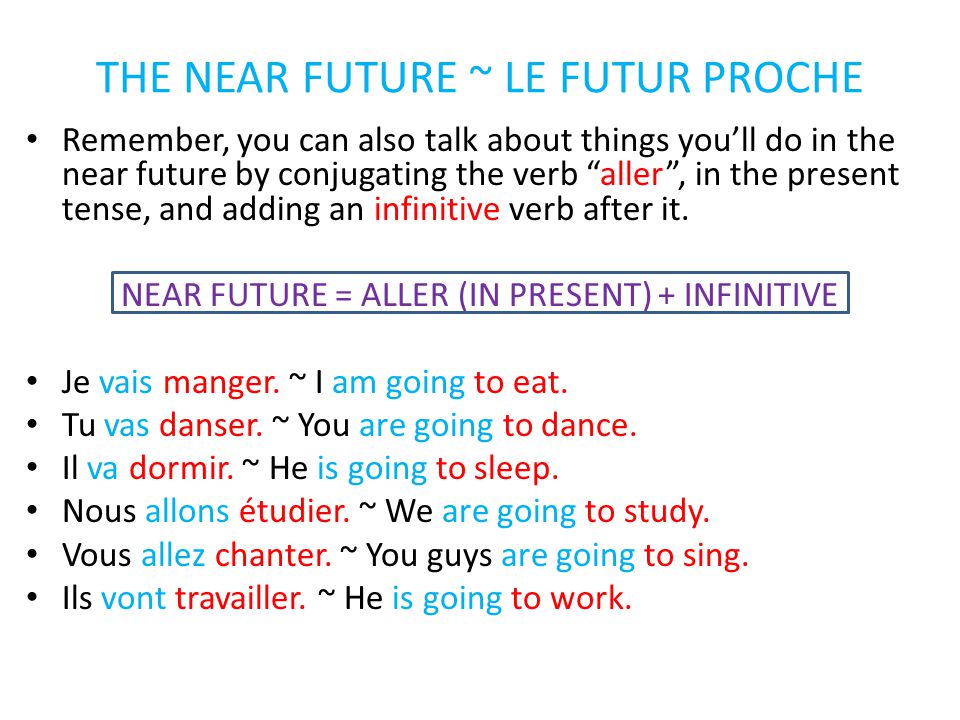 In addition, you can express an imminent action in the near future by conjugating the verb aller (to go) in the present tense and adding the infinitive of the action the speaker will perform. Keep in mind that the irregular present tense of aller is je vais, tu vas, il va, nous allons, vous allez, and ils vont.
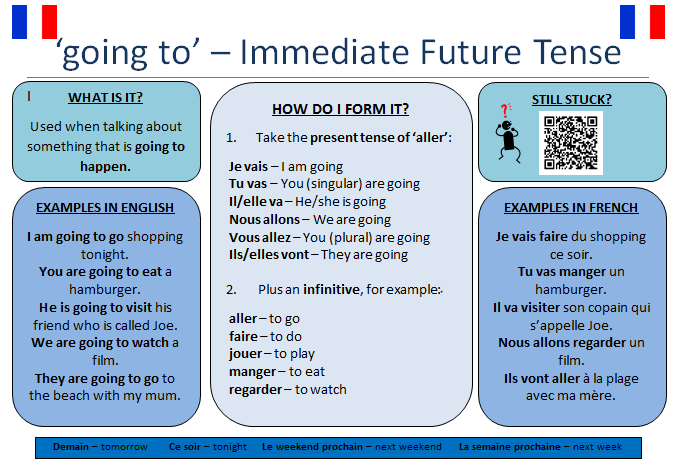
- Il va aller loin. (He’s going to go far.)
- Ils vont jouer. (They are going to play.)
- To express what will happen: Je réussirai. (I will succeed.)
- After quand (when), lorsque (when), dès que (as soon as), andaussitôt que (as soon as), when referring to a future action, even if the present tense is used in English: Quand (Lorsque, Dès que, Aussitôt que) nous aurons beaucoup d’argent, nous irons en France. (When [As soon as] we have a lot of money, we will go to France.)
 Note the following about forming the future tense of regular verbs:
- ‐re verbs drop the final e before adding the appropriate future ending: vendre (to sell) becomes nous vendrons (we will sell)
- The e of the er infinitive stem of the future is not pronounced.
- j’emplo i erai, nous emplo i erons (I will use, we will use)
- je pa i erai or je pa y erai (I will pay)
 For verbs ending in e + consonant + er (but not é + consonant + er), change the silent e before the infinitive ending to è in all forms of the future tense.
- tu ach èteras, vous ach èterez (you will buy)
- nous appellerons (we will call)
- nous jetterons (we will throw)
 Negating in the future tense
To negate a sentence in the future, simply put ne and the negative word around the conjugated verb:
Negating in the future tense
To negate a sentence in the future, simply put ne and the negative word around the conjugated verb:
- Elles ne sortiront pas ce soir. (They will not go out this evening.)
- Il ne fumera jamais. (He will never smoke.)
- Irez‐vous en France cet été? (Will you go to France this summer?)
- Jouera‐t‐elle du piano? (Will she play the piano.)