 The Conditional
The conditional is not a tense because it does not refer to a time period. Instead, the conditional is a mood that expresses what a subject would do under certain circumstances.
Use the conditional in the following situations:
The Conditional
The conditional is not a tense because it does not refer to a time period. Instead, the conditional is a mood that expresses what a subject would do under certain circumstances.
Use the conditional in the following situations:
- To express what would happen under certain conditions: Si j’avais le temps je voyagerais. (If I had the time, I would travel.)
- When “could” has the sense of “should be able to,” in which case you use the conditional of pouvoir: Il pourrait faire ceci. (He could [should be able to] do this.)
- To politely make a request or a demand: Je voudrais l’acheter. (I would like to buy it.)

The conditional uses the same stem as the future tense, but you then add the conditional endings, which are exactly the same as the imperfect endings, as shown in Table 1.
For irregular verbs and verbs with spelling changes, you simply add conditional endings to the stems used for the future.
- acheter: nous achèterions (xxx)
- appeler: vous appelleriez (xxx)
- devoir: il devrait (xxx)]
- envoyer: j’enverrais (xxx)
- essayer: j’essaierais or j’essayerai (xxx)
- jeter: elle jetterait (xxx)
- pouvoir: ils pourraient (xxx)
- recevoir: je recevrais (xxx)
- venir: nous viendrions (xxx)
- vouloir: ils voudraient (xxx)
Irregularities in the future and conditional also occur in related verbs:
- nous mettrions (we would put); nous permettrions (we would permit)
- j’enverrais (I would send); je renverrais (I would send back)
Negating in the conditional
To negate a sentence in the conditional, simply put
ne and the negative word around the conjugated verb:
- Elle ne rirait pas. (She wouldn’t laugh.)
- Je ne pleurerais pas. (I wouldn’t cry.)
Remember that pronouns remain before the conjugated verb:
Il ne vous punirait pas. (He wouldn’t punish you.)
Questions in the conditional
To form a question using inversion, reverse the order of the subject pronoun and the verb and join them with a hyphen:
- Voudriez‐vous aller en France? (Would you like to go to France?)
- J’aimerais partir. (I would like to leave.)
French Prepositions of Place – Countries, Cities, Regions
Why do you say “Je vais en France” but “Je vais au Japon”? Like any inanimate object, continents, countries, and regions also have genders in French. The ending will usually tell you which is feminine or masculine and help you choose the correct French preposition of place.
A – General Rule About French Prepositions of Places
When the name of a region
ends in an E, it’s usually feminine.
La France, l’Angleterre, la Suisse, la Chine, l’Inde, la Californie, l’Asie
- To say you’re going TO it, use EN
Je vais… en France, en Italie, en Afrique, en Floride…
- To say you’re there, use EN
Je suis… en France, en Italie, en Afrique, en Floride…
- To say you’re coming from it, use DE
Je viens de France, d’Italie, d’Afrique, de Floride…
(There are many exceptions though, such as Le Mexique, Le Maine, Le Zimbabwe…)
When the name of a region
ends in any other vowel but E,
or a consonant, it’s usually masculine.
Le Canada, le Japon, le Portugal, le Burundi, le Luxembourg, le Texas
- To say you’re going TO it, use AU
Je vais… au Niger, au Brésil, au Maroc, au Congo
- To say you’re there, use AU
Je suis… au Niger, au Brésil, au Maroc, au Congo
- To say you’re coming from it, use DU
Je viens… du Niger, du Brésil, du Maroc, du Congo
When a
masculine country starts with a vowel or an H, use the rules of the feminine countries
L’Iran, l’Ouganda, Oman, Angola, Israël
- Je vais en Iran, je viens d’Angola, je suis en Israël
B – Particular Cases About French Prepositions of Places
Unfortunately, there are too many exceptions to be listed… So be ready to face many particular cases. Here are some pointers
1 – Plural names
A few names of regions are plural. Most plural regions end in an S, but not all regions ending in an S are plural (
le Laos, L’Arkansas)… So with plural regions, here is the rule
Les États-Unis, les Maldives, les Pays-Bas, Les Philippines…
- To say you’re going TO it, use AUX
Je vais… aux États-Unis, aux Maldives
- To say you’re there, use AUX
Je suis… aux États-Unis, aux Maldives
- To say you’re coming from it, use DES
Je viens… des États-Unis, des Maldives
Note the pronunciation of les États-Unis – there are 2 strong liaisons in Z, whether its introduced by les, aux or des = Zéta Zuni
2 – Cities
Cities are usually not introduced by any article, and are usually feminine.
Paris est belle (because here Paris refers to “la ville de Paris”).
- For most cities, to say you’re going TO it, use à
Je vais… à Paris, à Tokyo, à New-York
- To say you’re IN it, use à
Je suis… à Paris, à Tokyo, à New-York
- To say you’re coming from it, use DE
Je viens… de Paris, de Tokyo, de New-York
But some cities include an article in their name – Le Havre, le Caire, La Paz, Les Andelys… For these, usually the article contracts with the à, becoming au, du etc…
3 – Islands
Are messy business in French… !! Many don’t have any article, and will be introduced by à or de
Je vais à Cuba, à Haïti, à Madagascar
But some are masculine
Je vais au Japon
And some are feminine
Je vais en Corse
And other plural
Je vais aux Maldives
So it’s more like a case by case scenario…
4 – Regions and states
These usually follow the general rules for gender.
La Provence, Le Sussex, l’Oregon.
Note that in the US, the states are masculine except:
La Floride, La Californie, La Caroline du Sud, La Caroline du Nord, La Louisiane, la Georgie, la Virginie occidentale (West Virginia), la Virginie Orientale (Virginia), La Pennsylvanie.
But watch out… Le Maine.
For prepositions used with regions and states, it’s very difficult to say there is a rule per se… We tend not to use à, but rather en, au, aux or dans le, dans la, dans les… It’s really a matter of custom, not grammar.
Au Texas, dans le Maine, en Bourgogne, en Californie, dans la Creuse….
]]>



 Spoken French[/caption]
 ]]>
]]>
 Future Tense
The future tense expresses what the subject will do or is going to do in the future. It also describes what action will or is going to take place at a future time.
Although the future tense is usually used for events taking place in the future, the present tense in French may be used to refer to an action that will take place very soon or to ask for future instructions.
Future Tense
The future tense expresses what the subject will do or is going to do in the future. It also describes what action will or is going to take place at a future time.
Although the future tense is usually used for events taking place in the future, the present tense in French may be used to refer to an action that will take place very soon or to ask for future instructions.
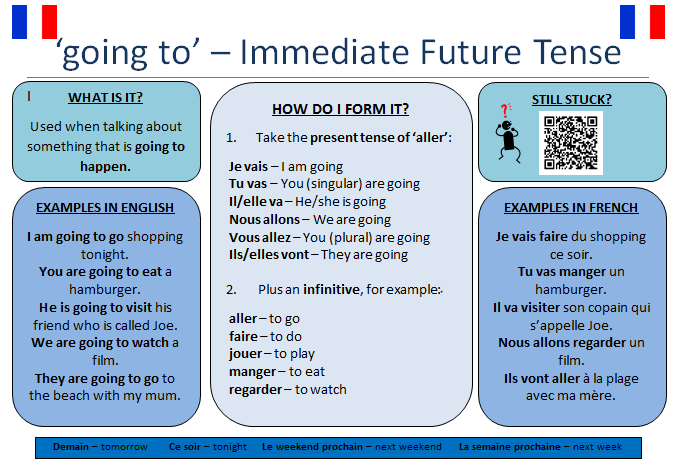
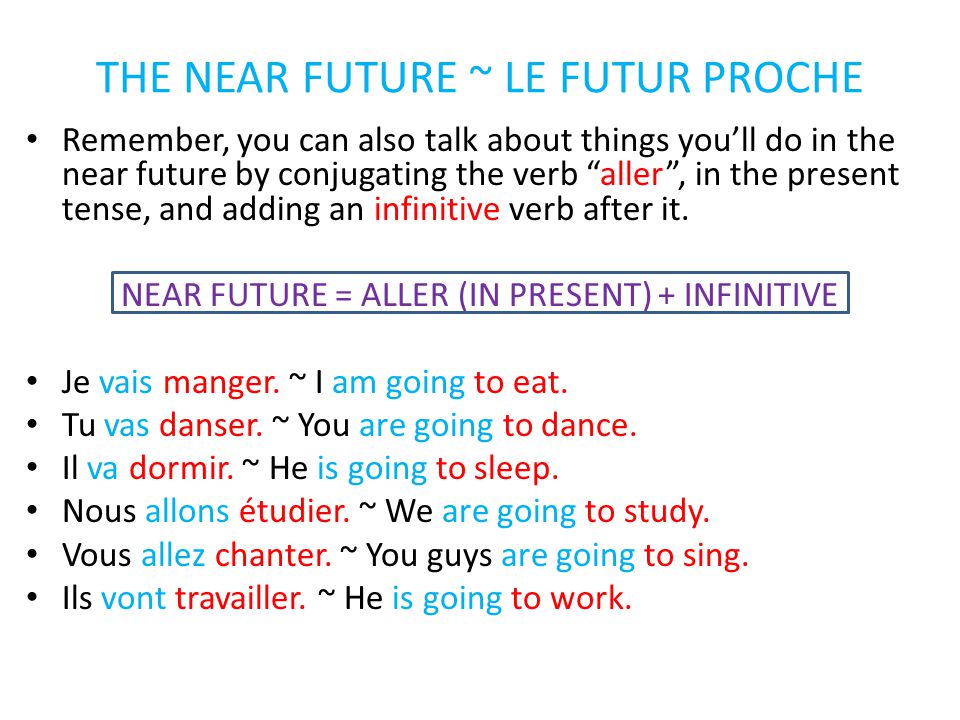 In addition, you can express an imminent action in the near future by conjugating the verb aller (to go) in the present tense and adding the infinitive of the action the speaker will perform. Keep in mind that the irregular present tense of aller is je vais, tu vas, il va, nous allons, vous allez, and ils vont.
 Note the following about forming the future tense of regular verbs:
 For verbs ending in e + consonant + er (but not é + consonant + er), change the silent e before the infinitive ending to è in all forms of the future tense.
 Negating in the future tense
To negate a sentence in the future, simply put ne and the negative word around the conjugated verb:
Negating in the future tense
To negate a sentence in the future, simply put ne and the negative word around the conjugated verb:

 The passé composé, a compound past tense, is formed by combining two elements: when (the action has taken place and, therefore, requires the helping verb avoir) and what (the action that has happened and, therefore, requires the past participle of the regular or irregular verb showing the particular action). See Figure 1.
 Here are some examples of the passé composé.
Elle a expliqué son problème. (She explained her problem.)
Ils ont réussi. (They succeeded.)
J’ai entendu les nouvelles. (I heard the news.)
Forming the negative in the passé composé with avoir
In a negative sentence in the passé composé, ne precedes the helping verb, and the negative word (pas, rien, jamais, and so on follows it:
Je n’ai rien préparé. (I didn’t prepare anything.)
Nous n’avons pas fini le travail. (We didn’t finish the work.)
Il n’a jamais répondu à la lettre. (He never answered the letter.)
Questions in the passé composé with avoir
To form a question in the passé composé using inversion, invert the conjugated helping verb with the subject pronoun and add a hyphen. Then place the negative around the hyphenated helping verb and subject pronoun:
As‐tu mangé? (Did you eat?)
N’as‐tu rien mangé? (Didn’t you eat anything?)
A‐t‐il attendu les autres? (Did he wait for the others?)
N’a‐t‐il pas attendu? (Didn’t he wait for the others?)
Here are some examples of the passé composé.
Elle a expliqué son problème. (She explained her problem.)
Ils ont réussi. (They succeeded.)
J’ai entendu les nouvelles. (I heard the news.)
Forming the negative in the passé composé with avoir
In a negative sentence in the passé composé, ne precedes the helping verb, and the negative word (pas, rien, jamais, and so on follows it:
Je n’ai rien préparé. (I didn’t prepare anything.)
Nous n’avons pas fini le travail. (We didn’t finish the work.)
Il n’a jamais répondu à la lettre. (He never answered the letter.)
Questions in the passé composé with avoir
To form a question in the passé composé using inversion, invert the conjugated helping verb with the subject pronoun and add a hyphen. Then place the negative around the hyphenated helping verb and subject pronoun:
As‐tu mangé? (Did you eat?)
N’as‐tu rien mangé? (Didn’t you eat anything?)
A‐t‐il attendu les autres? (Did he wait for the others?)
N’a‐t‐il pas attendu? (Didn’t he wait for the others?)
 Regular verbs follow a prescribed set of rules for the formation of the past participle, whereas irregular verbs (discussed in the following section) must be memorized. Past participles of verbs conjugated with avoir agree in gender (masculine or feminine — add e) and number (singular or plural — add s) with a preceding direct object noun or pronoun:
Le(s) film(s)? (The film[s]?) Je l'(les)ai aimé(s). (I liked it [them].)
Quelle(s) robe(s) a‐t‐elle choisie(s)? (Which dress[es] did she choose?)
Il nous a vus. (He saw us.)
Regular verbs follow a prescribed set of rules for the formation of the past participle, whereas irregular verbs (discussed in the following section) must be memorized. Past participles of verbs conjugated with avoir agree in gender (masculine or feminine — add e) and number (singular or plural — add s) with a preceding direct object noun or pronoun:
Le(s) film(s)? (The film[s]?) Je l'(les)ai aimé(s). (I liked it [them].)
Quelle(s) robe(s) a‐t‐elle choisie(s)? (Which dress[es] did she choose?)
Il nous a vus. (He saw us.)
 Dr. and Mrs. Vandertrampp live in the house in Figure , as illustrated in Table 1. Their name may help you memorize the 17 verbs using être. An asterisk (*) in Table 6 denotes an irregular past participle.
Verbs whose helping verb is être must show agreement of their past participles in gender (masculine or feminine — add e) and number (singular or plural — add s) with the subject noun or pronoun, as shown in Table 2 :
Remember the following rules when using être as a helping verb in the passé composé:
Vous can be a singular or plural subject for both masculine and feminine subjects.
Singular Plural
Vous êtes entré. (You entered.) Vous êtes entrés. (You entered.)
Dr. and Mrs. Vandertrampp live in the house in Figure , as illustrated in Table 1. Their name may help you memorize the 17 verbs using être. An asterisk (*) in Table 6 denotes an irregular past participle.
Verbs whose helping verb is être must show agreement of their past participles in gender (masculine or feminine — add e) and number (singular or plural — add s) with the subject noun or pronoun, as shown in Table 2 :
Remember the following rules when using être as a helping verb in the passé composé:
Vous can be a singular or plural subject for both masculine and feminine subjects.
Singular Plural
Vous êtes entré. (You entered.) Vous êtes entrés. (You entered.)
 Vous êtes entrée. (You entered.) Vous êtes entrées. (You entered.)
For a mixed group, always use the masculine form.
Roger et Bernard sont revenus. (Roger and Bernard came back.)
Louise et Mireille sont revenues. (Louise and Mireille came back.)
Roger et Louise sont revenus. (Roger and Louise came back.)
If the masculine past participle ends in an unpronounced consonant, pronounce the consonant for the feminine singular and plural forms:
Il est mort. (He died.) Ils sont morts. (They died.)
Elle est morte. (She died.) Elles sont mortes. (They died.)
Forming the negative in the passé composé with être
In the negative, put ne before the conjugated form of être and the negative word after it:
Il n’est pas sorti. (He didn’t go out.)
Elles ne sont pas encore arrivées. (They didn’t arrive yet.)
Questions in the passé composé with être
To form a question using inversion, invert the conjugated form of être with the subject pronoun and add a hyphen. The negatives surround the hyphenated verb and pronoun:
Sont‐ils partis? (Did they leave?)
Ne sont‐ils pas partis? (Didn’t they leave?)
Vous êtes entrée. (You entered.) Vous êtes entrées. (You entered.)
For a mixed group, always use the masculine form.
Roger et Bernard sont revenus. (Roger and Bernard came back.)
Louise et Mireille sont revenues. (Louise and Mireille came back.)
Roger et Louise sont revenus. (Roger and Louise came back.)
If the masculine past participle ends in an unpronounced consonant, pronounce the consonant for the feminine singular and plural forms:
Il est mort. (He died.) Ils sont morts. (They died.)
Elle est morte. (She died.) Elles sont mortes. (They died.)
Forming the negative in the passé composé with être
In the negative, put ne before the conjugated form of être and the negative word after it:
Il n’est pas sorti. (He didn’t go out.)
Elles ne sont pas encore arrivées. (They didn’t arrive yet.)
Questions in the passé composé with être
To form a question using inversion, invert the conjugated form of être with the subject pronoun and add a hyphen. The negatives surround the hyphenated verb and pronoun:
Sont‐ils partis? (Did they leave?)
Ne sont‐ils pas partis? (Didn’t they leave?)
 Verbs whose helping verb is être must show agreement of their past participles in gender (masculine or feminine — add e) and number (singular or plural — add s) with the subject noun or pronoun, as shown in Table 2 :
 Remember the following rules when using être as a helping verb in the passé composé:
Vous can be a singular or plural subject for both masculine and feminine subjects.
Singular Plural
Vous êtes entré. (You entered.) Vous êtes entrés. (You entered.)
Vous êtes entrée. (You entered.) Vous êtes entrées. (You entered.)
For a mixed group, always use the masculine form.
Remember the following rules when using être as a helping verb in the passé composé:
Vous can be a singular or plural subject for both masculine and feminine subjects.
Singular Plural
Vous êtes entré. (You entered.) Vous êtes entrés. (You entered.)
Vous êtes entrée. (You entered.) Vous êtes entrées. (You entered.)
For a mixed group, always use the masculine form.
 Framing Questions in French Using Est-Ce Que
 Conjugating Reflexive Verbs
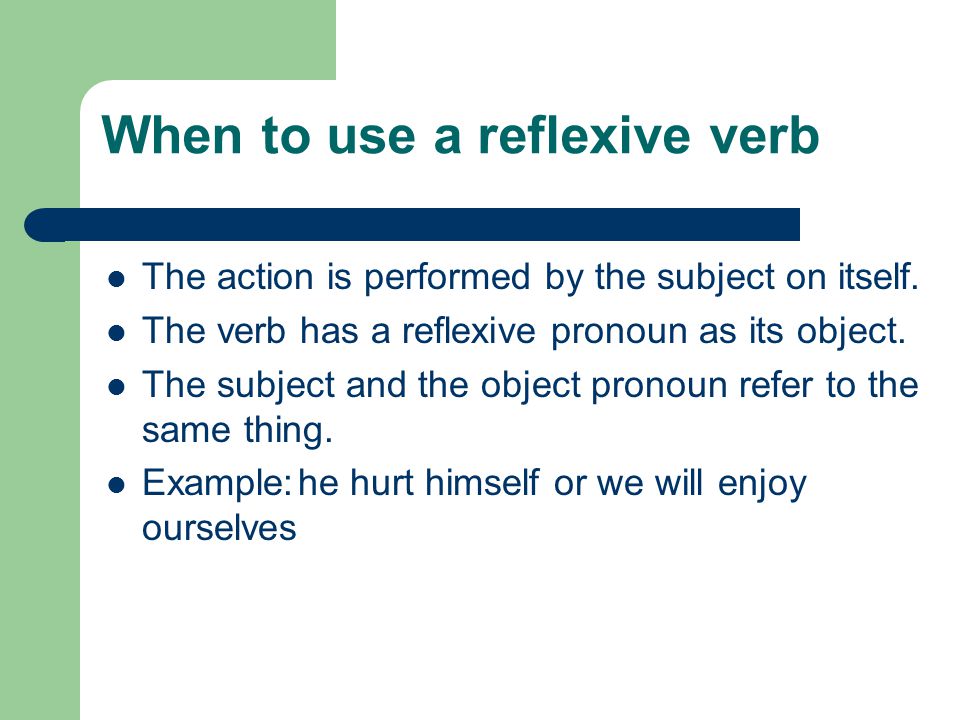
A reflexive verb infinitive is identified by its reflexive pronoun se, which is placed before the infinitive and that serves as a direct or indirect object pronoun. A reflexive verb shows that the subject is performing the action upon itself and, therefore, the subject and the reflexive pronoun refer to the same person or thing, as in je m’appelle (I call myself), which is translated to “My name is.”
Conjugating Reflexive Verbs
A reflexive verb infinitive is identified by its reflexive pronoun se, which is placed before the infinitive and that serves as a direct or indirect object pronoun. A reflexive verb shows that the subject is performing the action upon itself and, therefore, the subject and the reflexive pronoun refer to the same person or thing, as in je m’appelle (I call myself), which is translated to “My name is.”
 Some verbs must always be reflexive, whereas other verbs may be made reflexive by adding the correct object pronoun. The meaning of some verbs varies depending upon whether or not the verb is used reflexively.
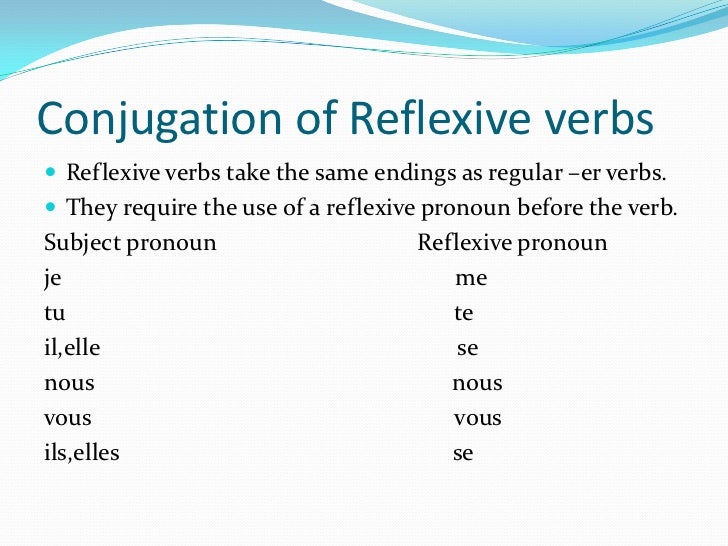
Reflexive verbs are always conjugated with the reflexive pronoun that agrees with the subject: me (myself), te (yourself), se (himself, herself, itself, themselves), nous (ourselves), and vous (yourself, yourselves). These pronouns generally precede the verb. Follow the rules for conjugating regular verbs, verbs with spelling changes, and irregular verbs, depending on of the tense, as shown in Table 1:
Reflexive constructions have the following translations:
Some verbs must always be reflexive, whereas other verbs may be made reflexive by adding the correct object pronoun. The meaning of some verbs varies depending upon whether or not the verb is used reflexively.
Reflexive verbs are always conjugated with the reflexive pronoun that agrees with the subject: me (myself), te (yourself), se (himself, herself, itself, themselves), nous (ourselves), and vous (yourself, yourselves). These pronouns generally precede the verb. Follow the rules for conjugating regular verbs, verbs with spelling changes, and irregular verbs, depending on of the tense, as shown in Table 1:
Reflexive constructions have the following translations:
 Consider the following most commonly used reflexive verbs. Those marked with asterisks have shoe verb spelling change within the infinitive.
 er (cut oneself)
 Expressions of Quantity with Numbers or de